

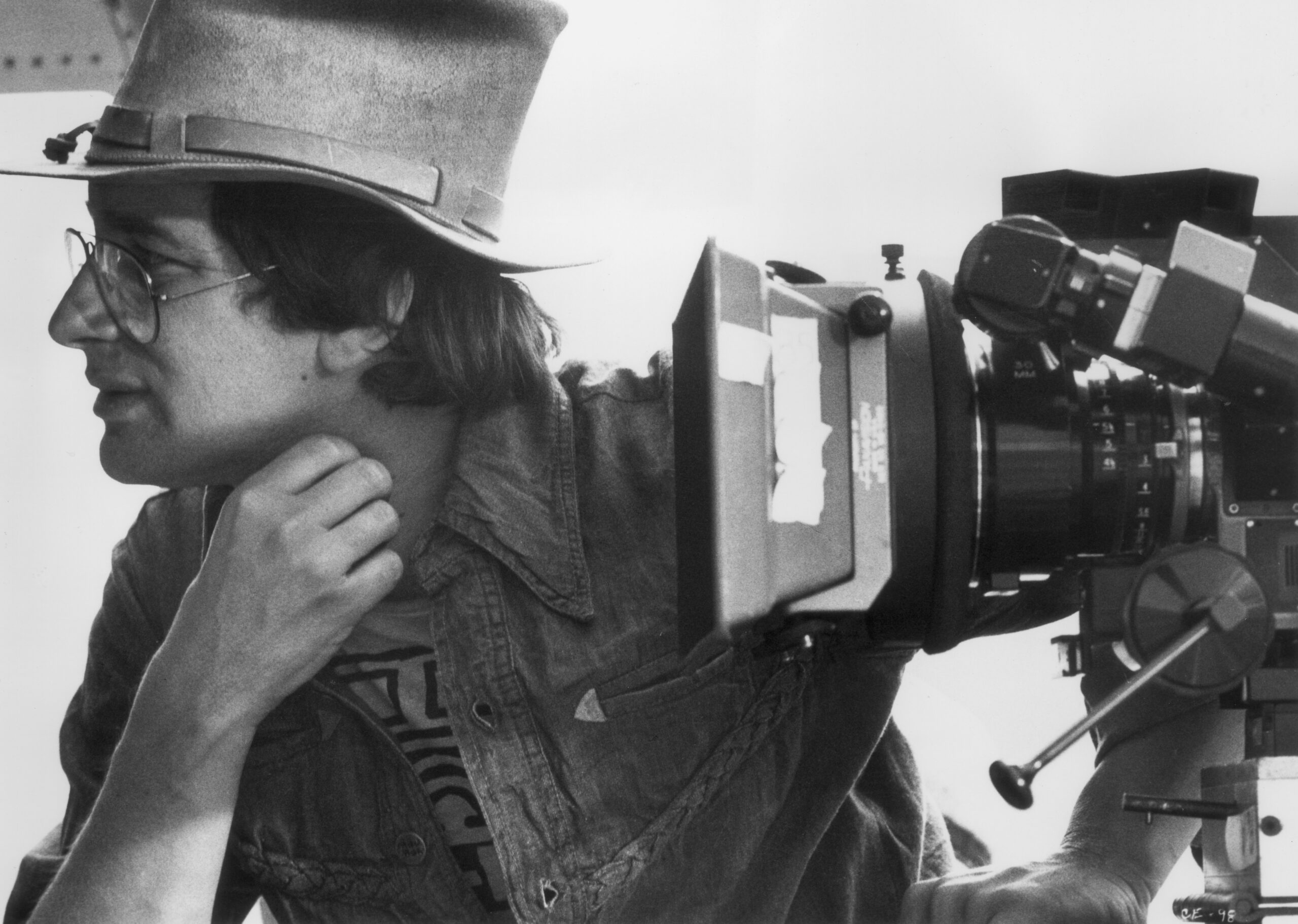
As the legendary director returns to theaters this weekend, we look back at his greatest films.
There are directors and there are filmmakers. The distinction matters. A director shows up, calls action, and delivers a product. A filmmaker builds a world, then invites you inside it. Steven Spielberg has been doing the latter for over fifty years, and the argument could be made that no one in the history of American cinema has done it better or more consistently. Today, with Disclosure Day arriving in theaters, feels like the right moment to make that argument out loud.
The resume is almost unfair. He invented the summer blockbuster with a broken mechanical shark off the coast of Martha’s Vineyard. He made a movie about the Holocaust that won seven Academy Awards and shot it back to back with a movie about dinosaurs. He gave us the most visceral twenty-five minutes of war ever put on film, a Cold War procedural that plays like a thriller without a single shootout, and a Philip K. Dick adaptation that has only gotten more uncomfortable to watch as the years have passed.
The knock on Spielberg, if you have to pick one, is that he is too crowd-pleasing, too sentimental, too invested in giving audiences what they came for. What he actually is, at his best, is precise. He knows exactly what a scene needs and he delivers it without waste. The sentimentality is real but he works hard to earn it, which is all you can really ask for. And the range is genuine. The same instincts that made Jaws terrifying made Schindler’s List devastating and made Close Encounters of the Third Kind feel like a genuine encounter with the unknown.
Disclosure Day puts him back in the territory he first mapped in 1977, the question of what we do when something arrives that we cannot explain and cannot control. It is a question he has been circling his entire career. But when it comes to the question of his best films, we think we’ve made a pretty compelling case below.
15. Ready Player One
Year: 2018
Written by: Zak Penn, Ernest Cline
Box Office: $583 Million
For a director that created the films that added so many icons to the pop culture lexicon, it made sense that Spielberg would tackle the 2011 novel, set in a future where citizens regularly tap into a simulation that has them engaging in races, combat, and more, using their favorite pop culture icons as their in-sim avatars. A dazzling spectacle, Ready Player One is chaos inside of a computer, an epic on a different scale that puts the idea of “nostalgia as a form of escapism” on grand display. —khal
14. The Color Purple
Year: 1985
Written by: Menno Meyjes
Box Office: $142 Million
An epic of a different sort, The Color Purple found Spielberg stepping out of the usual spectacle of his past releases for a more grounded, human tale set in North Carolina. The Color Purple tells the tale of Celie (portrayed by Whoopi Goldberg, a performance that secured the Golden Globe for Best Actress in a Drama), coming of age in early 20th century America. Celie’s coming of age in America ran the gamut of struggle, from domestic violence and multiple forms of abuse to the racism and sexism of the day, but out of those hardships comes a story about survival and perseverance. A timeless classic about a forgotten era in America. —khal
13. War of the Worlds
Year: 2005
Written by: Josh Friedman, David Koepp
Box Office: $603.9 Million
Probably the most underappreciated film in the Spielberg catalog. Most people remember it just as a Tom Cruise action movie. But War of the Worlds is a disaster film shot almost entirely from the perspective of a frightened man trying to move his children through a world that is ending without any particular interest in explanation or resolution. Spielberg and cinematographer Janusz Kaminski put the camera where the chaos is, and the sequence in which the tripods first emerge from the ground remains one of the most genuinely terrifying set pieces he has ever staged. Cruise is not heroic here. He panics, lies, and makes selfish decisions, likely because that’s what we would do. The famous H.G. Wells story gave Spielberg a framework; what he made inside of it was closer to a 9/11 anxiety dream. A film about civilian terror and the helplessness of ordinary people when you can’t outrun catastrophe. It deserves a full reappraisal.
12. Hook
Year: 1991
Written by: James V. Hart, Malia Scotch Marmo
Box Office: $300.9 Million
Only Spielberg could make a film that is a sequel to a novel released eight decades before it. Hook, starring Robin Williams as an adult Peter Pan, finds the now Peter Banning with no memories of his life as Peter Pan, the playful little boy who was never supposed to grow up. Dustin Hoffman’s performance as the titular Captain Hook is a sight to see, yet for all of the swashbuckling, Hook failed to dazzle critics upon release. More of a cult classic these days, Spielberg found a way to have Robin Williams shine on screen with that group of kids, highlighting who and what this story was truly for and about. Proof that Spielberg could still capture the spirit of the young (and the young at heart). —khal
11. Bridge of Spies
Year: 2015
Written by: Matt Charman, Ethan Coen, Joel Coen
Box Office: $165.5 Million
The Cold War produced no shortage of spy thrillers, but Spielberg wasn’t interested in making one. What he made instead is closer to a civics lesson a story about what it actually means to believe in the principles a country claims to stand for when doing so is expensive and inconvenient and nobody is watching. Tom Hanks’s James Donovan is an insurance lawyer who gets tasked with defending a Soviet spy in an American courtroom. The film’s quiet argument is that he is the most patriotic figure in it precisely because he takes the assignment seriously when everyone around him would prefer he didn’t. Mark Rylance won the Oscar for his Rudolf Abel, and rightly so, it’s a performance built almost entirely out of stillness and a single repeated line, and it is somehow devastating by the end. In a filmography full of awe and spectacle, Bridge of Spies is remarkable in how intimate it feels.
10. Close Encounters of the Third Kind
Year: 1977
Written by: Steven Spielberg
Box Office: $306.8 Million
Jaws made Spielberg famous. But this movie showed you what he actually cared about. Not monsters, not adventure, not spectacle for its own sake, but wonder. And aliens. The sustained, almost unbearable experience of encountering something so far outside your comprehension that you cannot explain the pull you feel toward it. Richard Dreyfuss’s Roy Neary is a mess: irresponsible and obsessive and not entirely sympathetic. The film takes its time, and that patience is what makes the finale land with the force that it does. John Williams’s score is one of the great pieces of cinematic communication ever written, doing in a few notes what most screenwriters couldn’t accomplish in a whole script. There’s a purity to Close Encounters that’s hard to find anywhere else in the catalog, something we may never get from him again.
9. Catch Me If You Can
Year: 2002
Written by: Jeff Nathanson
Box Office: $352 Million
The story of Frank Abagnale Jr. — con man, forger, compulsive impersonator, and all around real one — gave Spielberg permission to make something loose and propulsive and unencumbered by the moral weight his bigger films carry. The result is one of his most purely enjoyable movies. Leonardo DiCaprio plays Abagnale as a kid who figured out that confidence is currency, and the performance has a lightness to it that suits the material perfectly. Tom Hanks’s FBI agent Carl Hanratty is the funnier role, though — a humorless, unfashionable man who is nevertheless the only person in the film who sees Abagnale clearly. John Williams’s score is all bossa nova swing and midcentury cool. Not to end on a corny note, but the film understands that the real con Abagnale was running wasn’t on banks or airlines, it was on himself, a kid who never stopped performing long enough to figure out who he actually was.
8. E.T. the Extra-Terrestrial
Year: 1982
Written by: Melissa Mathison
Box Office: $792.9 Million
A marvelous film, E.T. finds a young boy befriending an extraterrestrial stranded on Earth. It’s a great look at exactly how kids may encounter an alien; they’d feed it Reese’s Pieces, play dress up, and go ride bikes. Who hasn’t dreamed of meeting an otherworldly being and having said being become your best friend? Apparently everyone, as E.T. owned the box office, becoming the highest-grossing film of all time, at the time, breaking 1977’s Star Wars record, and holding it until Spielberg’s Jurassic Park was released in 1993. From the iconic design of E.T. itself to the real-life tears a young Drew Barrymore shed during some of the film’s most pivotal moments, E.T. will remain one of those ones for years to come. —khal
7. Lincoln
Year: 2012
Written by: Tony Kushner
Box Office: $275.3 Million
If you haven’t seen this yet, you probably think it’s the most boring film in Spielberg’s oeuvre. You’re wrong. But, it’s understandable: A two-and-a-half-hour procedural about the legislative maneuvering behind the Thirteenth Amendment has no business being as propulsive as this is. Most directors couldn’t have pulled it off. Tony Kushner’s script is dense and precise and genuinely funny in a way that honors the historical record without reducing it to a civics lesson. It also doesn’t do that thing where it infuses a historical piece with modern-day humor as a crutch. But the whole enterprise rises or falls on Daniel Day-Lewis. Day-Lewis gives Lincoln a private interior life, a weariness, humor, and sadness that makes him feel less like a monument than a man who happened to be in the room where history needed to happen. Tommy Lee Jones’s Thaddeus Stevens steals every scene he’s in, which is saying something. Lincoln is a film about democracy as dirty, exhausting, necessary work, and given the current moment, it lands harder now than it probably did in 2012.
6. Minority Report
Year: 2002
Written by: Scott Frank, Jon Cohen
Box Office: $358.4 Million
It’s weird to say, but sometimes it feels as if this film is underrated in his catalog. Working from a Philip K. Dick story, Spielberg and production designer Alex McDowell built a version of 2054 Washington D.C. that felt genuinely extrapolated rather than imagined. It’s grimy and vertical and surveilled in ways that have only become more uncomfortable to watch as the years pass. Tom Cruise gives one of his better performances here, playing a man whose entire professional identity collapses the moment the system he built and believed in turns on him. The PreCrime premise is doing real philosophical work about determinism and free will, and the film never lets you forget it even as it turns into a chase thriller. It came out in 2002, which puts it in the same decade as A.I., Catch Me If You Can, and Munich. Whatever that decade was for Spielberg creatively, it deserves more serious examination than it gets.
5. Saving Private Ryan
Year: 1998
Written by: Robert Rodat
Box Office: $481.8 Million
The first twenty-five minutes packed up every other war movie. Spielberg desaturated the film stock, removed the lens filters, and instructed his camera operators to shoot the Omaha Beach sequence with the shutter speed cranked to expose the full chaos and violence of what actually happened on June 6, 1944. Veterans wept in theaters. Some walked out. The sequence is so visceral and so exact in its rendering of industrialized death that it functions almost as an act of historical witness rather than filmmaking. What’s easy to forget, because the opening is so overwhelming, is that the film that follows is also exceptional. A serious inquiry into what we owe the dead and whether survival itself can be its own kind of guilt. Tom Hanks carries the weight of the whole enterprise on his back and face, and by the time the old man collapses at the grave site in Normandy, Spielberg has made the question he’s been asking for two and a half hours feel genuinely unanswerable. No notes.
4. Schindler’s List
Year: 1993
Written by: Steven Zaillian
Box Office: $322.2 Million
There is almost nothing useful left to say about this film that hasn’t already been said better by someone else. Spielberg made it in black and white, shot on location in Kraków, using a handheld verité style that felt closer to documentary than fiction. Liam Neeson’s Oskar Schindler works because he is not a hero at the start. He is just an opportunist, a charmer, a war profiteer. And the film earns every inch of his transformation without sentimentalizing it. Ralph Fiennes’s Amon Göth remains one of the most frightening human beings ever committed to film precisely because Fiennes humanizes him, makes him pitiable, even, in moments when you wish he wouldn’t. Schindler’s List is not an easy watch and it is not meant to be. It exists as a document and as a reckoning, and the fact that Spielberg released it the same year as Jurassic Park says something almost incomprehensible about his range.
3. Raiders of the Lost Ark
Year: 1981
Written by: Lawrence Kasdan
Box Office: $389.9 Million
Considered an instant classic, Raiders of the Lost Ark is our first introduction to Indiana Jones (Harrison Ford), an explorer who is looking to acquire the Ark of the Covenant—which, as the story goes, makes an army holding it invincible —before those evil Nazis get their hands on it. Easy enough, right? Good, because that simple premise gives way to some of the greatest escapist cinema of all time. It’s Spielberg’s modern take on serialized films, with a protagonist who must find ways to escape all kinds of doom and danger. With a host of kooky characters, interesting locales, and massive set-pieces, Raider of the Lost Ark is what summertime cinema used to be about: spending two hours being thoroughly entertained by some of the most insane spectacles you’ve never seen or thought up. Spielberg at his most adventurous. —khal
2. Jurassic Park
Year: 1993
Written by: Michael Crichton, David Koepp
Box Office: $1.05 Billion
This movie wouldn’t have worked if the dinosaurs were the most interesting part of the film. Yes, the effects were generational — ILM and Stan Winston’s team did something that genuinely changed what cinema thought was possible — but Spielberg knew that, as crazy as the dinos were, they were just the window dressing. He didn’t want to just make a theme park ride. Crichton’s genius book deserved more than that. What makes Jurassic Park endure is the architecture underneath it: two kids in genuine danger, a scientist forced to reckon with the consequences of his own ambition, and an island that very quickly stops being a wonder and becomes a threat. Jeff Goldblum is there almost entirely to say what the audience is thinking, and the film is wise enough to let him be right. Thirty years later, the kitchen scene with the raptors still makes people hold their breath, which tells you everything you need to know. Classic.
1. Jaws
Year: 1975
Written by: Peter Benchley, Carl Gottlieb
Box Office: $476.5 Million
What else could it be? This is his magnum opus. Nobody believed it would work. A director in his late twenties who hadn’t proven anything yet, and a studio that thought the whole production was a disaster in the making. But Spielberg’s instinct to hide the shark — partly of necessity — turned a potential B-movie into Hollywood legend. What you don’t see is always more terrifying than what you do, and Jaws understood that at a cellular level. Roy Scheider, Richard Dreyfuss, and Robert Shaw created one of the great three-person dynamics in American cinema, three completely different men sealed inside a too-small boat with something ancient and indifferent circling below them. Jaws invented the summer blockbuster, which is a legacy with complicated consequences, but the film itself remains utterly pure — a masterwork of tension, character, and dread that still works on audiences the same way it did in 1975.
Read More:

Red Hook Tavern: Where Billy Durney Wants to Know Your Name
Keanu Reeves’ Next Act Is Built on Two Wheels

The Blueprint: Jessica Holtz Meets the Moment

The Power Broker: Emma Grede Is Just Getting Going

Quiet Power: Imani Ellis on CultureCon, Creators, and Learning to Let Go