
WNBA legends and leaders unpack the forces driving the league’s next chapter, from record-setting momentum and big business to the challenges shaping the game on and off the court.
Thirty years in, the WNBA is having its moment. But the question isn’t whether the league has arrived; it’s whether anyone can keep up with how fast it’s moving.
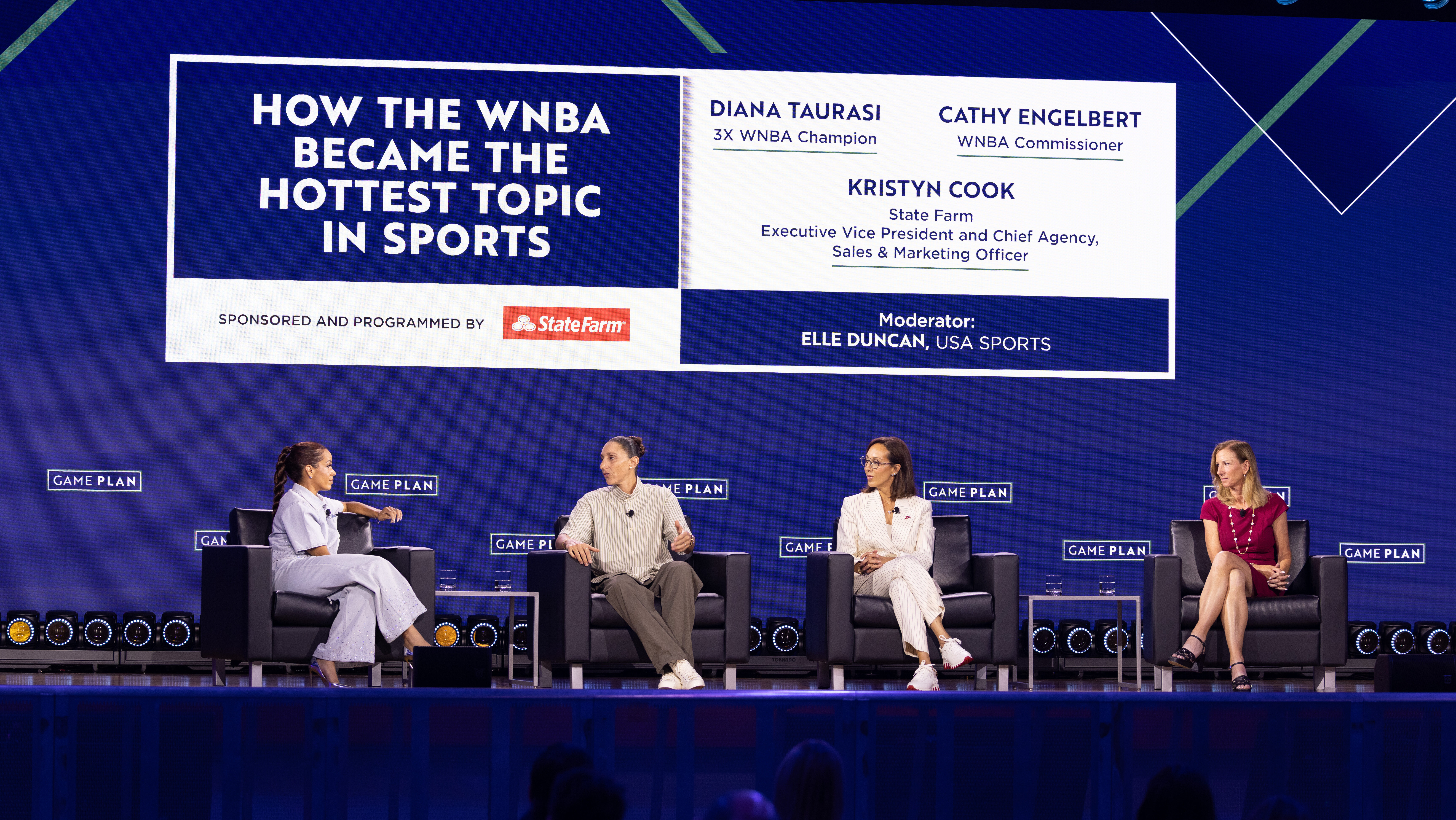
At this year’s Game Plan Summit at Fanatics Fest, presented by State Farm, WNBA legend Diana Taurasi, league commissioner Cathy Engelbert, and State Farm’s Kristyn Cook sat down with Elle Duncan for one of the more honest and wide-ranging conversations about the state of women’s basketball that you’ll find anywhere. What emerged wasn’t a victory lap; it was a real accounting of how the league got here, what’s still being figured out, and why the people closest to it believe the best is genuinely yet to come.
Engelbert set the tone early. When Duncan asked whether she was surprised at the speed of the league’s growth, the WNBA Commissioner pointed to a convergence — investment from corporate partners, a dramatic expansion of national broadcast availability, and the rising global profile of women’s basketball.
“When I came in, I think we had 80 of our 240 games on national platforms,” Engelbert said. “Now this year we’ll have over 220. So if you build it, they will come.”
The numbers back her up. By the midpoint of the 2026 season, the WNBA had already surpassed 63 million unique viewers, a figure that matched the entire previous season. Engelbert didn’t mince words about what that means: “The sky’s the limit for this league.”
For Taurasi, who spent two decades laying the foundation for everything the league is experiencing now, the growth is personal. When Duncan asked whether she was bitter that others are now reaping what she helped sow, Taurasi didn’t hesitate.
“I’m so happy for them from the bottom of my heart,” she said. “Whenever you’re embedded in a company, in a business for 20 years, something that is my passion, my love — when you leave something 20 years later, and it’s better than when you found it, that is a beautiful thing.” The players who came before didn’t just build the league. They made it what it is now, even when nobody was paying attention.
Cook, whose brand has been a WNBA partner for over two decades, made the business case plainly: “Investing in the WNBA is good business,” she said. “We believed in the league. We believed in these incredible players, the growing fandom, and then the potential.” State Farm didn’t arrive when the cameras did; they were there when being there was less fashionable, and the credibility that comes with that longevity is something you can’t manufacture after the fact.

But the conversation didn’t stay in the wins column for long. Duncan pressed the panel on the toxicity surrounding the league — the online hate directed at players, the vitriol that has become a persistent undercurrent to an otherwise extraordinary moment. Engelbert was direct about how seriously it’s being taken.
“The vitriol and everything that our players receive is unacceptable,” she said, pointing to tools like the league’s Social Protect platform and “No Space for Hate” initiative, as well as mental health resources, physical security, and digital security measures. “We’re trying every angle we can.” She acknowledged the challenge is real, rooted in social media and broader societal dysfunction, without pretending there’s a clean solution. “I’ve solved a lot of complex things in my career before I even got here. And this is a challenge.”
Taurasi offered the player’s perspective on the league’s evolution, both in terms of how the game is officiated and how the culture has shifted. When the conversation turned to physicality, and whether the game is genuinely more physical now than it was in her era, she didn’t let anyone off the hook. “If you think the game is physical now, go back and watch some of those finals 15, 16 years ago,” she said. The responsibility, in her view, is shared. “The referees got to get better. The officials got to get better. On the league side, we have to do a better job of making sure we know what are certain things that we want our players to be able to do.” And on coaches who push physicality and then complain about it: “If you have coaches telling to beat the shit out of everyone and then they complain about physicality, well then you’re at fault too.”
Engelbert noted the results of the freedom of movement changes made in the offseason. Offensive efficiency is at an all-time high, scoring is up, the game is faster. The Valkyries, in just their second year, are sitting in second place. Portland and Toronto are producing immediately.
“The more you grow, the better it is in the end,” the commissioner said.
When Duncan asked each panelist about the biggest opportunity over the next five years, the answers formed a coherent picture. Taurasi pointed to the core of what has always kept the league standing: “The W is going nowhere. We’ve been here for 30 years. We’ve been through the highs, the lows. The same people that didn’t support us are supporting us now. So just stay with it a little bit longer.” Cook talked about the next generation of fans, reaching them through social, through NIL, through storytelling that meets people where they already are. And Engelbert looked ahead to the players coming — Juju Watkins, Hannah Hidalgo, Michaela Blakes — and beyond them, the U17 players she says nobody has seen yet: “I think there’s decades of growth to come.”
Thirty seasons in, the league isn’t just surviving; it’s setting records mid-season that used to take a full year to reach. The people who built it, fund it, and run it all said the same thing in different ways:
This is just the beginning.
Read More:
Red Hook Tavern: Where Billy Durney Wants to Know Your Name
Keanu Reeves’ Next Act Is Built on Two Wheels

The Blueprint: Jessica Holtz Meets the Moment
The Power Broker: Emma Grede Is Just Getting Going
Quiet Power: Imani Ellis on CultureCon, Creators, and Learning to Let Go