
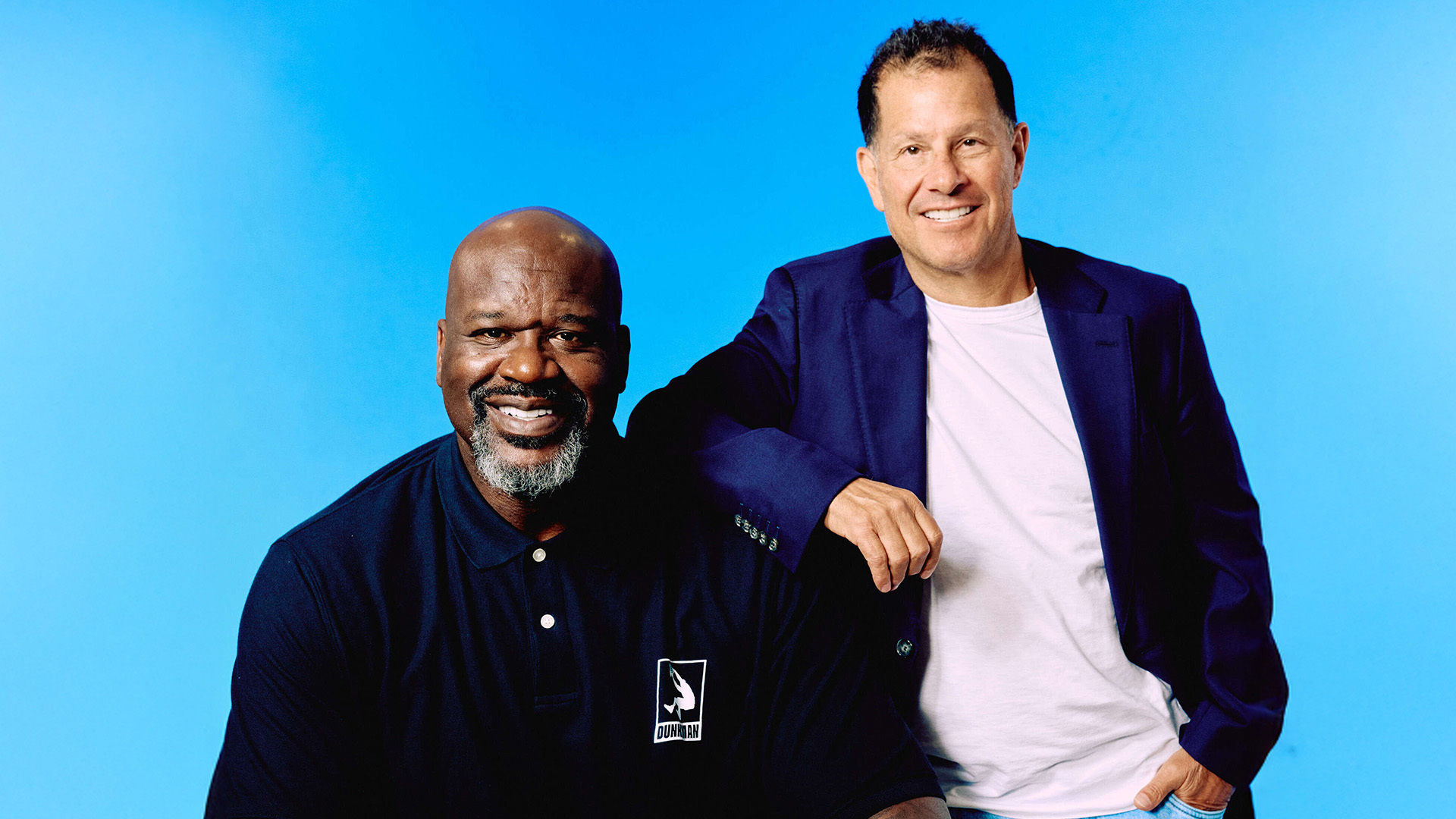
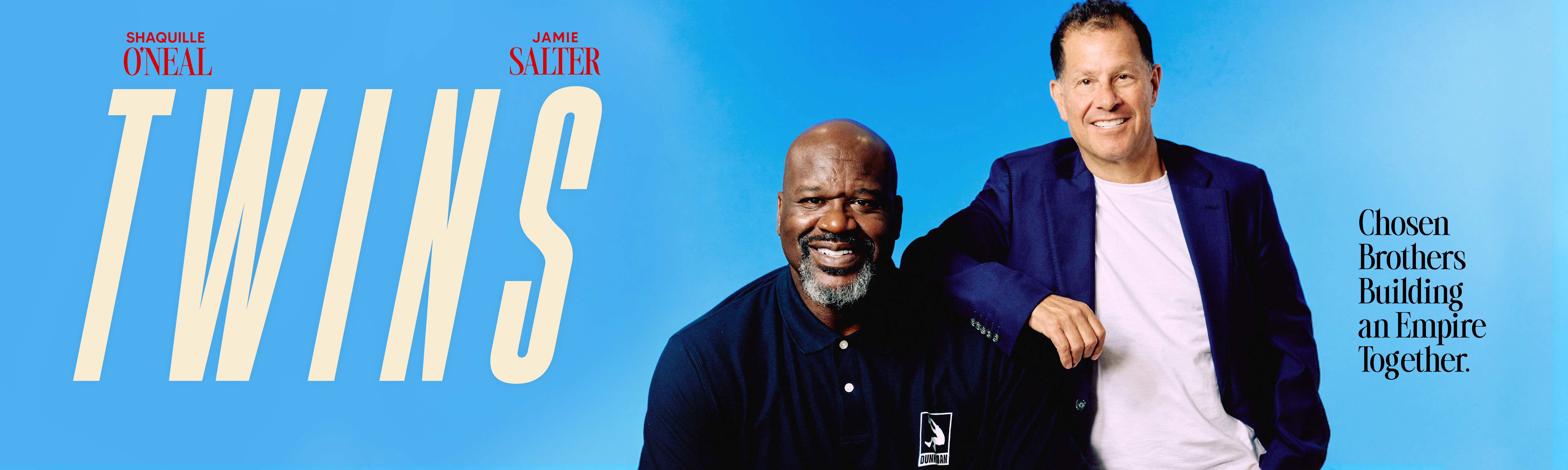
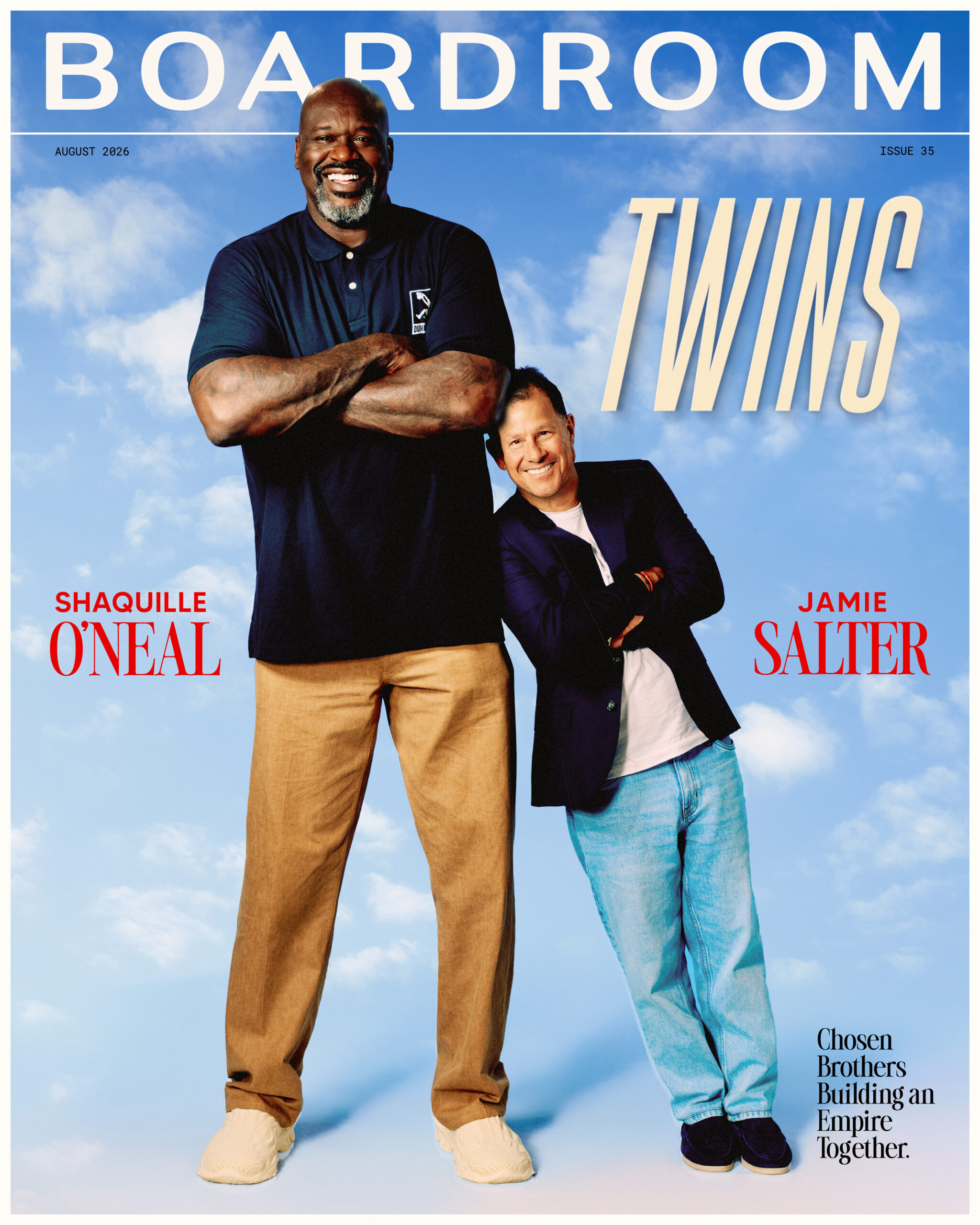
Before we get into any of it, you should hear Shaq’s story about the first time he ever sat down with Authentic Brands Group Founder and Executive Chairman Jamie Salter. They hadn’t even closed a deal yet, and Jamie and his son started going back and forth right in front of him, arguing about the business. Most guys in that room might’ve gotten nervous. Shaq turned to his own team and said, “We’re going with these guys.” “That’s family right there,” he told me. Ten years later, sitting across from both of them at Fanatics Fest, it’s clear Shaq still feels the same way.
I’ve always been a sucker for partnerships. Jimmy Iovine and Dr. Dre. Jay-Z and Dame Dash. Kevin [Durant] and I have been building something together for years now. So getting to sit down with Shaq and Jamie, with a couple hundred people walking by trying to get a look, I wasn’t just there to do a job. I kind of wanted to figure out how this actually works. How does a guy who didn’t finish college and a guy who’s maybe the most famous athlete alive end up building something together that neither one of them could’ve built on his own?

On paper, it doesn’t really add up. Jamie’s built Authentic Brands Group into a company that owns Reebok, Brooks Brothers, Champion, and over 50 other brands you’d recognize walking through a mall. Shaq’s turned himself into somebody whose name works on a sneaker box, behind a DJ booth, and on a broadcast desk, all at the same time. Two completely different guys, two completely different paths to get here.
But you sit with them long enough, and you start to get it. Shaq calling Jamie at four in the morning with some idea. Jamie telling him no over and over again when discussing the idea of buying Reebok, then finally calling him up like, “You sitting down?” Shaq says flat out that Jamie’s mentality is that of a father to him. At some point it stopped being about Reebok or the WNBA deal or DUNKMAN, the dunk league Shaq launched this year. The partnership became the whole thing.
That’s what we got into. How they built it, why Shaq’s putting his name behind a league for dunkers nobody else was paying attention to, and what it actually looks like when two guys with almost nothing in common decide they’re family.
This interview has been edited for clarity and length.
Want More from Boardroom? Join our Members Club!
Rich Kleiman: Jamie, tell me the path of how you got here and what Authentic is today.
Jamie Salter: When we started Authentic 16 years ago, there were other companies in the licensing business, and we said, “How can we do it better?” What was really important was, can we build a model that has duration, can we buy brands and make sure that they last forever? When we looked at Disney, that content drives you to the parks, and from the parks you buy merchandise. So content drives commerce. Today, [Authentic Brands Group] is about $38 billion in annual retail revenue. 25% is entertainment-based, 75% is lifestyle.
Kleiman: Shaq, what was your mindset on business off the court coming into the league?
Shaquille O’Neal: Just coming in and wanting to be a basketball player. Magic Johnson tells me, “Make sure you focus on business.”… My professor at marketing class started talking about branding—there’s good brands, really good brands, great brands, and brands that live forever. And I always wanted to live forever. Towards the end of my career, I started to see my name fade away. I’m walking down Hollywood Boulevard and there’s Elvis stuff everywhere, Marilyn Monroe stuff everywhere. I’m like, How do these people live forever? So I started doing my research on companies. When I met with Jamie and his son [Corey], they had a big argument in front of me — I was like, “I want to be with these guys.”
Kleiman: What did you change about your approach?
O’Neal: I wish my father was still here. He was an Army drill sergeant who taught me to use fear as motivation. Towards the end of the career, it got me a little scared. So I signed up with a bigger and better company. When I met with Jamie, he’s like, “You’ve done a wonderful job, but let me help you take it to the next level.” He’s a great mentor, but he listens. I remember begging him 10 years in a row to buy Reebok. He was like, “No, we’re not ready.” Then one day he called me: “You sitting down?” I said, “No, I’m laying down.” He said, “Your dream’s finally come true.” And he purchased Reebok [in 2022 for $2.46 billion]. So he’s a great partner. Jamie is one of the smartest businessmen I know. And I just found out a couple of weeks ago that he never went to college, because he called me and said, “Hey man, congratulations on getting your third mansion. You know I never went to college?” I was like, “What?” Hes like, “How’d you do this?” He said, “Hey, I just meet people, shake hands, and learn.” So thats what I’m doing with him.
Salter: I did go to three years of college. I didn’t go to school a lot, but I did go to three years. I never graduated, though.
Kleiman: Shaq was the first partnership you had. How did you approach that deal?
Salter: Marilyn Monroe taught us social media. A guy came into my office and says, “Do you know Marilyn Monroe has 250,000 followers?” I said, “What’s a follower?” He explained, “You can advertise on Facebook or Instagram for free and send messages to all your fans.” So I said, “We should build a business around this.” When we had the opportunity to partner with Shaq we said, “If we get Shaq behind not just the Shaq brand, but other brands that we own—oh, my God, we could move the needle.” Today they’re called creators and influencers, but back then we didn’t know that. And, of course, it worked.

Kleiman: How do you structure those deals?
Salter: If we buy something like Reebok, Authentic would buy 100% of it. But something like David Beckham or Shaquille O’Neal or Kevin Hart — those are basically fifty-fifty joint ventures. You’re not going to tell Shaq what to do, and Shaq’s not going to tell us what to do either. It really is a partnership between both sides. Think of it like a marriage, but there’s no divorce clause. We’re going on 10 or 11 years now, and we didn’t even go through a seven-year itch. We have 50-plus brands in the portfolio. But he was there at the beginning, and he does have a new idea every day.
Kleiman: Why did you want to buy Reebok so badly?
O’Neal: Because when I was with Reebok in the ’90s, we were never No. 1, but we were never number three. Adidas purchased them and just kind of diluted them, left them in the fitness industry. I wanted to bring them back. I would call him once a month: “Jamie, you got to do Reebok; they’re not ready.” He did send me an AI version of him getting married to Marilyn Monroe. But no, we have a great partnership. Then [in spring 2022] we went to F1, Jamie saw Kasper Rorsted, the CEO of Adidas, and Jamie and I cornered him, and Jamie made him an offer he couldn’t refuse. A couple weeks later, Jamie woke me up: “We got Reebok.”
Kleiman: And you serve as the president of Reebok Basketball?
O’Neal: Yes.
Kleiman: And AIlen Iverson is involved as well?
O’Neal: Yes.
Kleiman: What have you started to do to change the perspective on how people look at Reebok?
Salter: We have a saying: “Let Reebok be Reebok.” Reebok was in sport in a major way prior to Adidas buying the company. Adidas took a bunch of their silhouettes and contracts, to focus on the bigger brand called Adidas. So they said, “Fine, we’re going to sell Reebok.” The first thing Shaq said is, “We’re going back into sport in a big way—basketball, hockey, soccer, lacrosse, cricket.” We went into the archives, put a marketing budget together, focused on the best players and the best teams in the world. Reebok has almost doubled in value since we bought the business—close to $6 billion retail around the world today.
O’Neal: I can remember asking him for a big budget, and he quickly called me down: “You’re not Shaq. You’re Shaquille O’Neal, the president of basketball. No giving him your big budget till you prove yourself.” Instead of going after the high-profile professional athletes, we started with the youngins, and Angel Reese signed with us. He says, “I’m not talking to Shaq. I’m talking to Shaquille, the president of Reebok, and you don’t get $50 million for the budget, you get this amount.” That was a great learning experience for me.
Salter: He’s just so smart. He goes, “We’re going back into basketball,” and needs X amount of money. I said, “I’m not giving you that kind of money, but we’ll give you Y.” He came back: “I want to focus on women. We’re going to go into women’s basketball, WNBA. I’m telling you, Jamie, there’s going to be a surge.” This is three years ago — people weren’t really talking about it. He says, “We’re going to sign this player, her name’s Angel Reese.” I really do think Shaq changed the WNBA, because the money being paid to the players was kind of not fair. He came into my office: “I want to pay her double, then triple.” She wasn’t asking for more money, but he believed she could move the needle. My hat goes off to him, because women in sport today are making substantially more money.
Kleiman: Talk about DUNKMAN, which I know Reebok is also tied into and something that you’re passionate about. It started as one thing and now it’s evolved into something bigger.
O’Neal: I got absolutely sick and tired of being involved as a player and as a fan watching the NBA Dunk Contest. My favorite dunk contest was in high school, Dominique [Wilkins] versus Jordan—guys made every dunk, gave the fans a show. In the last 15 years, we haven’t had a real top guy—we’ll call him out: Zion Williamson — participate in a dunk contest. So I go to my team: “I want to start a league.” If you look online, there are kids that are not good enough to be in the NBA but they’re unbelievable dunkers, and they got a lot of views. We got 24 amazing dunkers — England, China, international players. I’ve seen kids dunking better than NBA players. The winner gets $500,000. If I see something impressive, I may call Jamie: “Can we put it up to a million?” That’s what makes this sport great. When I went to the NBA All-Star Game, I wanted to see the three-point shootout and the dunk contest.
Kleiman: So how does it work? Twenty-four dunkers — do they compete in remote cities or move around?
O’Neal: We’re probably just going to start season one in Atlanta, and then we’ll have the championship somewhere — we haven’t announced that. It’ll be dunking against each other, dunk-offs. All the judges were professional athletes, professional dunkers. I don’t want to give you too much, so make sure you tune in. [Editor’s Note: The entire first season of Dunkman took place in Atlanta.]
Salter: We’re partners with TNT on the media side.
O’Neal: Yes. And Eli Lilly is our biggest sponsor.
Salter: And now Dick’s Sporting Goods too.
Kleiman: When you build a new IP, is there the ability to utilize the rest of the portfolio of brands?
Salter: That is definitely part of the ecosystem — our whole mandate with DUNKMAN. How do we turn this into a league? How do we turn it into a profitable business? But more importantly, how do we help market other brands within our portfolio? Reebok will have a very close relationship with DUNKMAN, and some of our other brands will too. Content drives commerce, and I’m going to continue to say that to you. Fanatics Fest is a great example — even if Michael [Rubin] broke even on it, it’s still a home run, because there’s an enormous amount of content driving the overall Fanatics business. Most companies are pay-for-play. So doing this with Dunkman, you’re going to see us—we have another show coming out with Amazon in 2028.
Kleiman: You have Kevin Hart, David Beckham, and Shaq. How many of these partnerships can you do?
Salter: Not a lot. You got The Rock out there — amazing. You got LeBron James — amazing. You’re going to be partners with these people forever. I could give you a list, but it’s less than 10. They got to want to do it, we have to want to do it, and it’s forever. I won’t mention the gentleman’s name, but he’s bringing in a lot of money in the business, and I asked him, “What are you going to do when you get all this money?” He says, “I can’t wait to go to my boat, sit in the sun.” And I said, “It was great to meet you.”
Kleiman: But not the right partner.
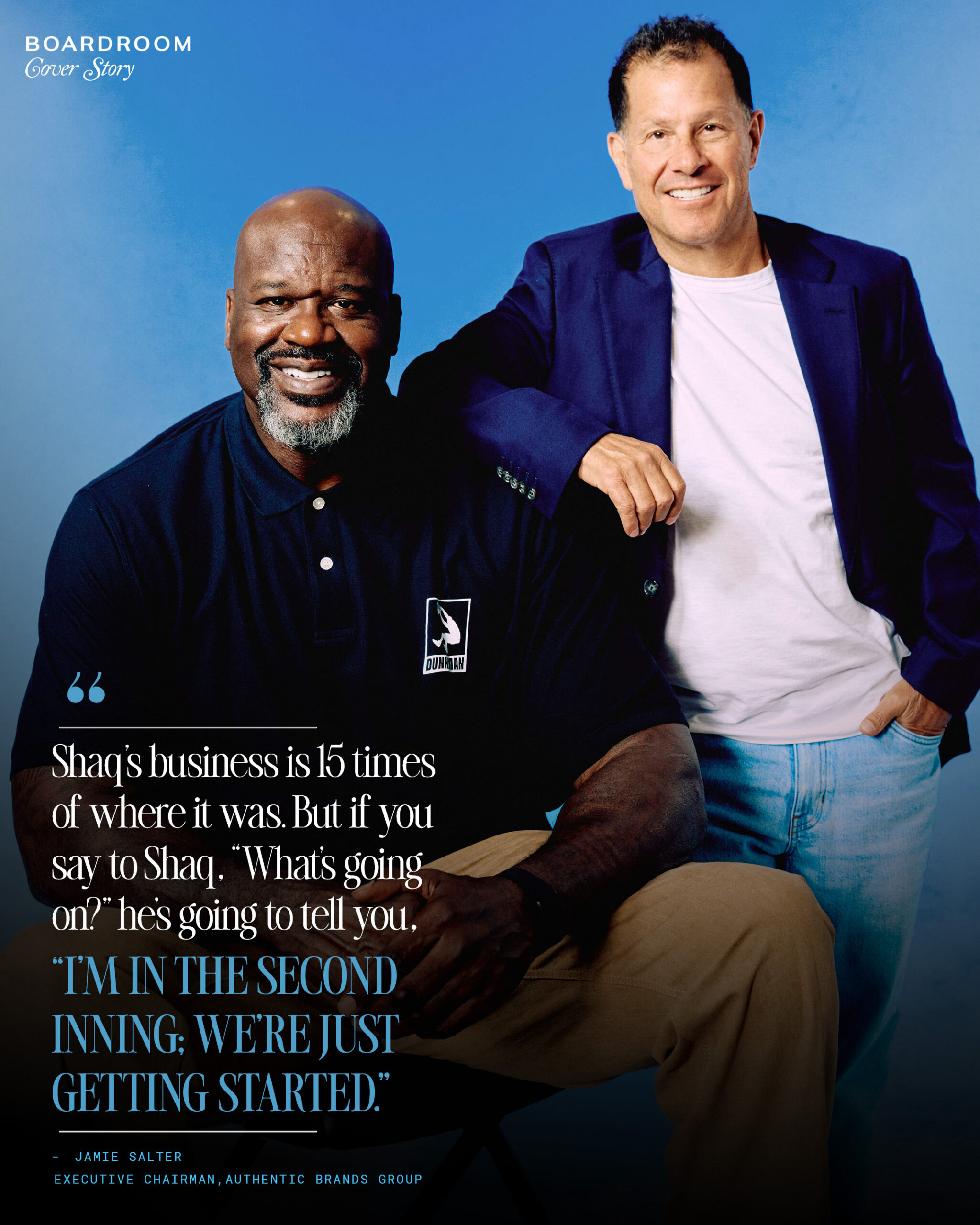
Salter: You’re not the right partner. You’re writing a big check, and now you’re fifty-fifty partners with him, and they got to want to work. David Beckham is the hardest-working man at the World Cup. Shaquille O’Neal is the hardest-working man, in my opinion, in the NBA. He’s on TV, he’s doing DJ events, merch deals, licensing deals. Working is not work—for me, it’s enjoyment and it’s fun. That’s what you’ll find with Shaquille, and with Kevin, and with David. Shaq’s business is 15 times of where it was. But if you say to Shaq, “What’s going on?” he’s going to tell you, “I’m in the second inning; we’re just getting started.” It’s about, “Should we buy X, Y, Z company together?” “Jamie, I think it’s a pretty good company. They’re doing $6 billion in revenue. I think we could do $10 billion.” He’s thinking really, really big. That’s why this is a great partnership—but there’s not too many Shaqs out there.
O’Neal: It’s nice to have somebody that I can talk to. His mentality is that of a father. Every time I see a company going into bankruptcy, I’ll call him, and the next day I’ll have an email—too much debt, this is why it’s not a good idea. It’s like a teacher moment for me. I never had that before. That’s very important to me.
Kleiman: Has this side of your life filled the space of what it was like to be an athlete at the highest level?
O’Neal: I’m having more fun. I’m doing it with the greatest shooter in the world—he would be my Jerry West or my Larry Bird in business, and all we do is win championships. He’s great to be around, he’s honest. We’ve not had a disrespectful argument, but we have disagreed, because he’s not going to say yes to everything, and I’m not going to say yes to everything. When I went to the first meeting, Jamie and Corey started arguing—like we hadn’t even closed the deal yet. I was like, “We’re going with him—that’s family right there.” I don’t really look at the business all the time. It’s just family.
Kleiman: Jamie, it’s got to be really cool to be partners with Shaquille O’Neal, right?
Salter: It’s the coolest thing in the world. My granddaughter Livvy, she’s 8 years old—she calls me: “Your partner is Shaquille O’Neal, and he’s really famous, and so are you.” And Logan, who’s 5 years old, all Logan wants, because he collects cards, is he wants a Shaquille O’Neal signed NBA card.
Kleiman: You miss playing basketball still, ever?
O’Neal: No, never. Not against these cupcakes.
Kleiman: I think that’s a good way to wrap this up.
O’Neal: They’re all cupcakes. Write it down, tweet it, Instagram it, Facebook, and I said it.
Kleiman: I’ve always been enamored by partnerships. I think it’s special when you can work on that level, like a marriage. You two have an incredible, magical partnership. It’s been fun to talk to the two of you. Thank you so much.
Salter: Thank you.
O’Neal: Appreciate it.
Interviewer – Rich Kleiman
Art Director – Michelle Lukianovich
DP – Dan Fridman
Camera Op – Dan Goedeker
Camera Op – Sean Li
Video Editor – Matt Strickland
Sr. Producer, Camera Op – Craig Newton
Associate Director – Audrey Blackmore
VP, General Manager – Paul Beckles
VP, Content – Damien Scott
VP, Revenue & Brand Partnerships – Abigale Smith
VP, Partnership Strategy & Marketing – Bernadette Doykos
VP, Social Media – Yoni Mernick
VP, Audience Development – Jonathan Wiener
Sr. Director, Marketing & Content Operations – Stephanie Talmadge
Sr. Manager, Content Operations – Griffin Adams
Sr. Manager, Social Media – Tate Jordan
CMO – Sarah Flynn
Co-Founders – Rich Kleiman & Kevin Durant
Photographer – Caroline Tompkins
Read More:
Keanu Reeves’ Next Act Is Built on Two Wheels

The Blueprint: Jessica Holtz Meets the Moment
The Power Broker: Emma Grede Is Just Getting Going
Quiet Power: Imani Ellis on CultureCon, Creators, and Learning to Let Go
The Long Game: How LeBron James and a Few NBA Friends Might Elevate the Game of Golf