

The rap pioneer talks Paid in Full’s mission to honor hip-hop legends and protect the next generation.
For the past decade, rap has been the highest selling genre of music in the United States. Driven by social media and streaming, it has far outpaced genre that outperform it in the global market, like pop and rock. But despite its relatively recent success, rap’s forbearers, the artists who helped to build the genre into a worldwide force, have largely missed out on the financial windfalls that many newer acts received. To help right those wrongs, Benjamin and Felicia Horowitz founded the Paid In Full Foundation. With a mission to “recognize transformational artists who have made a significant cultural impact and empower them to fulfill their continued creative and artistic endeavors,” the Paid in Full foundation built a star-studded team including Michelle Ebanks, Quincy Jones III, Steve Stoute, Nas, Fab 5 Freddy, and Anthony Selah to help carry out the mission.
Now in its third year, the Paid in Full foundation is hosting its annual Hip-Hop Grandmaster Awards in Las Vegas on October 18. After honoring legends like Grandmaster Caz, Scarface, and Rakim in years past, this time around they are honoring hip-hop icons Grand Puba and Kool G. Rap. The Godfather of Funk himself, George Clinton, will be receiving the Quincy Jones, while the all-new the Contributor award will be given to Kool Rock Ski of the Fat Boys and Jalil Hutchins of Whodini.
But the best story of this year’s awards may be the fact that one of last year’s honorees, Roxanne Shanté, will be hosting and MCing the event. A rap legend in her own right, Shanté broke the mold at a time when rappers really only looked and sounded one way. And even though she only dropped two albums, her fierce style and incomparable wordplay left an indelible mark on the genre. Boardroom got to chop it up with Roxanne a few days before the event to learn what being an honoree really means and how it changed her life. She also dropped a few jewels for younger artists looking to better monetize their careers.
This interview has been edited and and condensed for clarity.
Boardroom: What do you see as the importance of the Paid in Full Foundation?
Roxanne Shante: Well, for me, the importance of the Paid in Full foundation is not just the monetary aspect of it, but it’s the acknowledgement. There’s so many people who have been involved in hip hop, who have never gotten their accolades, never received their flowers. There’s always been those who have been overlooked and underpaid. And I think it is wonderful to see that Paid In Full foundation took a different look at this and said, Okay, you know what? This is what we’re going to do for those who have contributed to this great thing that we call hip hop, but never received anything from it. Paid In Full is that spark of light that says, listen, we did not forget you. We understand and we are here to help you. And I think it’s wonderful.
It’s interesting to me that one of the conditions of receiving the honor is that the honoree agrees to continue on with their art to continue contributing to rap music and the hip hop culture. I’m curious, how have you been contributing since you were an honoree in 2024?
Yes. It allowed me to be able to go out and do keynotes and to be guest speakers at different universities and schools, places that I would not have been able to go because financially I would not have been able to go. And we’re not talking about going to places where you are paid to attend. We’re talking about being able to show up and just show out. And, literally, that is what it’s allowed me to do. It’s allowed me to be able to tell my story because there’s some little girl somewhere in a school that needs to hear my story. Or maybe it’s the young female artist who needed to hear my story. And the only way I was able to present her with the story was to be able to be at a library or to go to a school or to go to a group home or to go to a shelter.
And they’re not able to pay you to come to these places. And so because of the [Paid In Full Honor], it has allowed me the financial freedom to be able to do that. And not only that, I’ve been able to start other projects where I do this thing where I look back into whoever it is that [a young female rapper] is working with, and I find out whether or not they are [who they say they are]. If they’re really a promoter. I find out whether or not they really have done a production on a project that they said. So, in other words, that these young ladies don’t get fooled.
Wow. That last endeavor sounds very fascinating. Can you talk a little bit more about that?
It’s called Mind Over Matter. I have a lot of young ladies who are in this circle, and what they do is, when someone comes to them and says, listen, “I’m a photographer and I would love taking pictures [of you], and I took pictures of Nicki Minaj,” what I do is I use my own resources to find out if they really did those things. If they are who they say they are, to keep these young ladies from walking into these circumstances. Because there are a lot of things that have taken place. And a lot of women won’t talk about what has happened to them trying to pursue a career, whether it’s in hip hop or whether it’s in the industry period. So they’re able to come to me and they’re able to get the word to me.
That is amazing. I wish that was in every industry. I was listening to an Angie Martinez interview with Eve and she mentioned your “Five Deadly Venoms” Sprite commercial that I completely forgot about. I’m curious if you can share a story from that shoot or that deal—anything from around that time. I completely forgot it happened and it is one of the best Sprite commercials ever.
Oh my goodness. Absolutely. Well, I can remember when we decided to do the Five Deadly Venoms, and I was like, okay, well I’m going to be The Toad. And [they] were like, no, we’re not going to be the Toad. And I was like, nah, I could be the toad. And I was thinking, because I had gained some weight and the Toad had a wide back [laughs] and I was like, yeah, I could just be the toad. Everybody’s favorite from Five Deadly Venoms was the Toad because he was almost invincible until he told somebody what could happen to him. I was like, yeah, that’s me. I’m The Toad all day. And they were like, no, you’re going to be The Black Widow and we’re going to put you in every commercial.
Did you guys bring the idea to Sprite or did Sprite already have the idea?
No, it was like a group effort. Everybody who got together said, Ok, this is what we’re going to do. We’re going to go with the Five Deadly Venoms. So, everyone picked who they were going to be. Everybody had the reflection of what they were going to be. Everybody loved kun-fu flicks. That was our thing. Now, unlike everyone else, I used to sleep in the movie theater on 42nd Street, so I knew the movie by heart, every word of it, every scene. To me it was like a dream come true. I remember showing up and telling them, Okay, I’m ready and I’m going to do my own stunts. And they were like, “What?! You want to do your own stunts?” I was like, “Yeah, y’all don’t know I can kick ass. Let me just show y’all.” I remember them putting this harness on me and I’m ready. And I’m standing there and I’m thinking, I’m getting ready to do some karate moves! And just when I got ready to start kicking, they snatched me up in the air and put somebody in there. And I remember I felt so devastated. They didn’t trust my ability, but I was ready.
That’s incredible. It feels like we don’t get commercials like this anymore.
Yeah. It’s like when you watch a movie, the soundtrack doesn’t match the movies anymore.
Right. That’s also true.
Before, when you would go to a movie theater and you would listen to the soundtrack of each scene, if he died, they’d be like, “Freddy is dead, Freddy is Dead.” Everything is about placement and hopefully we will get back to that original creativity of being able to really be engaged in whatever it is. But everything is so fast now. Attention span is a little shorter, records are shorter, everything is so I wish they would go back to that. I mean, honestly, I wish Sprite would just replay that. I didn’t get really paid for that, so I wouldn’t probably get paid for it if they redid it, but I still wouldn’t mind seeing it.
I think that young artists struggle to find brands and deals that align with who they are personally and what they try to represent. What advice would you have for young artists trying to find brand deals that work for them?
Well, I would say first off, they need to make sure that whatever brand it is that they represent, that that brand also represents them; that it is something that they use. It is something that they love. Something you can really speak highly of. Something that you engage with every day. I think what they need to do is start to focus on the everyday brands.
Interesting.
If someone were to say to me, Roxanne Shante, we can give you two deals right now. What companies would you want? And I would honestly say Geritol and Ford.
And why those?
Because I take Geritol every day. And then the second one would be Ford because I can afford a Ford, so I drive a Ford. If it breaks down, I can fix a Ford. I can tell you everything about a Ford and I drive a Ford Bronco. I post up in it and everything. So people need to get the brands that are associated with them, the things that they like. Ketchup, mustard, mayonnaise, light switches, electric cords, whatever. But everybody’s always reaching for what they feel everyone else wants and that’s not what everyday people use every day.
Before I let you go, I wanted to get your thoughts on the honorees this year: Kool. G. Rap and Grand Puba. What comes to mind when you think of these guys?
When I think of Kool G Rap and Grand Puba—George Clinton is in a whole different category by himself. He is the funk God, so that’s different. All you could say is worship and mothership. That’s all you can say about him. But when it comes to my hip hop brothers, Kool G. Rap and Grand Puba, not only the longevity, not only the legacy, but they deserve this because their contribution to hip hop has been incredible. Grand Puba had everybody slow down and would really be able to ride a beat when he came in there. His whole swagger, his whole style made everyone say, “I like that, I want to be able to do that.”
And then G. Rap is incredible with the street stories, the storytelling, he was like our first gangster rapper. And everybody needs to acknowledge that because he was the first one to tell us that you won’t be smiling on Rikers Island. They are so deserving of this. And it’s truly an honor to be able to stand beside them on that stage to know that I had once crossed that stage too. And then I’m going to cross it again as the host. So it’s going to be incredible. I’m looking forward to it.
Read More:
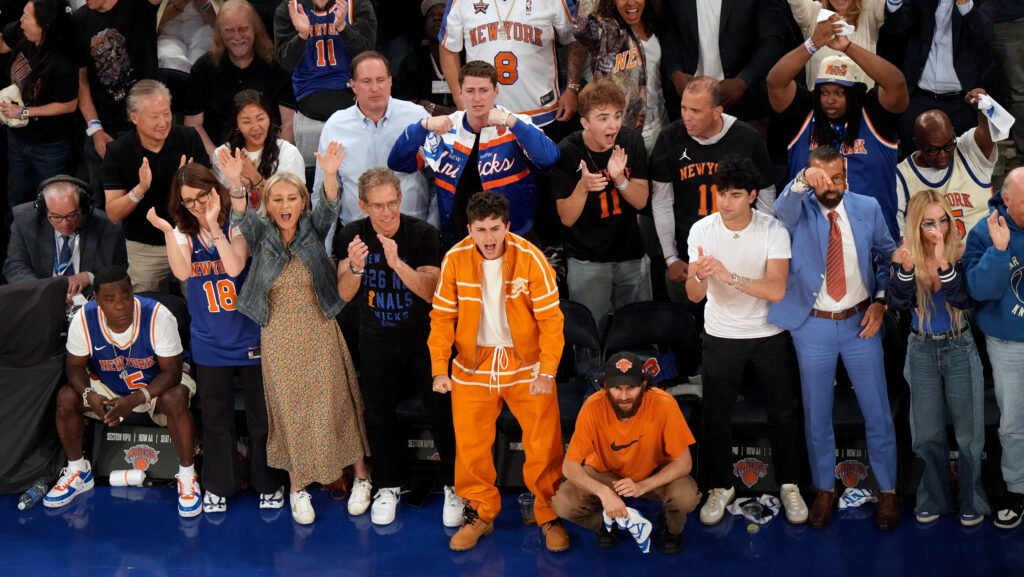
$40K Seats, Timothée Chalamet, & the Knicks: Inside the First NBA Finals at MSG Since 1999
Taylor Rooks: The Problem With How We Define Legacy in Sports

PlaqueBoyMax Believes Streaming Is the Future of Everything
Why Hollywood Is Leaving L.A. for the Garden State
Inside Nike’s Biggest Soccer Push in Years