

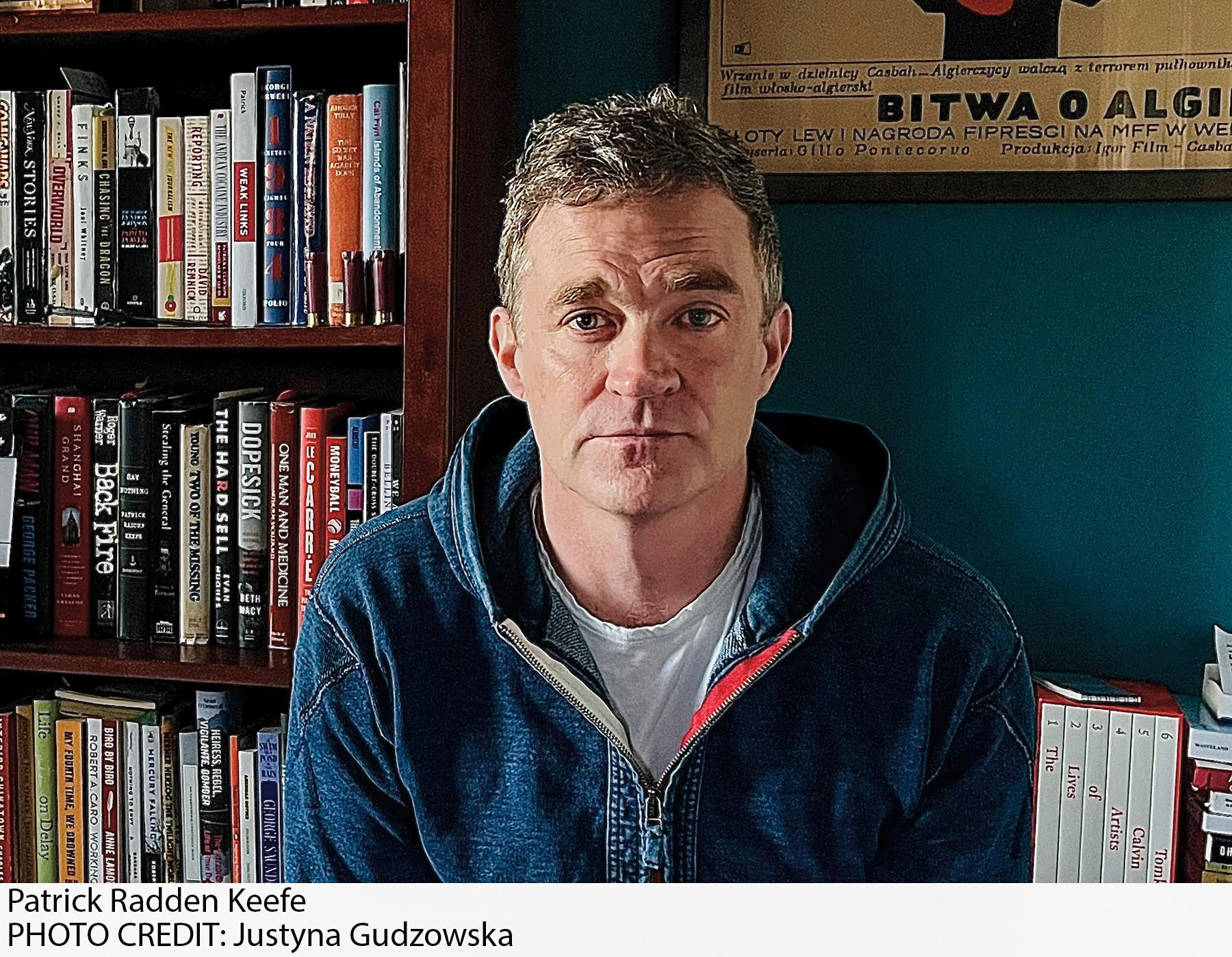
The New Yorker writer talks to Boardroom about his latest book and how he’s learned to navigate the movie and TV business.
Everybody knows Patrick Radden Keefe is a storyteller. He’s one of the best of our time. He works in a number of mediums, too. He began his career as a screenwriter, then made his way to The New Yorker, where he remains a staffer to this day. His nonfiction breakthrough came in the form of “Say Nothing,” which dealt with the Troubles in Northern Ireland through the lens of a family tragedy. The book was adapted into a miniseries for Hulu, and Keefe served as an executive producer. Then came “Empire of Pain,” which dove into the global reach of the Sackler family. He hosted a CIA-obsessed podcast, “Wind of Change,” and just released his latest brilliant book, “London Falling.” Keefe has a theory as to why he’s such a one-of-a-kind storyteller. It might be because he’s a listener — always curious, always looking for a story that helps explain why the world exists as it does.
“I do have a tendency to always strike up a conversation with a stranger, which drives my kids crazy because I will be the guy who gets into the Uber and starts talking to the driver,” Keefe explained to Boardroom the day “London Falling” arrived on shelves. His latest book is a story he stumbled upon, too. While on set for Say Nothing, he got into a conversation with someone who thought he might be interested in the story of Zac Brettler’s tragic and mysterious death. He met with the Brettler family a week later and spoke with Zac’s parents, Matthew and Rachelle, for two hours. Eventually, Keefe condensed this story into “London Falling.” Like all of his work, the book is impossible to put down, deeply researched, and, ultimately, a story about people. Read our conversation with Patrick Radden Keefe below, which has been edited for length and clarity.
Boardroom: What was your introduction to the story of Zac Brettler?
Patrick Radden Keefe: It came to me in this random way. When I go looking for ideas, I tend not to find them. If I just move through the world and have conversations with people, they come to me. I do have a tendency to always strike up a conversation with a stranger, which drives my kids crazy because I will be the guy who gets into the Uber and starts talking to the driver. In this case, I was living in London in the summer of 2023, shooting the limited series based on “Say Nothing.” I met a guy who was a visitor on the set that day, just a total stranger. He was a guest of the director. We went back and forth, shooting the breeze. I told him what I do, that I write these long investigative stories for The New Yorker. He said, “Oh, I might have a story for you.” He told me this story. He said three or four sentences and I knew that if the family would talk to me, I was in. I had to write this story.
How quickly did you begin diving in?
The first step was to meet with the Brettlers, which I did just a few days later. I didn’t want to pressure them. I didn’t want a situation in which I twisted their arms into cooperating with the story. I know that you want people to be very sure on the front end because what you don’t want is for people to agree to talk to you and then get cold feet down the line. We moved slowly. My first long conversation with them, I didn’t even have a notebook. I wasn’t recording. We were just talking totally off the record. We had a few meetings in London and over the course of those meetings, we talked through what it would look like if I wrote a New Yorker piece. They eventually said, “Alright, we’re in. Let’s do it.” I’ve spent hundreds of hours talking to them ever since.
I can’t imagine those first conversations being particularly easy. They were probably still in the midst of their grief — I imagine they still are. How do you walk that line between knowing there’s an amazing story while still honoring the very, very delicate feelings of the subjects that are still living?
It’s a thing that I think about daily when I am doing these kinds of stories. There is a level on which I appreciate the stories just as stories. I have fun with this work. It has to be fun for me. Even if the subject matter is dark at times, I enjoy the process of investigation. I really love the challenge of doing my research and then thinking about how I can tell the story in the most pleasurable way for the reader. On the one hand, you have all those kinds of considerations, but on the other hand, it’s important that those considerations not eclipse the fact that these are true stories about real people who are alive and who’ve suffered and are still suffering in some cases. In this case, one check on me was that I was talking with the Brettlers all the time, that the reality of their experience was never very far away.
You asked about that first conversation. Sometimes people who’ve been through a very traumatic experience deal with it in a private way. In the case of the Brettlers, I think they worried that people wouldn’t want to hear them talking about it constantly. They have a high enough emotional intelligence to feel as though they didn’t want to be the people who wouldn’t shut up about their son’s death. Then I come along and I’ve got all the time in the world to hear them talk. I want to hear them talk. That first conversation actually was as if I had uncorked something and they just talked for two hours straight. I hardly asked a question and I just listened.
It’s crazy to even say that phrase — they’re worried about talking about their son’s death too much. That is the defining moment of their life, tragically. The fact that they would ever feel that way is kind of staggering.
That’s very much the thing about them as characters. There’s that moment in the book where Matthew is at work and he gets a call from Rachelle telling him that their son is dead and he’s there with his business partner. He thinks to himself, “I feel so bad for my business partner because it’s going to be so awkward for him to be here when I find out that my son was killed.”
They come across as remarkable people. One thing I noticed in the book is the emphasis on how hard it is to raise children in the social media era. Is that something that you were reckoning with on your own as you were writing this book?
Because I think that Zac’s story is complicated, I don’t want to lay anything down. It’s not like the internet killed this kid. There’s a discourse of moral panic about this stuff that I don’t necessarily want to get slotted into, but I have two adolescent sons — they’re of a similar age difference to Zac and Joe. My kids are athletic and competitive, just like Zac and Joe were growing up. There was no way for me not to sometimes relate on a very personal level to the dilemmas that Matthew and Rachelle were feeling. I’m usually not the person who thinks, “Oh, that would never happen to me,” or, “That person is kind of fundamentally different from me.” I’m usually trying to find points of convergence with people that I’m writing about, even if their experiences are very different from my own.
Is that something you’ve developed over time or has that been your operating procedure since you’ve been in this career?
It wasn’t deliberate or anything. But my first piece for The New Yorker came out 20 years ago this month. A comfortable place for me is between 8,000 and 12,000 words. That’s a huge time investment. That’s six months of my life at a minimum. I have to find some sort of emotional access point to the people I’m writing about, even if they’re awful people who’ve done terrible things. Otherwise, I just don’t think I could sustain it.
“Say Nothing” was so successful and adapted into a miniseries. Is that something that you now reckon with when you’re looking for your next project?
There is a whole kind of economy of journalism that is actually designed to get optioned. I understand — when you look at the nature of the business and the kind of squeeze that we’re all in — why people do that, but I also think it’s really wrongheaded. I don’t have any interest in spending a huge amount of my time doing one thing when what I’m really hoping is that it’ll be something else. I’d rather do one thing well, and then we’ll see what happens on the other side. It’s not that I turn my nose up at this stuff. In fact, I just optioned this new book to A24. I think that these stories can have different lives across different media, but if you go into writing a piece of journalism or a piece of nonfiction and what you’re really hoping is that it can be this other thing, I would end up writing bad stories and books.
It’s cool how your career has returned to screenwriting, in a way. What’s it like coming from a place where you have some financial stability and your name is recognizable and you’re not trying to break through as a screenwriter?
I started as a screenwriter 20 years ago. I was a freelancer; I didn’t have health insurance. I got health insurance through the WGA. My family still has WGA health insurance all these years later. The Hollywood stuff was fun and it felt glamorous. You could fly business class and stay at nice hotels. I would write one script and I’d make more money than I was going to make in journalism in a year, but none of the stuff that I wrote got made. Fifteen years ago, it was fine because this is the business and you know that in Hollywood, most of what gets developed doesn’t get made.
There’s an industry that feeds people — people who write scripts that go unproduced. These days, the opportunity costs are just different for me. I’m older; I’m turning 50 next month. You can go write a screenplay and there’s an overwhelming statistical likelihood that that screenplay is never going to become anything. The time that you spend working on it is going to be time that you’re not writing an article or a book that is going to become something and be an artifact out in the world. I still do screenwriting. I’m writing a script for HBO right now, but I’m much more picky about that work than I used to be.
It’s the dream, really, to be a freelancer or self-employed and be able to pick and choose what you want to do as opposed to having to work on things because you need to pay the bills that way.
I was a freelancer for years and I really hustled. I did every imaginable job to stay afloat and keep the dream alive. The years since “Say Nothing” came out have been much better than the years before, but there’s no part of me that feels as though this was written in the stars. I kind of lucked out — and this is not false modesty. I don’t mean the books aren’t good. I think they are good. What I mean is every year I read a ton of nonfiction books that are really spectacular that don’t set the town on fire for one reason or another.
In some cases, I know the authors of those books, and they’re kind of struggling to make it work with kids and schools and mortgages and loans and all the rest of it. If me today told me 10 years ago where we would end up, I would’ve been gobsmacked. I also think that there’s an element of serendipity, and me 10 years from now could look a lot more like me 10 years ago. (laughs)
Are you always in pursuit of your next idea or do you give yourself a little bit of time? Now, for instance — are you working on new stuff?
I like to be always hustling on something. I actually just closed a big New Yorker piece last night that’s going to come out next week (editor’s note: the story is out now). There are also going to be a lot of months of book touring, which is great. I feel very lucky for that, but I also get antsy if I feel like I’m still running a victory lap for work that I did a long time ago. There’s also a new podcast I’m working on with the “Wind of Change” guys. It’s very different from “Wind of Change,” but we’re in the early stages of a new pod.
Talk to me about your relationship with London. I know you spent a lot of time there and you were living there during parts of writing this book. What has that city meant to you over the course of your life and career?
My parents actually met in England. My mother’s from Australia and my father is from Boston. They met in England in the late ’60s. There was probably always a little bit of a sense that I would end up there myself at some point. I lived there for two years after college, and I have gone back virtually every year since. London’s a city I really love. The book is written from a place of great affection, but I’m critical in the way that only somebody who really loves you can be.
It’s fascinating how the world has changed through that city — the way it represents so much change around the world.
I’m glad to hear you put it that way because I think that in some ways it’s very distinct to London, but in other ways you could write a similar book about Miami or L.A. or Dubai or New York.

Ben Shelton on the US Open, Playing in NYC, & the Future of American Tennis

Lindsey Vonn On Why Winning Must Come Before Money

10 College Football Towns Every Fan Should Visit
Lane Kiffin Is Building LSU for the New College Football Economy: Interview

Kevin Durant On LeBron’s 76ers Move, the Knicks Ring, Westbrook Retiring, & His NBA Future