

There is a timeline in which Phillip Schermer never attended the breakfast meeting that changed everything. Thankfully, we’re not living in that one.
This story is set to appear in Boardroom’s Summer Issue print magazine and has been adapted for online publication.
In 2019, Phillip Schermer, then a rising executive at one of the world’s most powerful asset-management firms, sat across from the managers of Logic, the rapper who had released “1-800-273-8255,” a song named for the old National Suicide Prevention Lifeline. The song was a massive hit, having gone eight times platinum and notching a couple of Grammy nominations.
But what the managers told Schermer that morning had nothing to do with streams or chart positions. They told him that on the day the song was released, the suicide hotline saw the second-highest call volume in its history, the first being the death of Robin Williams. They told him about the 50% spike the night Logic performed it at the VMAs, the 300% spike after the Grammys. And then they told him the number that changed everything: One year after the song’s release, call volume to the hotline was still up 30% year-over-year. A study published in the British Medical Journal found a statistically significant reduction in suicides during the song’s peak.
Schermer couldn’t stop thinking about what that meant. Not about Logic specifically, but about what the song revealed. A rap star had been honest about his own pain, and because of that honesty, people who were suffering felt comfortable enough to reach out for help. Schermer, who had spent years at the intersection of finance, policy, and culture, recognized it as a signal of something much larger.
He spent the next stretch of his life trying to understand that signal. He cold-emailed researchers at the CDC and HHS. He read every piece of thought leadership he could find. He built a group of 20-something professionals from Google, Amazon, Bumble, and BlackRock who started gathering on Saturday mornings at 11 a.m. and Wednesday nights at 8:45, not getting paid, not yet knowing what they were building—just certain they had to build something. When he finally organized all of his notes and research into one document, he wrote a single sentence at the top: “Welcome to Anxious America.”
What they built is Project Healthy Minds, a nonprofit Schermer formally launched after leaving BlackRock in 2022. The organization functions less like a traditional mental-health charity and more like a public utility. It offers a free, direct-to-consumer platform designed to be the front door to mental-health care in the United States. He had a simple thought: Whatever you need — a therapist, a psychiatrist, a crisis line, a support group, an eating-disorder clinic, a substance-use service — should be findable in one place, as easy as booking a flight. Since then, Schermer has partnered with Logic, Carson Daly, Daniel Radcliffe, Jenna Ortega, Becky G, Chance the Rapper, Alex Cooper, Meghan Markle, the Duchess of Sussex, and many more. He’s built an annual World Mental Health Day festival in New York City. He’s become the impact partner for documentary storytelling from The Kid LAROI and Demi Lovato. The festival has drawn Prince Harry, former Surgeon General Vivek Murthy, and the Governor of New York, Kathy Hochul.
So, we know it started with a song. Here’s what’s going to happen next.
The interview has been edited for length and clarity.
Boardroom: You’ve talked about that breakfast with Logic’s managers as the moment this all started. After you heard it, what made the click so deep, as opposed to this just being a project you’d work on for a short period of time?
Phillip Schermer: The thing that was most remarkable is he wrote this song thinking it will be personally meaningful but not sure if it will be commercially successful. Why would a hip-hop artist rapping about depression be a chart topper, right? And then the song blows up. Eight times platinum, nominated for two Grammys, song of the year, music video of the year. When they told me the day the song was released, the suicide hotline had seen the second-highest call volume in its history, behind the death of Robin Williams, I was blown away. Then they tell me he performed at the VMAs—there’s a 50% spike in call volume. Then they tell me he performed it as the closing set at the 2018 Grammys — there’s a 300% spike in call volume. But the thing that really floored me was that one year after the song had been released, the hotline published a report showing that call volume was up 30% year-over-year. And then there were subsequent studies published in the British Medical Journal and elsewhere showing it wasn’t just an increase in call volume, but it had led to a statistically significant number of lives saved. The song was defying the laws of gravity of our compressed attention spans — it wasn’t just a one-time spike or a two-time spike or a three-time spike, but over the course of a full year, it was inspiring consistently all of these people to pick up the phone and call for help, inspired by the fact that a culture maker was being honest and vulnerable about his own journey. There was something bigger happening in culture that explained what was going on here. It was how repeatable it was over such a long period of time that blew me away.
You’re still at BlackRock at this point, on a very upward path. Who is the first person you told this idea to?
Nobody’s asked me that question ever before. I was out with some friends on a Friday or Saturday night, and people always used to ask me what was going on with Music Matters — they knew that in addition to my day job, I’d started this thing in college that always brought together music and social impact. I said to someone, “You wouldn’t believe the breakfast I just had. My friends told me this story. I can’t stop thinking about it. And I think there’s something there.” I said this early in the night, maybe at 11:00. Fast-forward three hours later, that same friend came back to me at the bar and said, “Hey, I’ve been thinking about what you said to me all night, and here’s a story I never told any of our friends about my own journey in connection to this issue. If there’s any way that I could ever help and be a part of this, I don’t know what I could help with, but I’d love to help.” And it was remarkable. I was floored. The next day my friend hit me back and said that he had thought about it all night and just wanted to reiterate that if there was anything he could do, to let him know. Part of the reason why I tell you that story is — the beginning of Project Healthy Minds, we built it with a group of 20 or so people in their 20s and 30s who all had day jobs. Google, Bumble, BlackRock, Amazon, Venture Capital. People who cared deeply about this issue but were on very successful career trajectories themselves. None of us were clinicians. None of us were experts. We weren’t sure yet what this could be. But what started happening was all these people my age started to hear secondhand, thirdhand, fourth-hand that we were working on something in the mental-health space, inspired by some song that was successful. That’s all they understood. We frankly didn’t know anything else. But that pattern started happening organically over and over and over. This group started to get together every Saturday morning at 11:00 a.m., Wednesday nights at 8:45 or 9. People were doing this not getting paid. There wasn’t even an organization. We didn’t even know what we were building. The common thread was rooted in what was happening in culture, and this draw that so many people feel to try to make some difference in the mental-health space. What people were looking for was: I have some professional skill set. How can I use that to make a difference?
What other cultural moments made you believe you were on the right path?
The more I thought about it and the more I looked, the more I found. You could go all the way back to Biggie and “Suicidal Thoughts.” You could broaden from music into TV — I would actually argue The Sopranos had a profound impact. There was a whole generation of people for whom the art that shaped their understanding of mental health was One Flew Over the Cuckoo’s Nest. And yet this generation grew up where — take Sopranos as an example — you had never seen a show about the mob and peak masculinity where the central throughline is about him and his therapist. You could look at Kendrick. Jay-Z has talked about mental health, talked about the need for more therapists in school — not just in the music, he’s actually done interviews talking about it. And I grew up with Mac Miller, and he passed not too far from this time period. You can think about Lil Wayne. The point is you just had, in many different contexts, a plethora of different experiences that all kind of drive at the same idea. I spent literally thousands of hours reading every report, every piece of thought leadership, cold-emailing and speaking to people at the CDC and HHS, and every researcher and clinician I could get my hands on. And at the end, when I organized it all, I wrote one sentence at the top that I think is still true today: “Welcome to anxious America.” You could take it all the way to Broadway—Dear Evan Hansen. Whether it’s from hip-hop, whether it’s from film and TV, you could pull it through to Euphoria. Sports: Kevin Love, DeMar DeRozan, Dak Prescott, Simone Biles. No matter what part of culture you looked at — music, film and TV, sports, Broadway, the arts, fashion—underneath all of it was a story about mental health. That was the big sign to me that something bigger culturally was happening that we had to spend more time on.
You’ve talked about three barriers to getting people help: stigma, discoverability, and affordability. How do you assess where you are on each of those?
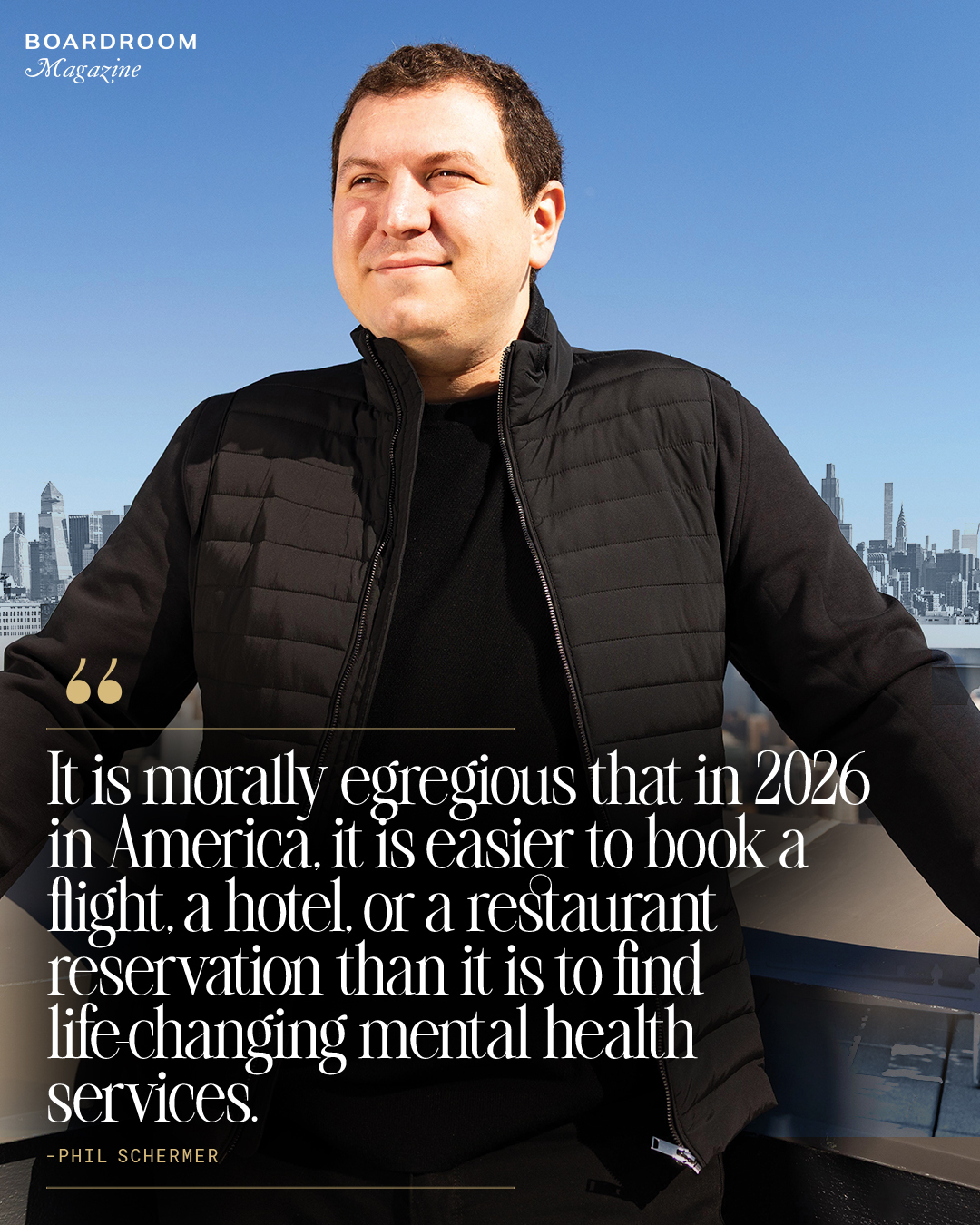
I just think it is morally egregious that in 2026 in America, it is easier to book a flight, a hotel, or a restaurant reservation than it is to find life-changing mental-health services. It should be as important to all of us that when people feel a sense of despair and they need help, it should be as easy to find mental-health support. In the same way that we built physical infrastructure to connect Pittsburgh to Philadelphia, we have to build public infrastructure on the internet that makes it easier for people to access important services that they need to thrive. We think about the work we’re doing as building a public utility on the internet—so that no matter what zip code you live in, no matter whether you have insurance, no matter the type of care that you might need — a therapist, a psychiatrist, medication, inpatient or outpatient, a support group, an eating-disorder clinic, a substance-use service, a crisis line — there should be one front door on the internet for finding mental-health care. If you’re a single mom with two kids working two jobs, the one thing you don’t have is the time to go navigate a very confusing ecosystem. And then the role of the culture makers — the lesson of the Logic song is the power of culture makers and role models to destigmatize mental health and inspire people to go seek support. Every time that we’ve partnered with someone — Logic, Carson Daly, Daniel Radcliffe, Jenna Ortega, Becky G, Chance the Rapper — we see a huge increase in the number of people who are then seeking care and we see it immediately. It can be an episode of a podcast from Meghan Markle. It can be something as simple as an Instagram story that disappears after 24 hours from Jenna Ortega. All of it leads to a very significant increase in the number of people who then seek help through our platform.
What’s the pitch when you go out to these people? Is it difficult to get them on board?
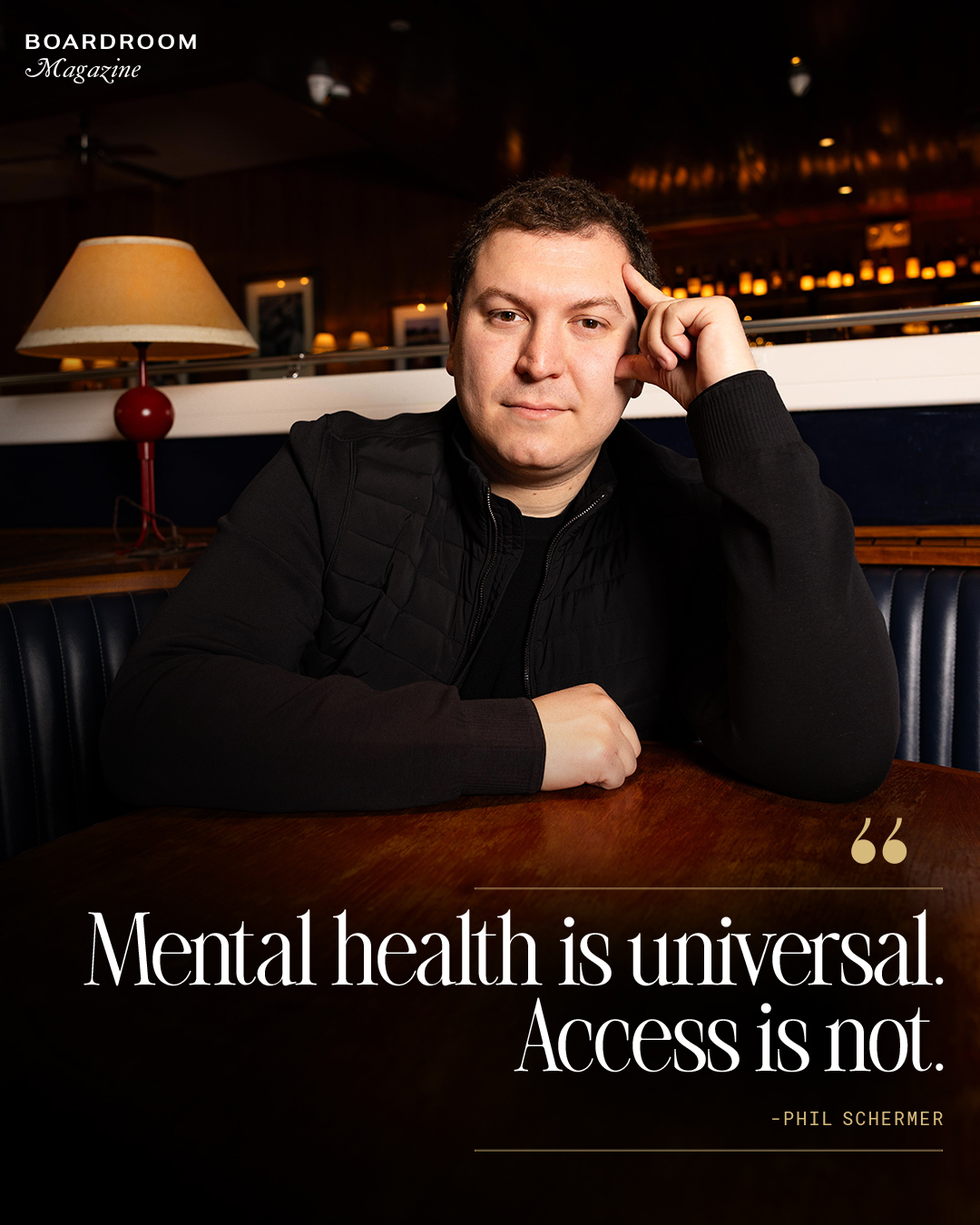
What draws people in is how universal this issue is. Mental health is universal. Access is not. In the category of mental-health nonprofit, historically most nonprofits focus on research or ad-policy work — really important, but it’s harder for a culture maker to understand how they could use their platform and their influence to really make a dent in a meaningful way for a scientist who’s sitting in a lab. In our case, we have a direct-to-consumer offering that is free for people and that serves every community in the United States. When people realize there is a very tangible way to use their audience and their influence to inspire people to seek care, and that we can measure it — that is not something that cultural figures have ever had access to before. There are a lot of people who want to make a difference. It’s not clear exactly how to make a difference. Here is a way that is actually very easy for them to make a difference that they can measure and that they can feel. And once they do it, what they all experience is an echo of what I experienced—once they start talking about it, all these people come out of the woodwork. Carson Daly says, “I’ve been on TV for 30 years. When I go to the airport, everybody wants to talk to me — not about MTV or The Voice or the Today Show. They want to talk to me about being part of the same club, and thank you for talking about it.” Sometimes people are a little nervous to share, but what they find is once they share even a little bit, all of these people — friends in their own lives and fans who look up to them—start coming out of the woodwork sharing these incredibly emotional stories, and they all basically say the same thing: “Thank you. Because of you, I decided to reach out and get the help I needed.”

Has there been any trepidation on your end about combining the tech world and the mental-health world?
There’s no doubt that we are in a moment. There’s a lot of conversation about technology’s impact on the mental health of people in this country in a negative way. But I think the moral imperative, the question we’re all called to answer, is: How can we use technology to help? It’s obvious there are ways that technology has exacerbated the mental-health crisis, but the moral obligation, the urgent question of our time, is: How can we use technology to help address the crisis and to make a difference for the positive? One of my first principles on this is I don’t think that technology should only be used to accrue financial value in commercial purposes. The benefits of technology also can be harnessed to improve social outcomes for people. So far in this country, we have a mature ecosystem that encourages entrepreneurs to harness technology for a billion-dollar exit. There is not a mature ecosystem at all that incentivizes, encourages, supports entrepreneurs to harness technology to solve social issues. I don’t think technology solves every social issue — I don’t think it solves the majority of social issues even. But I think technology can be used to solve more social issues than it does today. And so the benefits of technology should not only accrue to a few wealthy people. They should accrue to the benefit of everyone.
What keeps you up at night? What is the problem in this space that causes you the most dread?
I think we need a lot more audacious thinking in this space, and in particular in the nonprofit space. There’s too much incrementalism and not enough bold, audacious big bets that can really make a difference. If incrementalism was the answer, we’d all still be using Motorola flip phones. The other thing is — a core part of this mental-health challenge is around the loneliness epidemic and the elimination of third places. That is a massive, massive issue. When you have replaced time that you used to spend in person with people and instead just spend it at home on your phone — it’s a singular activity, not a group activity. You do it once, it doesn’t feel like it’s problematic, but it accrues slowly and then all at once in a really profound way. When people are lonely, they don’t trust the system. They don’t trust the other. They just don’t trust anyone. And I think that sits underneath so many of the challenges in the country.
Ten years from now, everything goes according to plan. What does it look like?
That’s easy. We’ve served more than a half million unique Americans in this first phase—more than 500,000. The next phase for us is 10 million Americans over the next 10 years. Nothing like this exists at this scale in the country today. And the only way we’re going to be able to make it work is if we can convince a whole bunch more cultural figures and executives in sports and music and entertainment and culture to jump on board and help us scale this work. We need the next-best hundred to be part of this. This conversation is going to lead to people hearing a story where they have a personal connection to this issue, but they’ve frankly never done anything on mental health. They might have done stuff on cancer. They might have done stuff on democracy. They might have done stuff on climate. And this is a deeply emotional, personal issue. And yet they’ve never used their influence to make a difference on it. If one person reads this piece in Boardroom and says, “Holy shit, look at who’s involved in this — maybe I should be contributing to this and using my influence for this purpose,” there will be another kid in America who got access to care…That’s the hope.
Read More:
There Is No Offseason: KLUTCH Sports Group COO Fara Leff on Commanding the Sports Calendar
Michael Che Opens Up About SNL, Kanye, Colin Jost, Cancel Culture, & Comedy

Red Hook Tavern: Where Billy Durney Wants to Know Your Name
Keanu Reeves’ Next Act Is Built on Two Wheels

The Blueprint: Jessica Holtz Meets the Moment