


Why LeBron James should finish his career with the Cavaliers, where basketball logic, championship aspirations, and the perfect ending all align.
There is a version of this story that writes itself so cleanly it almost feels too easy. LeBron James — the kid from Akron who became one of, if not the greatest basketball player who ever lived — going home one final time to finish what he started. The city that loved him before the world knew his name, that forgave him when he left, that cried when he came back, and that erupted in the streets when he delivered the most miraculous championship in the history of professional sports, waiting one more time, arms open, for the last chapter of the greatest career the game has ever seen.
That’s the story. And for once, the story and the basketball logic are pointing in the same direction.
James should finish his career in Cleveland. Not because it’s sentimental, not because it makes for a clean narrative, and not because the city deserves it, though all three of those things are true. He should go back because, of all the options available to a 41-year-old player entering a record 24th season, Cleveland gives him the best chance to win, the most comfortable landing spot, and the lightest burden he has carried at any point in his professional life. That combination doesn’t exist anywhere else on the board right now.
Start with the roster, because that’s where the practical case lives. The Cavaliers made the Eastern Conference Finals last season before running into the Knicks at the peak of their championship run. They were swept, yes, but the argument that Cleveland was done in by earlier playoff missteps against Toronto and Detroit more than by fundamental inferiority to New York is a reasonable one. That team, without LeBron, pushed deep into May. Now add him.
James Harden and Donovan Mitchell in the backcourt give LeBron two prolific, experienced offensive players who can carry scoring burdens on nights when he doesn’t need to. Evan Mobley and Jarrett Allen form one of the best frontcourt duos in the Eastern Conference — versatile, switchable, elite rim protectors, both capable of running the floor and operating in pick-and-roll situations. The supporting cast around those five is solid. What Cleveland has been missing, the one thing that has kept them from being a genuine championship conversation team, is a wing who can make plays and change games. James solves that problem immediately and completely.
More importantly, this version of LeBron — the 41-year-old who spent two seasons as the third option in Los Angeles behind Luka Dončić and Austin Reaves — doesn’t need to be the engine anymore. He can operate as a facilitating, defensive-switching, shot-creating secondary piece on a team that already has its primary ball handlers. He can be the player who makes everyone around him better without needing to log 35 minutes a night to do it. The Cavaliers don’t need LeBron to be 2016 LeBron. They need him to be 2026 LeBron — older, wiser, more efficient, and still capable of taking over a game when the moment demands it. That player absolutely still exists. We watched him flash it in flickers all season in LA.
Then there’s the home element, and before you dismiss it as sentimentality, understand that for LeBron at this stage of his career, comfort and familiarity are genuine competitive advantages. He still owns the first house he ever built in Cleveland. He still has family in the area. Northeast Ohio is in his bones in a way that Los Angeles, Miami, and Golden State simply aren’t. He knows the roads, the restaurants, the rhythms of the place. That sounds trivial until you remember that this is a man who is going to be asked to sustain his body through an 82-game regular season at 41 years old. The margins matter. The mental load of being somewhere that feels like home — genuinely like home, not a calculated real estate decision — is not nothing.
And Cleveland will receive him the way no other city can. The reception LeBron gets in that building on opening night, if he signs with the Cavaliers, will be something that hasn’t been seen in professional basketball since he came back in 2014. That city has a complicated relationship with him — The Decision, the departure, the return, the championship — but what lives underneath all of it is a love that never really went away. And as he makes his way around the league one final time, every arena will give him his flowers with standing ovations, tribute videos, the kind of send-off that only the all-time greats receive. But nowhere will it hit different than Cleveland. No other building will understand what those flowers actually mean, or why they’re deserved. The 2016 title erased everything. It didn’t just erase it; it transformed it into something permanent and unbreakable. Going back one more time doesn’t reopen old wounds. It closes the last one that was left.
Now, the money. This is the part that requires LeBron to make a decision about what matters most to him in the final act, except, according to those close to the situation, he’s already made it. James has reportedly told his agent Rich Paul that money isn’t the priority. He wants to compete — that’s it. That’s the whole conversation. For a player who has made over $500 million in NBA salary alone across his career, a billionaire with SpringHill, Fenway Sports Group equity, media deals, production companies, and investments that will generate wealth long after he plays his last game, that’s not a surprising position to take. It’s actually the only one that makes sense at this stage.
The Cavaliers can realistically get to around $15 million to offer him right now, a significant step down from the $52 million he made with the Lakers. But that number isn’t necessarily the ceiling. Shrewd salary cap maneuvering could change the math, and one of the biggest variables is James Harden, who declined his $43.2 million player option to give the franchise flexibility to go after LeBron. If Harden is willing to take a discount to stay in Cleveland and be part of something special alongside James, the Cavaliers could suddenly find themselves with significantly more flexibility to offer. Whether Harden takes less is its own conversation entirely, and nobody should assume that answer is yes. But if both players prioritize winning over earning — and LeBron has already signaled that’s where his head is — Cleveland’s front office has more room to be creative than the current cap sheet suggests.
Taking less money to go home one final time is a story that resonates. It’s the Jalen Brunson move — the decision that says winning and meaning matter more than the maximum, and that earns a city’s gratitude in ways that no contract number can quantify. If LeBron James signs with Cleveland for $15 million or less in the final season of his career, that decision gets talked about for decades. It becomes part of the legend.
The other options all have their appeal. Golden State has Stephen Curry, a partnership that fans have long clamored for and got a tease of during the Olympics last year. Miami has Giannis Antetokounmpo and Bam Adebayo and a defensive identity that could hide some of LeBron’s limitations at this age. There’s even places such as San Antonio, which has Victor Wembanyama and a championship infrastructure already in place. All of them make sense on some level.
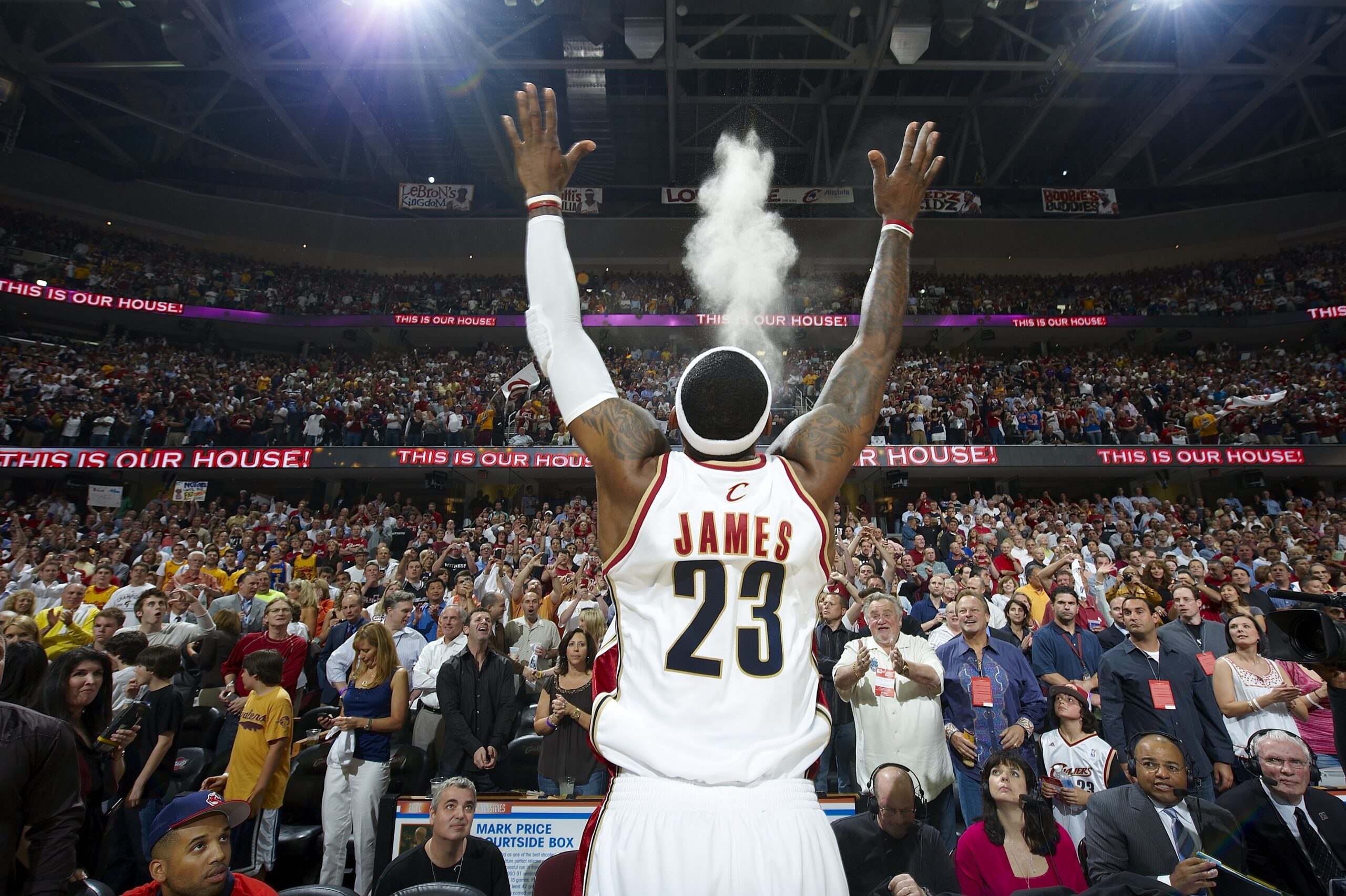
But none of them are home. None of them have the history. None of them delivered what Cleveland delivered in 2016, the greatest championship moment this sport has produced in the modern era — a 3-1 comeback against the greatest regular season team ever assembled, finished with a block, a chase-down, and a Kyrie Irving dagger that is still replaying in the memories of everyone who watched it happen.
LeBron was the reason that happened. Cleveland was the reason it mattered.
The story of LeBron James has never really been about the rings or the records or the MVP trophies, though he has all of those in abundance. It’s been about the journey. The kid from Akron who carried the weight of an entire region on his back before he was old enough to drink. The villain who became a hero. The hero who became a legend. Every chapter has built toward something, and right now, for the first time in a long time, the final chapter is sitting right there in plain sight.
He doesn’t need to go to Cleveland to validate his career. That ship sailed a long time ago. He’s going because it’s right. Because the basketball makes sense, the city is ready, and there is something profoundly fitting about the greatest player of his generation ending where it all began — not limping toward the finish line in someone else’s story, but writing his own ending in the place that has always understood him best.
Fifty years from now, when people tell the story of LeBron, they won’t start with the stats. They’ll start with Akron. They’ll talk about the promise, the pressure, the heartbreak, and the redemption. They’ll talk about 2016. And if this plays out the way it should, they’ll end it right back where it started: in Northeast Ohio, in front of a building full of people who loved him first.
Go home, Bron. One last time.
Read More:

Red Hook Tavern: Where Billy Durney Wants to Know Your Name

Keanu Reeves’ Next Act Is Built on Two Wheels

The Blueprint: Jessica Holtz Meets the Moment

The Power Broker: Emma Grede Is Just Getting Going

Quiet Power: Imani Ellis on CultureCon, Creators, and Learning to Let Go