
Boardroom sits down with the legendary eyewear brand for a behind the scenes look at how it taps in with the biggest artists and brands.
What goes into an Oakley collaboration? The brand, though celebrated for its signature eyewear and underrated clothing designs, has also become a game-changing force in the world of fashion crossovers. They’ve teamed up with Ibex, skateboard darlings Palace, golf game-changers Metalwood, street icons Stüssy, cycling’s coolest brand Pas Normal, and running’s most elite luxury-functional designers, Satisfy. That’s not to mention work with Travis Scott, Brain Dead, and plenty of others.
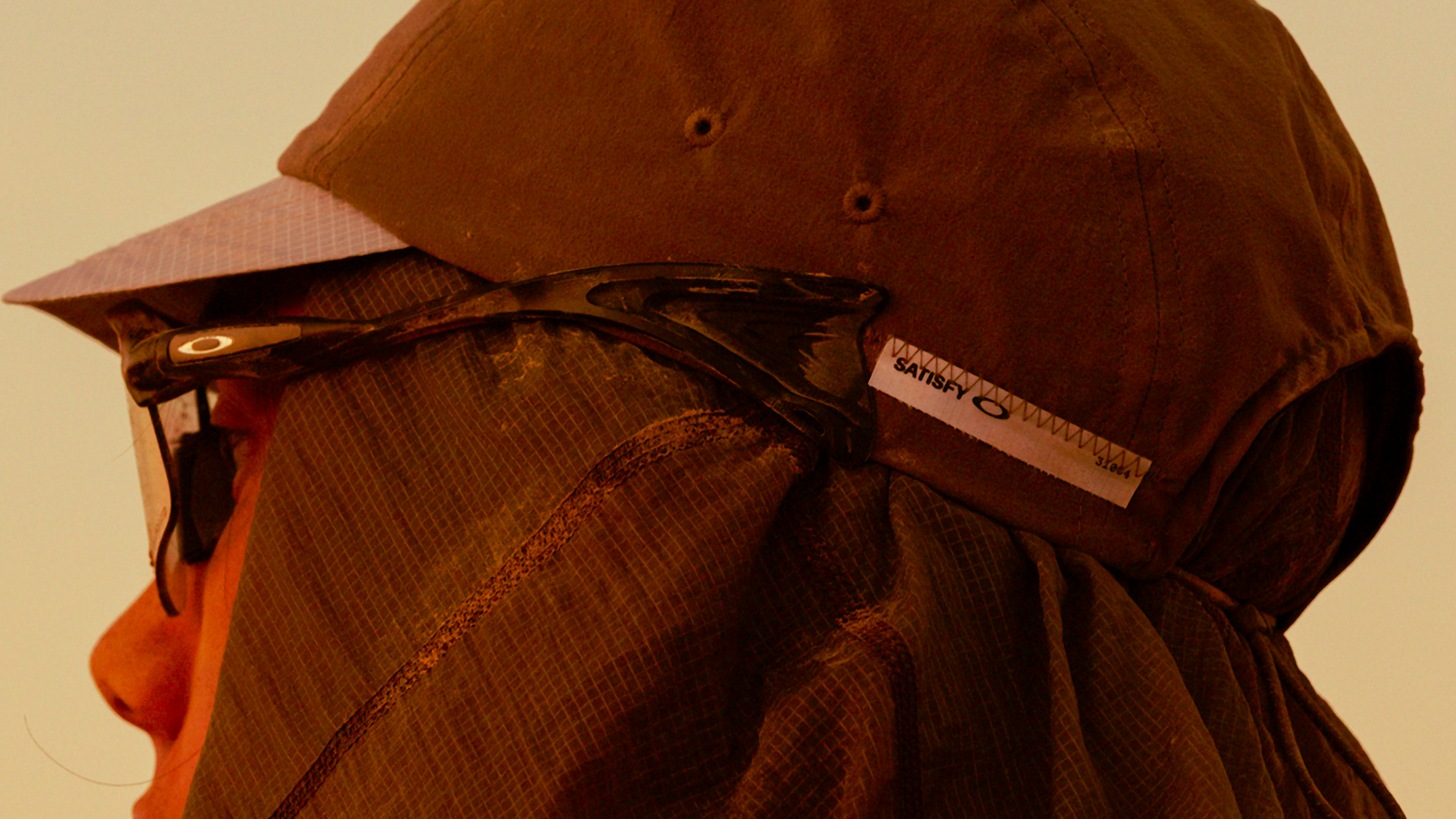
On the heels of their second drop with Satisfy, we caught up with Oakley’s Alex Ellinport, who serves as the Product Strategy Director for Sport, Lifestyle, and Collaborations. We spoke with Ellinport about what makes an ideal collaborator for Oakley, how they’re thinking about the future of the brand, and why a brand like Satisfy is the perfect partner for a joint project.
Check out the conversation below, which has been edited for clarity.
How long have you been with Oakley and what were you doing before?
Just about a year now. I come from retail. I started in New York at a store called Extra Butter. I became the buyer and GM there and then went to Converse, held various roles, mainly in the collaboration space, doing sales, merchandising, and product. Then I went to Levi’s, also mainly in the collaboration space, in a global merchandising project management role. I took the opportunity at Oakley because there was so much energy with the brand and it was a space I’ve been interested in. I was in footwear, I was in apparel, and I never worked somewhere where the factory is at the office. That’s a really unique thing for any American company.
Boardroom: It doesn’t seem like there are many brands that are as established as Oakley while still being interested in pushing the boundaries.
Alex Ellinport: Going back to everything being on site, you can have a really quick iterative design process so that when you want to push a boundary, our team has a model shop and can 3D print the concept that same day. We can design something, have it on hand, and then try it on all within a day’s time.
Is there an operating philosophy for collaborations at Oakley?
Most importantly it has to be something that matches with the Oakley DNA. There has to be a synergy. On the flip side, it should be something that we couldn’t do ourselves. What is that brand adding to the collaborative process to build something that’s greater than what we do on our own? If you look at Satisfy, we’re bringing the innovative design, they’re bringing the community and culture in places that we’ve had a lot of historical significant relevance, but through the guise of a new lens, today.
I’m not sure about the financials of these collaborations, but it seems like there’s not as much pressure on it to make as much money as humanly possible. Obviously, they need to succeed, but there’s a cultural measurement, too, it seems. Is that fair?
Very fair to say. It’s more about getting the product right and working with the right people. Even historically, if you look at Oakley’s philosophy and putting out product, it’s really been about releasing it when it’s ready, not rushing it because we have a deadline to meet. This goes all the way back to our founder, Jim Jannard. That’s how we operate. The product has to be right and has to hit the brief of what it’s supposed to do.
How big is your team?
My direct team is four people and we manage the entire sun product line. It’s a really big business but it’s a very small, lean, and nimble team.
Is there a lot of collaboration between different collaborative units? Like, are you speaking with the footwear team?
Absolutely. If you go all the way back to 1992, the Max Fear Light campaign that served as the through line of what everything Oakley would look like for about 25 years. When that commercial debuted, there was no CGI. They approached world building through a cinematic narrative. So no brand, I mean obviously no one was even talking about it. No brands were talking about mission, vision, purpose, and Brand decks back then, but that created the Oakley universe. Thirty years later, we’re now working on what we call Future Genesis, which is not bringing back that narrative, but a continuation of the narrative.
Every year we’re putting out a CGI-based chapter. It’s essentially continuing Max Fear Light’s journey after he leaves the bunker. It’s laying the groundwork for brand foundation and brand narrative. When we approach partnerships, another big aspect of it is how does that partner align to or fit into a Future Genesis world? If you look at the shoe collab we did with South2 West8, you understand how they fit into that world. If you look at the content we shot with Satisfy, you understand how they fit into that world. It’s dystopian adjacent, but we like to use the word protopian, which means a journey towards building something better. We’ve really adopted it and it’s something that we champion as how we’re building towards the next 50 years.
How far out is this new story planned?
The narrative started a couple years ago. Some of it becomes external, but a lot of it is just internally driving our design in product stories. Right now, it’s planned out to 2030. Wow. Each chapter is named and every year our creative team works on what the chapter means and looks like. It’s a really unique way to approach how the brand shows up in the world.

It brings a lot of clarity.
Exactly. You just ask two questions: Does it fit in this world and does it feel like Oakley? If both answers are yes, you’re doing it right.
Why is Oakley so interested in boundary pushing collaborations?
I would take a step back and think about how Oakley pushes boundaries itself. We pioneered sport performance optics. We are the leader in that space. We have been for the past five decades. When we invented the Eyeshade, there was nothing like that. There’s still nothing like it, by the way. There are copies, but from an optical standpoint, we have the most optically correct eyewear specific to sport performance. That’s what makes the collaboration angle unique is that you’re working with the best brand in this space
What do you think it is about our current moment that makes everyone so into this hybrid of streetwear, workwear, and leisurewear? Oakley seems uniquely suited to thrive in this environment.
People like to look back on the past 20 to 25 years as a moment of nostalgia. Many would consider that to be a really pivotal moment in Oakley’s history from a design standpoint. It was around the time that the original Eyejacket came out. It was in the wake of the X-Metal series. Outside of the nostalgia aspect, in 2020, everyone was inside. There was a desire to get outside, be active, and people wanted to reconnect with the place that they were missing, which is nature. They latched onto all the brands that spoke to that, even if it was an aspect of faux utility. I think the brands that’ll come out of that and will last are the ones that are performance driven and purposeful.
What’s one collaboration you’re particularly proud of?
The Travis Scott partnership, because I really appreciate how Travis approaches product. He’s also a product person. When you see someone and you see the things they wear and the spaces they curate for themselves, you understand how deep the appreciation goes. He really gets deep into how something looks on him, how it fits, how it feels. The stuff that we’re creating together fits into the Cactus Jack sphere very well. It’s in his world, but it’s also just very personal to him.
What about a collaboration that’s already out?
The first drop with Satisfy was one of my favorites because of the overlap of world building and their consumer. We have our brand creeds that we live by. There are things that serve as a good checkpoint for why a product should exist or why we should do something. Physics wrapped in art is one of them. Satisfy really embodies that. Another one is, does it satisfy the eye, the mind, and the heart? What does it look like? How does it work? What does it do to you emotionally? What does it feel like? Satisfy is technology first, but they wrap it in this beautiful package and it’s just a perfect match for how we approach products as well.
What does creating a collaboration from beginning to end look like?
It’s contingent on the partner and it comes from different people within our organization. We have a core team that plans the partnership roadmap calendar, but something could come up and somebody could say, ‘Hey, so-and-so reached out,’ or we reach out because we know it’s a brand that we can make great products with. Sometimes that process can take years, beginning with an invite to the office. Then we keep the conversations going and then eventually we come in to do a design meeting and there’s a contractual piece of it. All that takes a lot of time, but once the process gets going, it moves pretty quickly. It comes down to, ‘How do the stars align to get something on books?’
Does Oakley have final say on creative decisions?
The guardrails are, ‘What are the things that are just impossible to do?’ There are certain color applications or finish applications that are just still impossible The other piece is our mainline product and making sure that nothing we have coming looks like what the partner wants to do. Outside of that, we really give them free reign to create something that is through their creative lens because that’s the reason we’re working with them. We don’t want to muddy the design intent.
Red Hook Tavern: Where Billy Durney Wants to Know Your Name
Keanu Reeves’ Next Act Is Built on Two Wheels

The Blueprint: Jessica Holtz Meets the Moment
The Power Broker: Emma Grede Is Just Getting Going
Quiet Power: Imani Ellis on CultureCon, Creators, and Learning to Let Go