
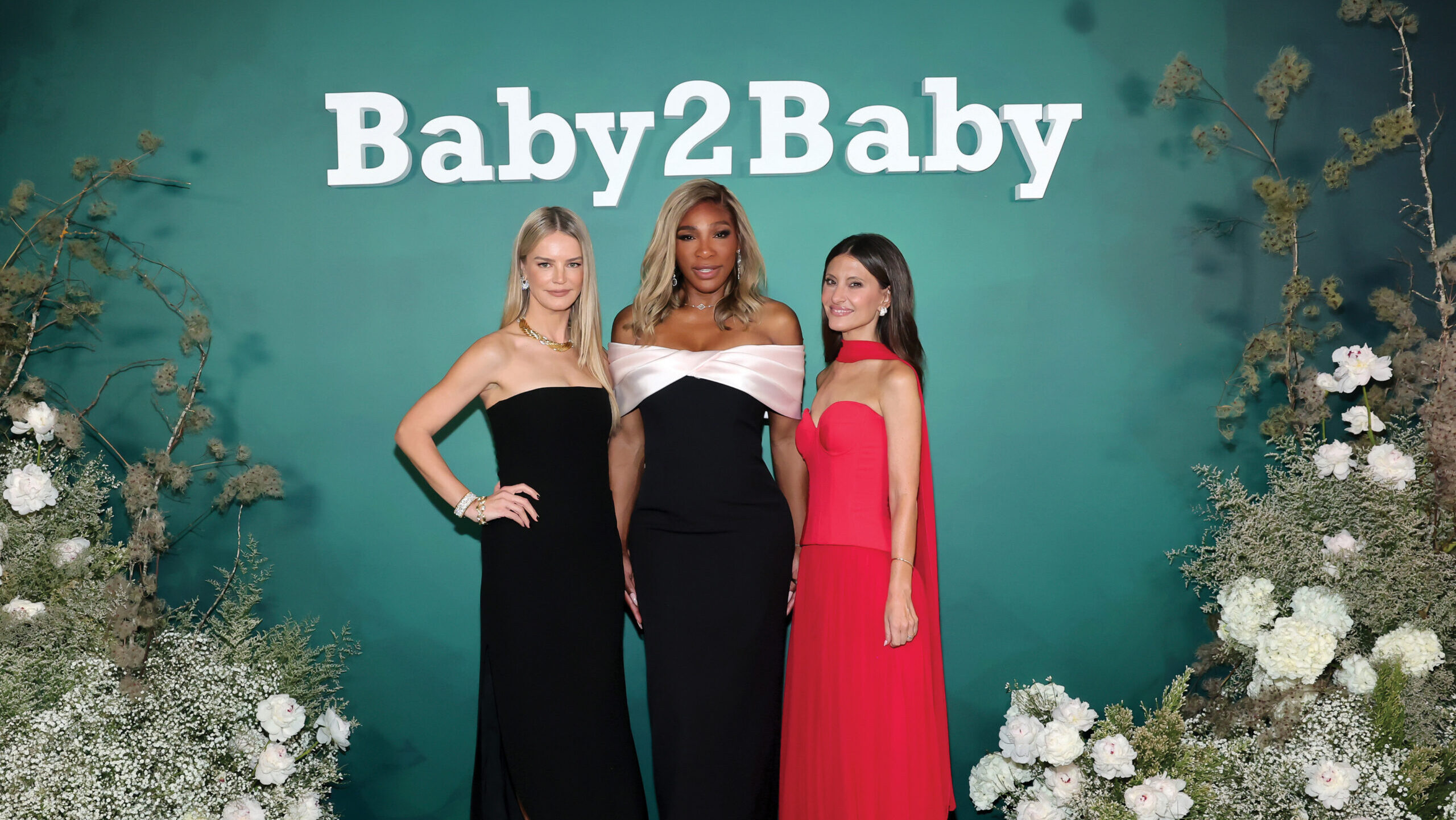
Kelly Sawyer Patricof and Norah Weinstein went from a 600-square-foot storefront to serving one million children a year across all 50 states. They’re just getting started.
This story originally appeared in Boardroom’s Spring Issue print magazine and has been adapted for online publication.
Let’s get something out of the way: If you hear the word nonprofit and your brain immediately downgrades the operation to something smaller, softer, less serious than a real company, respectfully, you’re not paying attention.
Kelly Sawyer Patricof and Norah Weinstein run Baby2Baby. And when we say run, we mean they took a 600-square-foot storefront on Pico Boulevard with one intern and turned it into a nationwide organization that has distributed over half a billion essential items to children living in poverty across all 50 states. They manufacture their own diapers. They operate warehouses across the country. They’ve responded to more than 100 natural disasters, including the L.A. fires, where they moved 35 million emergency supplies in real time. Last year alone, they raised $70 million in cash and brought in $117 million in donated products. Their annual gala pulls nearly $20 million in a single night. Time put them on its 100 Most Influential Companies list. Fast Company called them the most innovative nonprofit in the world. At a certain point, you just call it what it is: Baby2Baby is one of the most impressive operations in the country, full stop.
But here’s the thing that really stood out to Boardroom CEO Rich Kleiman: These two move like founders. The way they talk about scaling distribution, managing 1,000 partner organizations, lobbying state legislatures to remove the diaper tax, leveraging celebrity relationships not for clout but for supply chain. It’s the kind of energy that most people in the for-profit world would have a hard time matching.
And they did it their way. No traditional playbook. They built a network of over 70 angel ambassadors-every single one a woman, every single one a mom-including some of the biggest names in entertainment and business, from Jessica Alba to Kim Kardashian to Jennifer Garner, all of whom don’t just lend their names but actually show up, pack bags, fly across the country to lobby Congress, and donate millions of items from their own companies. That’s not a celebrity advisory board. That’s a movement.
The conversation that follows covers how a “blind date” at Chateau Marmont led to a 15-year partnership, how 100,000 diapers on a truck changed everything, and why Baby2Baby won’t sell you a single diaper, even though they easily could. Patricof and Weinstein are building something meant to outlast them, and right now they’re in the middle of a capital campaign for a permanent 47,000-square-foot headquarters in Santa Monica that says exactly that.
This interview has been edited and condensed for clarity.
Boardroom: Norah, tell me about when you first met Kelly and what your first impressions were.
Norah Weinstein: I certainly didn’t think we were going to start a business together, but I thought it was a fun dinner date. We were set up on a double-blind-date by Alan Patricof, Kelly’s father-in-law.
Kelly Sawyer Patricof: He loves to set people up on dates. That was around 2006, so about five years before we started at Baby2Baby.
Do you remember the first time the two of you talked about the void you noticed how so many children were underserved the most basic needs?
Patricof: We were at dinner, and I was telling Norah that I was a model in New York, but I volunteered at a Head Start CenterNorthside Center for Child Development. I loved it. Between traveling and modeling, it was actually my favorite thing out of everything I did. And Norah was telling me about her work as a lawyer and the pro bono work she did for families in need, women and children specifically. So we had that in common.
Weinstein: I was a lawyer at Skadden in New York doing corporate litigation, but I loved the pro bono work for families I got to do more. We both talked about how much we loved that part of our work, and that’s really how we got on the topic of it from the very first night we met.
Was it years of building a comfort level before you realized this was something you wanted to start together? Was there a specific moment you knew you had to act?
Weinstein: We kept in touch, talked about different business ideas, and then ultimately we went on some field trips. We started visiting other nonprofits together-a homeless shelter, a refugee center, a hospital, a parenting group. We didn’t have a specific plan at this point, but we were both interested in business, interested in children, and interested in the part of our careers that was most fulfilling, which was giving back to kids in need. So we just listened. We went into these organizations and asked, “What works? What doesn’t? Where are the holes?” What we found was that when we’d ask people on these visits what works, what doesn’t, and where the holes are, we were expecting them to say staffing issues or funding problems. Instead, they kept talking about diapers. They kept talking about the items they didn’t have. They’d say, “We can’t get parents into these programs because their children’s basic needs aren’t met.” Whether it was getting a mom to a parenting class, to sign an insurance form, or to come to the hospital for a well visit-these moms wouldn’t bring their kids in if the baby at home was in a dirty diaper. That was the early light bulb.
Did you start off focused on just serving L.A.?
Patricof: We were serving about 500 children in L.A .. It was the two of us and one intern in that 600-square-foot space. We had a cocktail party to announce that we were in charge. We scrounged up free alcohol, got a free space, and invited 25 women — two of them being Jessica Alba and Nicole Richie. A photo of us ran in Us Weekly: “The Baby2Baby launch party with Nicole Richie and Jessica Alba.” The next day, we’re sitting in this tiny space and the phone rings. It’s Edelman PR representing Kimberly-Clark, which owns Huggies. They said, “We’d love to give you 100,000 diapers and $100,000. Could you have a similar event?”
They asked us, “Do you accept pallets?” We’re googling “What is a pallet?” and saying, “Yes, of course.” They ask, “Do you have forklifts?” We’re googling where to rent forklifts and saying, “Yes, of course we have forklifts.” We got 100,000 diapers on a truck and had to get on the truck ourselves in heels with Exacto knives, cutting the plastic off the pallets. That day we called our partner organizations and social workers and said, “We have Huggies diapers. Do you need some?” They were picked up and gone within a day. Social workers stuffed their cars to the brim and tied boxes to the roofs.
Weinstein: We were giving out gold. They were lined up around the block. That was the day we realized diaper need is real. And celebrities really move the needle. Both of those light bulbs still drive us 14 years later.
You say celebrities, but it feels like the thread is that these were also moms who connected with it on a different level.
Weinstein: Absolutely. It’s what moved the needle. Every time someone would join, they’d say, “That resonates with me, too.” Someone would hold a pack of diapers so we could get millions more. A celebrity who was also a CEO would donate hundreds of thousands of items from her own company. These women would come to our offices, volunteer, sort through clothes, pack duffel bags full of supplies, and hand out essentials directly to mothers. They wanted to interact with the moms. They were juggling kids themselves and feeling like they wanted to do something to give back. We tried to give them easy, palpable ways to help — one lnstagram post, one hour volunteering, one corporate partnership.
We put together a group called our Angel Ambassadors. These women have never been names on a piece of paper. They fly on planes with us to advocate for diaper-tax removal. They fly to New York for events. They do PSAs. They put on masks and PPE and handed out supplies in school parking lots during COVID. They’ve given millions of items from companies like Jessica Alba’s The Honest Company, Kim Kardashian’s SKIMS, and Jennifer Garner’s Once Upon a Farm. We have over 70 angel ambassadors now-all women, all moms.
How big is the operation today?
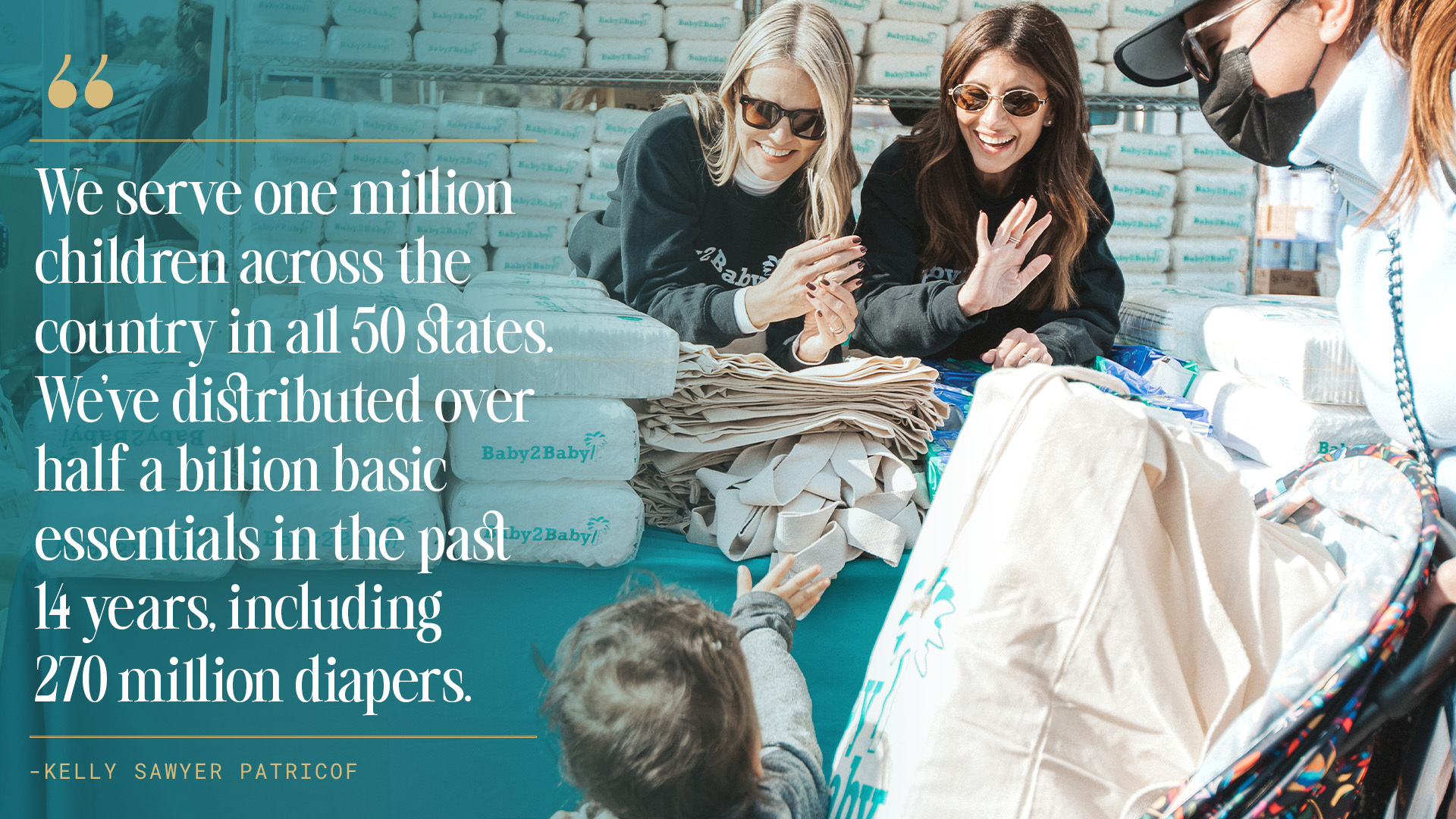
Patricof: We serve one million children across the country in all 50 states. We’ve distributed over half a billion basic essentials in the past 14 years, including 270 million diapers. Our disaster relief program is one of our fastest-growing programs-we’ve responded to over 100 disasters. The L.A. fires were our largest response, where we distributed over 35 million emergency supplies.
Weinstein: Our last gala raised $18.5 million, but we actually raised $70 million in cash last year and brought in about $117 million of in-kind items. We have our headquarters in L.A., warehouses across the country where we pre-position supplies for disasters, and a giant program in New York. We removed the sales tax from diapers in California in 2020. We manufacture our own diapers for 80% less than retail. But we still have requests for 1. 7 billion diapers. There are 10 million children we’re not reaching yet. We still have a lot further to go.
Now that you have this infrastructure in place, does this allow you to think globally?
Weinstein: We started in L.A., and we were actually pushed to expand very quickly, but the two of us decided to wait and make sure we were doing what we were doing as well as possible. It was a complicated logistics operation. We had about 500 separate partners in Los Angeles, and that was a lot of contracts to manage. Only at the point where we felt we had perfected that did we start expanding across the country. A lot of that happened through our disaster relief program — when we’d go into a hurricane in Texas, we’d meet the food banks, the diaper banks, the resource centers, the hospitals working on the disaster, and we’d bring them on as yearlong partners. Organizations from food banks to FEMA to the Department of Agriculture started calling us, saying, “We need more formula. We need diapers. We’ve heard you’re on the ground and can get them to us.”
Patricof: We talk about going global a lot, but we’ve distributed over 270 million diapers and we haven’t knocked out diaper need in America just yet. We serve a million children, but there are 10 million children we’re not reaching. So we’re focused right now on the U.S.
The gala is a cultural flagship moment on the calendar. How did you make it so special?
Patricof: From day one, we said we don’t want chicken at a hotel ballroom. We wanted to reach a younger crowd, make it exciting. A big part was the food-we partnered with Jon & Vinny’s from year one, and they brought in 20 of L.A.’s best chefs cooking at stations around the room. We wanted the program to be impactful but short. People leave knowing what Baby2Baby does, why they’re there, what their money’s going toward — and then we turn it to fun as fast as possible.
Weinstein: Our sponsors-loyal partners like Paul Mitchell and Summer Fridays-have always underwritten 100% of the gala costs. So every dollar from tickets, tables, and donations goes directly to Baby2Baby and the children we serve. People appreciated that transparency. It’s a big fashion event, which people — especially in L.A. — were looking for. And there’s a lot of strong female power in the room.
Tell me about the work you’re doing in New York and the maternal health program.
Weinstein: One of our fastest-growing programs started with the White House in 2023. It’s designed to combat the maternal mortality crisis — mental health is the leading cause of maternal mortality. The concept is giving women immediately after giving birth in the hospital the products they need: diapers, hygiene products, bottles, bibs, blankets. And also remembering that the women need to be taken care of too — breastfeeding supplies, pads, gifts for the moms. We piloted it in the South. Then the governor of New York came to our L.A. office, packed a kit, wrote a note to a mom in need, left, and 10 minutes later called to say she was going to give us a grant so that every single mother on Medicaid in New York will receive one of our maternal health and newborn supply kits.
You’re doing something incredible, but on top of it you’re operating a brand at a major level. Has that been tough to balance?
Patricof: There is a sexist view of nonprofit. Because we’re two women running an organization, people still ask us-even when we say we serve a million children and have distributed half a billion items and manufacture our own diapers-they say, “Oh, so do you have an office?” It’s infuriating, but it also lights a fire under us. If a man was a CEO of a nonprofit, would you ask him if he had an office? We didn’t know we’d be running a logistics, warehousing, and distribution company alongside all the marketing. But we have an incredible team of 70 and growing, and the brand awareness has really helped put us on the map.
Weinstein: That goes back to why I had a sensitivity early on about the “foundation” label. We’re so hyper-aware of Baby2Baby being treated as the business that it is. When Fast Company named us the most innovative nonprofit in the world, that meant a lot. And when Time magazine put Baby2Baby on their 100 Most Influential Companies list-not a secondary nonprofit list, but the companies list-we were most proud of that. We want that recognition for the people who work here, for the industry, and because we want people to trust us with their money and their donations the same way they would with an investment in a company.
I’d imagine if you wanted to create a consumer Baby2Baby product, it would be massive. You could fundraise through the profits. What are your thoughts on that?
Patricof: People ask us every day, especially business-minded people, particularly around our diapers — that we should manufacture them, sell them, and put the profits back into Baby2Baby. But we have so much work cut out for us. We haven’t solved child poverty in the U.S., and there’s a lot to do. I think launching a product line would take our focus off what we’re here to do, which is help children in need and keep growing.
Weinstein: We’re also very aware of the perception of nonprofits spending their money appropriately. That is so meaningful to us and to our donors. Our decision has been: Let’s make everything extremely clean and separated so there’s never any appearance of anything other than the work we’re doing. There’s a business angle and an emotional angle, and both drive us.
What makes the partnership between you two work so well? And where do you see Baby2Baby going from here?
Patricof: We just launched our capital campaign for a new building — 47,000 square feet in Santa Monica. It will be our permanent headquarters. We want the families and children we serve to know we’re here to stay. As for the partnership, Norah is the lawyer who keeps me in line. I have very big ideas and like to say yes to everything, and sometimes she needs to reel me in and make sure the i’s are dotted, and the t’s are crossed. But we do so many things together. We can end each other’s sentences by now. We have very different personalities, but when it comes to Baby2Baby and the children we serve, we’re on the same page.
Weinstein: There’s a lot of confidence that comes with 15 years of a partnership. Not many relationships last this long. At some point you start realizing there’s some special sauce to what we’re doing, and we believe in it. We know how to get through disagreements. We know each other’s priorities. Whatever we’re doing, our way is working. And we anticipate that we continue to innovate, work with for-profits and government entities, and just keep growing and growing.
Read More:
Inside Derek Jeter’s Bet on America’s College Towns: ‘That Passion Isn’t Something You Can Manufacture’
Kelsey Plum Gets Real About Money, Success, & the Future of Women’s Hoops
Maverick Carter on LeBron James’ NBA Career, The Decision, & Building a Billion-Dollar Blueprint

From Cursed to Contenders: LeBron James Picks the Sixers for Final Run
Diana Taurasi, Cathy Engelbert & Kristyn Cook on the WNBA’s Explosive Growth, Future of the League