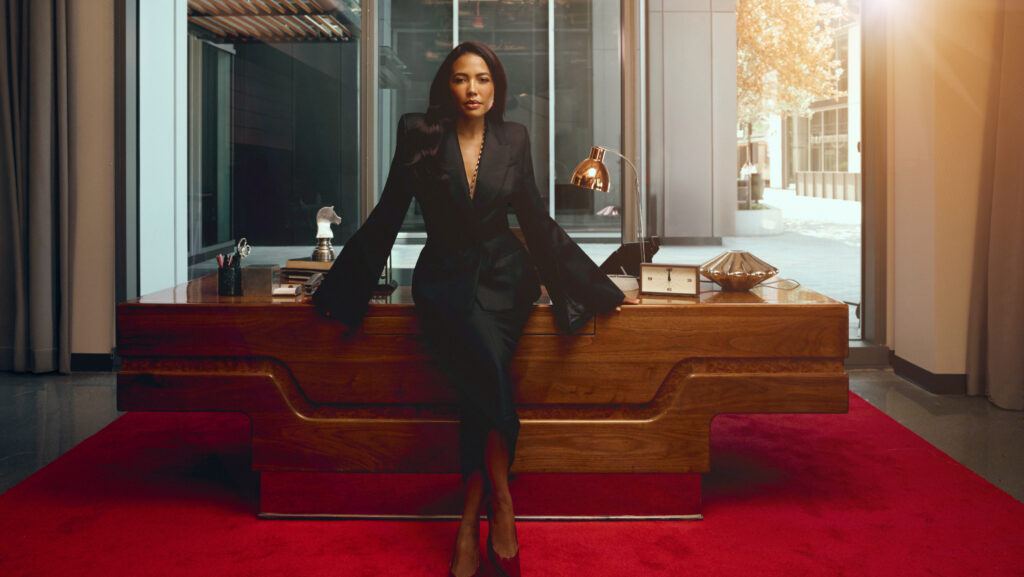


Helena Thornton, Nike’s VP of Brand Marketing, breaks down the company’s newest star-studded commercial and explains why its all in on the sport again.
If you were like me in 1998 — a young, impressionable, soccer-playing kid with a bit too much free time — you likely also tried to recreate the legendary Nike Airport commercial. If you don’t know what I’m talking about, just picture the scene: Nike put the Brazilian national team in a terminal — Ronaldo, Romário, Roberto Carlos — and had them running around playing a game of keep-away while juggling a ball through metal detectors and departure lounges. Bossa nova played underneath. The whole thing radiated a kind of effortless joy. My friends and I would watch MLS games, hoping to catch the spot so we could record it on a VHS tape and study it. Then we’d link up, bring a soccer ball, and try to turn every location into a makeshift pitch. We’d flick the ball off a curb, off a wall, off each other, convinced we were one rabona away from the real thing. We never were. But that wasn’t the point. The spot made soccer look like the coolest, most improvisational language on earth, and it made you want to be fluent in it.
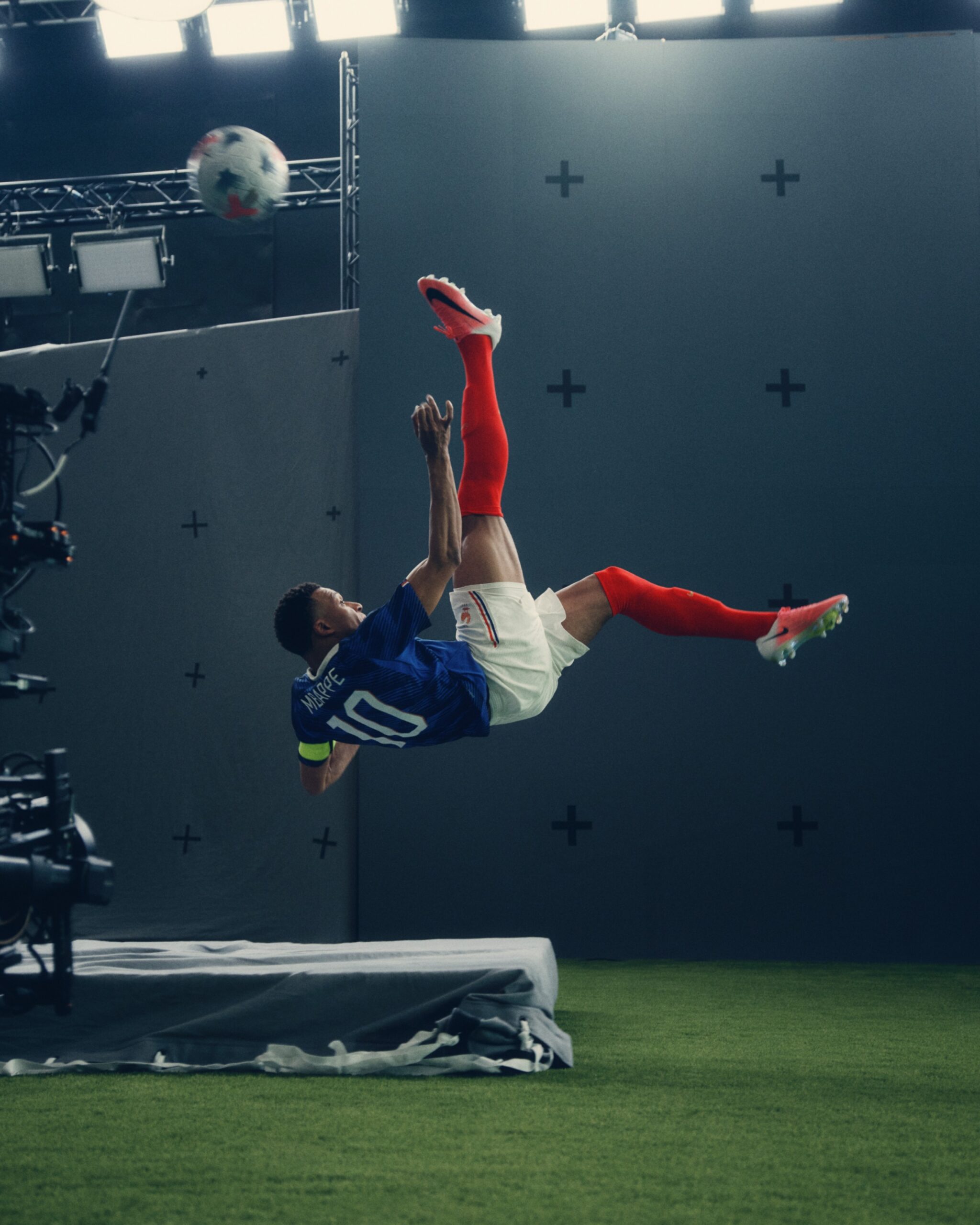
So when Nike unveiled its new World Cup film at its New York headquarters this week, I legit felt like a kid again. The new film is called Rip the Script, it was created by Wieden+Kennedy and directed by Dan Streit, and it was the first time the work had been shown to anyone outside the people who made it. It is, openly and lovingly, an heir to Airport — Nike reaching back to the formula that worked so well in the ’90s and rebuilding it for 2026, this time with a roster of football athletes and cultural figures assembled ahead of the tournament, which kicks off June 11.
The new film flips the old premise. It follows players and celebrities on a chaotic film set that falls apart when an overbearing director tries to control a game that lives in unscripted moments. The cast runs more than 30 deep — Cristiano Ronaldo, Erling Haaland, Kylian Mbappé, Vini Jr., Zlatan Ibrahimović, and Cole Palmer, with legends like Ronaldinho and Wayne Rooney mixed in. Then the cultural side: LeBron James, Kim Kardashian (and her soccer-loving son, Saint), Travis Scott, Serena Williams, K-pop star Lisa, and Young Miko. Nike calls it a “Football Universe,” built out the way Marvel and DC build a shared world.
It’s a much bigger machine than the one that hypnotized me as a kid. But it’s chasing the same feeling. I spoke with Helena Thornton, VP of Brand Marketing at Nike, about how they made it — and about what Nike is really after this time around.
This conversation has been edited for clarity and length.
Boardroom: You just watched the film with an audience for the first time. How do you feel?
Helena Thorton: I’m excited, honestly. It’s funny sitting there watching everybody else watch it. This is the first time we’re showing it to people outside of my world — the people who made it and touched it. And I was emotional. This is a real labor of love. It’s a real statement of how we feel about a sport and a game I’m personally incredibly passionate about. I just can’t wait for the world to experience the next part of this journey we’re going on this summer of football. I sit here tonight very excited.
How does Nike view football right now?
We’ve made a renewed commitment to the sport. Elliott’s come in and oriented the entire company to go back to sport. Football is a critical sport for us. We know it plays a different role in every market around the world — we’re not naive to that. But the influence across the globe is truly undeniable. That’s true in fashion, it’s true in athlete influence, and it’s true of the influence football has on other sports as well.
Yesterday we went live with our GOATs image of Cristiano and LeBron, both proving to the world what it takes to keep playing at your level. And the crossover we’re seeing now between football and basketball — you see it with Wemby, with Victor Wembanyama playing this weekend in PSG, with the love for the French national team. We really see football as a kind of Trojan horse to help connect with other sports, and to have real influence in the world of fashion.
The Trojan horse idea is interesting. When I was a kid playing travel ball soccer was cool — but not as cool as it is now. The game has grown so much. What are you trying to infiltrate at this point?
We’re trying to take football into totally new spaces. To your point, the athletes are the biggest athletes in the world. Cristiano Ronaldo is the most followed person on the planet. But football still has so many areas to grow.
Even just in the U.S., the legacy here is in the women’s game, and there’s energy at the street level that we’ve been investing in for a long time. But going into a World Cup right now, the nation is also behind the men’s national team. There’s this renewed love, energy, and passion for the sport. And I think one of the biggest shifts in the last few years is football’s influence outside of football itself.
You were maybe the only person wearing a Liverpool shirt — or just a football shirt in general — on your block. Now there aren’t many streets in the world where somebody doesn’t have something inspired by football, whether it’s the shoes on their feet or a jersey on them. Sometimes paired with tennis skirts or baggy jeans. Football has gone from being very strictly “I wear the shirt, and I wear the shorts, and I wear the socks” to touching a whole spectrum of fashion. When we talk about football as a Trojan horse, what we mean is: with athletes who have bigger platforms than ever, with clubs and federations that hold such powerful places in people’s hearts and minds, we have to figure out how to keep pushing the game and those assets into totally new spaces.
Product is so central to all of that — it was part of the appeal back then too. Cool is intangible, but can you talk about maintaining it?
We have two roles at Nike. One is to make sure consumers get what they want. The other is to take them to places they’ve never even thought possible.
Right now we’re seeing a huge trend toward heritage and retro styles. That’s why you take something like the Air Zoom Drive, which we’re about to drop — inspired by the iconic 1998 Mercurial boot that Ronaldo wore when we introduced that silhouette for the very first time — and innovate it all these years later into a lifestyle shoe. You get to play in both spaces at once. You play into deep heritage and the love people have carried for years, while also showing them that thing can go somewhere they didn’t know was possible.
We’ve also got amazing collections this World Cup that really speak to nods of the past — the T90 especially. We get to play into that nostalgia that people crave. But we also have to keep innovating. The Mercurial franchise is 28 years old. We created the speed silo with Mercurial for the very first time. We brought color to football boots for the very first time — before the blue and silver and the yellow, it was all black and white. Now, 28 years later, we have two Mercurials that have totally reinvented what speed looks like. It’s not just about running fast in a straight line anymore. It’s quick cuts, quick turns. So we give you what you love in Mercurial, and we take you somewhere new.
How do you expect people to actually watch the spot? My generation had to catch it on television — waiting for a MetroStars game just to see the Nike ad. How does that work now?
A bit of everything. The power of a moment like a World Cup is that people are watching live television. We have to show up in the moments where communities — fans of the game, extended family, every mate you’ve ever known on the block — are watching their country try to do something. But we also have to make sure we’re in the feed of every young football fan in the world. And how you do that has changed drastically even in just the last couple of years. It used to be that you put one video on one channel and the job was done. Now none of the channels even work the same way as each other. So the whole idea of the universe we’ve built around this campaign is to make sure that however you consume content — however you interact with brands in real life and on a screen — we’ve tailored the story we’re going to tell so it actually reaches you.
The cast is also a huge part of how we make sure the work gets seen. There were two filters for everyone we wanted to work with. First: do they embody “rip the script”? Do they trust their instincts? Are they ripping up the playbook of what should be? LeBron still playing at 41 — that’s the epitome of that. Second: do they have an authentic connection? LeBron is a minority owner of Liverpool, so he hits the brief, he’s in the work, and his involvement opens up an entire basketball fanbase to a football conversation in a genuinely new way. Through the cast we’ve assembled, we can tap into football conversations happening all around the world, even in audiences that aren’t strictly football-first.
What’s the role of the players — current and legendary — as the World Cup actually unfolds?
The current players in the work, we’re just excited to see them go do their thing on sport’s biggest stage. The legends — when you think about Zlatan Ibrahimović or Éric Cantona — have very strong points of view on the style of football that should be played in today’s world. They’ll have a role in terms of commentary on what’s happening in real time. And then there’s the cast from the surrounding industries.
Throughout the tournament, what you’ll see is us unpack these characters and tell deeper, funnier stories. We got eight hours of B-roll of Erling and Channing Tatum just becoming weirdly best mates on set. We genuinely didn’t know what to do with all of it. But the cast for us is really about: how do you continue to reinforce the style of football Nike believes in? How do you keep introducing bigger audiences into the game? And then we also have a responsibility — when the athletes playing in the tournament do something truly unbelievable, when they actually rip the script in real time, we need to make sure we’re part of that conversation.
The ending of the spot hits on something we were talking about on the way here — sports as the last real monoculture and one of the last places that’s truly gatekept in a meaningful way. What’s Nike’s thinking around the youth game — the kids who are going to try to recreate what they see in this campaign?
We’re here for it, genuinely. It’s true what you say — there aren’t many places in the world today where you can’t remove the friction to be good at something. Sport is still one of those places. The whole joke at the end, Haaland coming in and showing you he’s the best — it lands because he spent 20 years of his life becoming the best striker in the world. You can’t shortcut that.
So for us, it’s about investing in platforms that make sure more kids can find pathways to become the next Haaland. Toda is a big part of that — a street-sided football tournament we’ve been running for the last year across 25 cities. Ten thousand players have competed in it. And now we’re seeing it actually become a pipeline into scouting, into club systems.
Most recently, a couple weeks ago, we hosted an event at Venice Beach in L.A., and there were scouts from the U.S. National Team there. Which is almost unthinkable, because some of these players aren’t even in club systems. They’re just incredibly skillful in small-sided games. And people are starting to see that the very systematic, structured way of developing players — especially here in the U.S. — might actually be killing something. There’s creativity happening everywhere, outside those traditional systems.
Whether it’s the film or the platforms we invest in, we want to make sure that as many kids as possible genuinely believe they can become the next Vini Jr., the next Mbappé, the next Cristiano, the next Haaland — in whatever shape or form that takes.
Read Now
There Is No Offseason: KLUTCH Sports Group COO Fara Leff on Commanding the Sports Calendar
Michael Che Opens Up About SNL, Kanye, Colin Jost, Cancel Culture, & Comedy
Red Hook Tavern: Where Billy Durney Wants to Know Your Name
Keanu Reeves’ Next Act Is Built on Two Wheels

The Blueprint: Jessica Holtz Meets the Moment