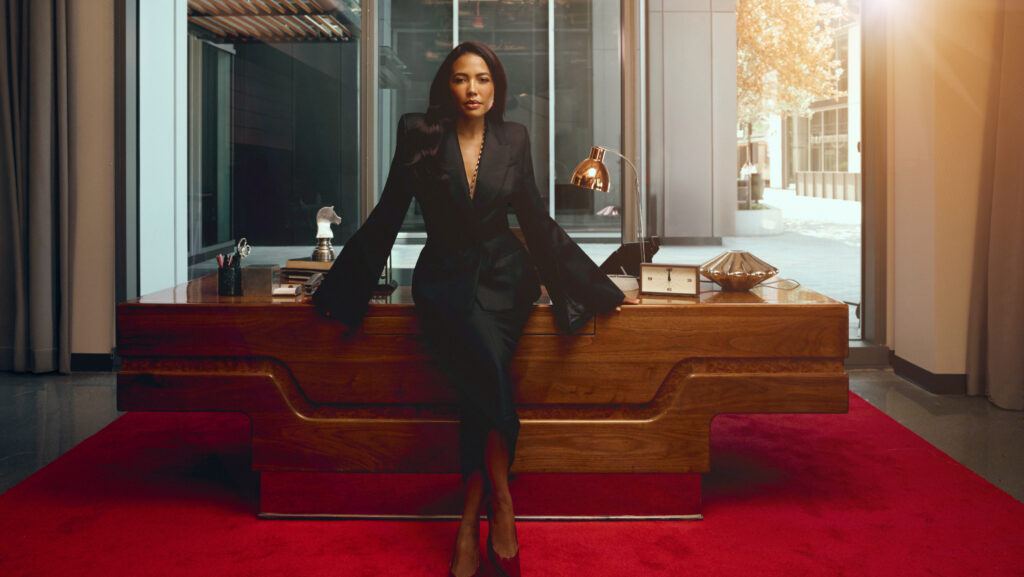


From plus-size fashion disrupter to wine entrepreneur, the supermodel has never stopped expanding what’s possible, for herself or for the women who look up to her.
This story appeared in Boardroom’s Summer Issue print magazine and has been adapted for online publication.
Much ado has been made about Ashley Graham’s laugh. So much so that it’s referenced in almost every interview I read ahead of our conversation. When she joins our Zoom meeting on an unseasonably warm day in April, it’s quickly apparent why. Hers is the kind of deep, raucous belly laugh that makes you feel as though you’ve just shared an inside joke with a friend of a decade-plus, not someone who has been on the cover of dozens of magazines, has walked the world’s most glamorous runways, and boasts a casual 21 million Instagram followers.
Today, though, her priorities are relatively straightforward. A few meetings, this interview, and then finally: date night with her oldest son. Each kid gets a turn at weekly date night, she explains, and he gets to pick the activity. “It rotates between going to the arcade, going to the pet store, going to get a hamburger, or going and getting some ice cream, or maybe going on a hike.”
“I almost came home with a guinea pig last week!” (Imagine, for a moment, almost selling a guinea pig to a supermodel.) “My 4-year-old’s looking at me with his big, big, beautiful eyes and he’s, like, ‘I’ll take care of him. I promise.’ And I’m just, like, ‘No, you won’t.’”
Now a mom of three, Graham and her husband, director and cinematographer Justin Ervin, moved from NYC to New Jersey a few years ago to accommodate their growing family. “I got pregnant with my twins, and I was looking for a family of five that looked really happy in Brooklyn, and I couldn’t find any,” Graham says, laughing.
Her beginnings are just as humble as she comes off today. When she was just 12, Graham was discovered at a mall in Omaha, and her first gig was modeling bras for a now-defunct Midwestern chain. She spent several years as a successful catalog model, booking enough jobs to warrant a move to NYC. A turning point, though, came in 2010 when she was cast in a controversial Lane Bryant ad that almost got taken off the air for being “too risqué,” though to a modern viewer, it’s rather PG. “It put me on the map, and it started a conversation,” she told Vogue in 2019. Previously relegated to more catalog opportunities, she credits her 2016 Sports Illustrated cover as the moment the editorial world started taking her seriously.
Despite spending nearly 20 years in New York, the 38-year-old had no trouble adjusting to life outside city limits. “It feels like we live in a tree house. We’re in a proper neighborhood, but it’s mini. Everybody has a couple acres at least. When you walk outside, it’s just an oasis, and there’s bamboo everywhere. It kind of feels like an L.A. house in the middle of Jersey.” Plus, she still spends a lot of time in NYC — and Europe, and L.A., and Dallas. “Before I had kids, I think I was on the road 60% of the time. Now it’s been reduced to probably about 40% of the time. I totally crashed out one day and said, ‘I just can’t do it anymore.’”
Recently, her family of five even added a new member, one that’s been gestating for over three years. “I always call Lucci the fourth baby that my husband wouldn’t let me have,” Graham says.
Launched in February, Lucci is her new wine label that produces Lambrusco — a dry, sparkling red — in Emilia-Romagna, Italy, a region just north of Tuscany. Now, if you find yourself trying to recall whether you had Lambrusco that one time at your aunt’s or if that was just fizzy grape juice mistakenly grabbed from the kids’ table, well, same.
“We heard no all the time” at first, Graham says. As to why, she tells me the initial feedback was two-pronged: One, celebrity alcohol brands are a dime a dozen these days. Check. Two, people are drinking less these days. Check, check. But I can’t help but suspect there was a secret third thing: Even among drinkers, how often is Lambrusco the go-to?
“In the ‘80s, Lambrusco was the No. 1 import wine in America,” Graham informs me. It was light, fizzy, and reminded people of cherry cola, confirms sommelier Ryan Tingle. In other words, it was basically the OG hard seltzer. At its peak, the U.S. was importing millions of bottles a year, but as it got more and more mass-produced, the tides turned. “When it got cheap and sweet, Americans thought, ‘Well, why am I drinking this? I don’t want anything to do with it,’” Graham says.
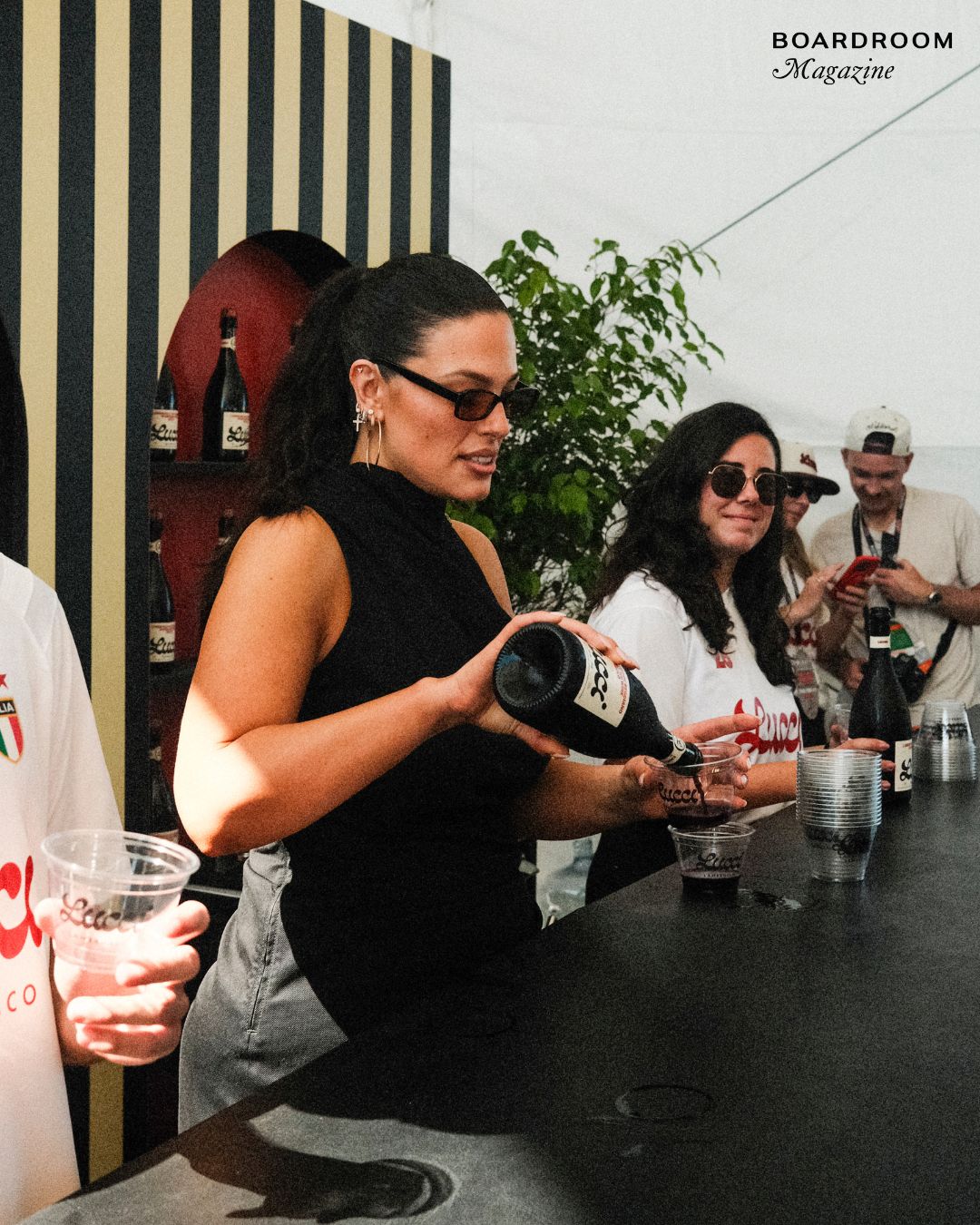
For Graham and her business partner of five years, Danny Epstien, that falloff signaled a market opening. “When I spoke to other people and realized that they also loved Lambrusco, but nobody could name a single brand, I knew that we had a real opportunity,” Epstien told Boardroom in an email. “It’s pretty rare to find something where people love the category but can’t name a single brand they like.”
The idea solidified over dinner at L.A.’s Bestia.“They always had a really great Lambrusco wine list,” Graham says. “And Danny and I, for a good year or so, we were going there, consistently drinking the Lambrusco on double dates, having business meetings there. And Danny said, ‘This is something we both love. Why don’t we make a Lambrusco together?’ And I thought, Well, how the hell do you make a Lambrusco? I don’t know anything about wine.” She and her husband had once dreamed of buying a vineyard and creating a red called Full-Bodied Wine — a kitschy play on her career as a trailblazing curvy model — but quickly abandoned the idea after looking into how much work it is to actually operate one.
“I thought, Well, let’s look on the back of the bottle and see where this stuff is made. I ended up DMing the winemaker right then and there at the dinner, and the next morning woke up to a message with, ‘Hey, we’d love to work with you. Is this really you?’ And it was really me and it was really them. We flew out to Emilia-Romagna a couple months later.”
Plus, while its U.S. popularity dimmed from its ’80s heyday, the bubbly drink has remained a local mainstay in the region for decades, especially as it’s begun to experience a bit of a renaissance in the last decade. It’s an exceptional food wine, says Tingle, who lives part-time in Tuscany. Plus, it’s relatively cheap. “If you’re in Bologna, you’ll find 10 different varieties at one small wine bar.”
Stateside, though, Americans are drinking less — of everything. A Gallup poll last year found that just 54%of Americans reported drinking alcohol — the lowest share recorded in the survey’s 90-year history, and that number drops down to 50% for the 18–34 age group. What’s more, a record-high 53% think that drinking in moderation, aka one or two per day, is bad for one’s health.

“The consensus is that even though people are drinking less, they’re drinking smarter,” Graham says. “When you go out and you have a drink, you want to know — if it’s tequila, vodka, wine, whatever—you want to know where it’s coming from. You want to know if it’s organic or if it’s clean. You want to know what country it’s from. All of that stuff matters.”
“We really wanted to focus on the alcohol content not being too high and the sugar content not being too high. So when we finally started hearing yeses about two years after banging down every door, [we knew] it was because the liquid was so good,” Graham says.
“I think a lot of people lose motivation or excitement when things are tough and take longer than they expected,” says Epstien. “She’s been a true partner in every sense as we’ve built this. There’s no task too small — she’s down to do whatever it takes.”
“It has really been a labor of love,” Graham adds.
Rather than being intimidated by the initial pushback Lucci received and some of the weakening signals in the beverage category, Graham seems to operate exclusively from a mindset of “challenge accepted.”
As one of — if not the — world’s preeminent curvy supermodels, Graham applies the same attitude to the current state of the body-positivity movement, which, in 2026, is at a sort of inflection point: If the 2010s brought us “All About That Bass” and BBLs, the 2020s have brought buccal-fat removal and the return of weight-loss culture.
In hindsight, while it wasn’t all positive (see 2016, generally), many trends of the previous decade represented a somewhat idyllic era of self-acceptance and inclusivity. The dawn of social media gave us makeup-free selfies and created space for communities of people who didn’t see themselves reflected in mainstream media. Women were showing photos of Kim Kardashian to their personal trainers and embracing their curves. Apparel and beauty brands were clamoring to release size- and shade-inclusive product ranges, lest they be publicly shamed for not doing so. The tide seemed to be shifting away from the diet culture and unrealistic standards that dominated the ’90s and the aughts.
And then GLP-1s hit the scene, and it’s easy to feel as though we collectively hit the mute button on all of that. Adoption has been exponential: As of fall 2025, the percentage of Americans who report using injectable weight-loss drugs rose to 12.4%, more than doubling from 5.8% reported 18 months earlier. The apparel industry is already feeling some effects — intimates brands report higher sales in smaller size ranges, and consumer spending on athletic apparel and athleisure is up. It’s the same story in the world of luxury fashion as well. The Vogue Business size-inclusivity report from 2025 stated that amid the so-called Ozempic effect, plus-size looks represented only .3% of the looks shown during fashion week globally, down from an already low .8% the season prior.

But Graham isn’t rattled. “I’ve always been a glass-half-full kind of girl,” she says. “There is more accessibility; there’s more visibility. I’ve never seen this many plus-size creators in my life. I think it’s the coolest thing ever. When I first started on social media, you didn’t see any of this,” she continues. “If we focus on the people who are making clothes for you [now], and you look back at the people who weren’t making clothes for you just 10 years ago, it is a vast difference.”
Today, Graham herself is one of those people. Last fall, Graham teamed up with JCPenney to release an exclusively plus-size clothing line, marking the launch with a conceptual campaign called Omitted that references an oft-cited stat from a 2016 Plunkett Research study: that the majority of women — 68% — wear plus-size. In the trailer for this spring’s collection, she hammers home another: “Plus-size fashion was a $250 billion industry in 2025.” Many studies place that amount even higher, while also forecasting steady growth over the next decade. Yet, despite that, “only 10% of brands design for us,” Graham continues in the campaign.
“More retailers haven’t invested in plus-size lines, in part, because manufacturing apparel in extended sizes requires extra fabric, and companies can’t necessarily pass the higher costs to consumers,” states a 2021 CNBC article. “Producing apparel in extended sizes also means maintaining more inventory, which can be a liability.” Plus, even when brands do make the decision to offer more size options, they don’t always get it right — frustrating shoppers with minimal size ranges in store and forcing them to shop online, or not tailoring their products to properly fit curves.
“There are brands that said that they were inclusive, and they just went up to an XL, maybe a double XL. Was that inclusive? No,” Graham says. “You just kind of went up a little bit. Your grading wasn’t correct. You didn’t have fit models. You didn’t even explore what that looked like.”
As creative director, Graham knew that for the JCPenney line to be successful, it had to nail those things, that employing the right fabrics, stitching, and construction would be key to serving a customer who too often gets the short end of the stick. “It’s really about the quality and the cut of the clothes, and that we have nailed. We have nailed the darts. We have nailed the pants and the jackets. Everything fits with precision, and everything is trending currently. It’s not four seasons later, like a lot of plus-size brands,” Graham says. So far, a lot of the customer reviews echo that sentiment, but of course, you can’t please everyone.
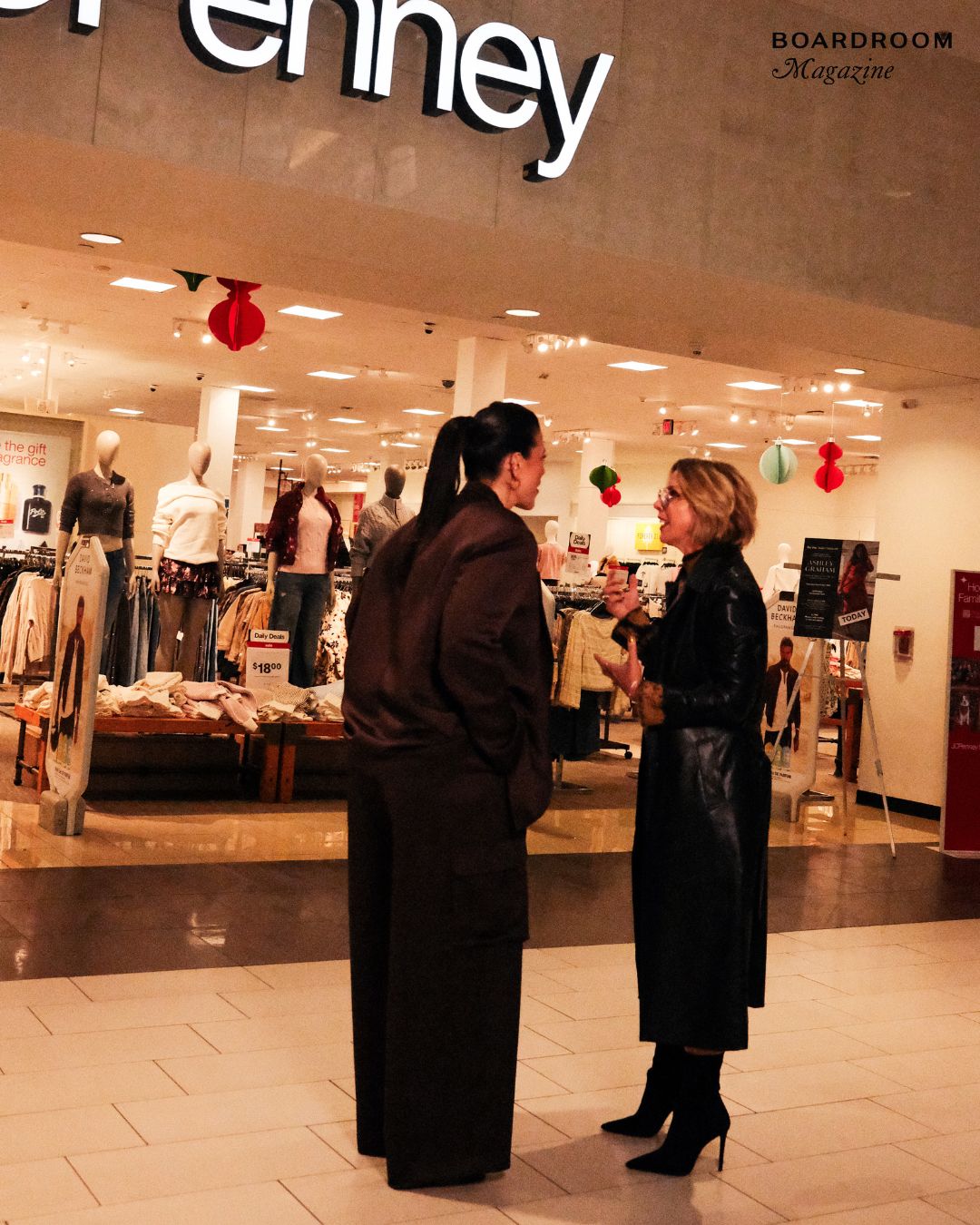
Beyond expanding her résumé, the collaboration represents a full-circle moment for her, as Graham previously worked as a catalog e-comm model for JCPenney when she was a teenager. “I grew up going and getting my picture taken there with my family. My mom used to get her hair cut and blown out there. It was our one-stop shop.” The nostalgia, coupled with the appeal of being able to create a space for her customers to shop in person, sealed the deal.
“What’s really cool is to see the girls going in and shopping and seeing how exciting it is that there’s a 3X, there’s a 4X, there’s a 5X for you. And it’s not just online,” Graham says. “It’s not, ‘Buy all three sizes and return what doesn’t fit,’ and that’s what it should be. I’ve been fighting for so long for visibility and representation, and now is the time to just keep going.”
The point is, there’s still a huge segment of shoppers who are massively underserved by the apparel industry’s current offerings, and money to be made by brands willing to make some adjustments. As Mallorie Dunn, an adjunct faculty member at the Fashion Institute of Technology, recently told CNBC, “Even if GLP-1 drugs did significantly reduce the amount of plus-size consumers, we still would be nowhere near overproducing plus-size clothing.”
“With the rise of so many different kinds of medicine that are helping with weight loss,” Graham says, “I think that that has brought in a different conversation that really doesn’t have anything to do with plus-size fashion. I say that because people are going to lose and gain weight for the rest of our lives. That is never going to go away.” Miracle drugs come and go, but bodies changing is forever.
Lucci’s tagline is “For every occasion or none at all,” Graham tells me when I ask about how she’s thinking about marketing a bubbly wine, something that for many is reserved for special occasions. “There’s always something to celebrate, or there’s also something not to celebrate,” she says, laughing. Truer words. The people of lower Manhattan must agree, because when I went to pick up a bottle from the Flatiron Eataly, the saleswoman told me there were only two bottles left. I asked if that meant it’s been selling well, and she promptly responded, “Oh, yeah. Like, really well.” It would seem the people have spoken, and they are ready to embrace the Lambrusco once more.
While her self-described fourth baby is only a few months old, and she’s busy working on the next collection with JCPenney, Graham isn’t slowing down any time soon.
“I am currently working on finalizing what will be my fifth baby,” Graham teased, noting that the project, coming later this year, is in a totally new sector for her — not apparel or food and bev. “I feel that it’s going to be incredibly disruptive and also true to me as a mom and a lady in fashion.”
But for tonight, the priority is her actual baby, which means maybe a trip to the pet store. I joked that Lucci is such a cute name, it almost works for a human baby. “You know what’s so funny? Somebody literally just said that to me,” she replies. “Maybe I could have a dog named Lucci.” Or, depending how tonight goes, maybe a guinea pig.”
Read More:
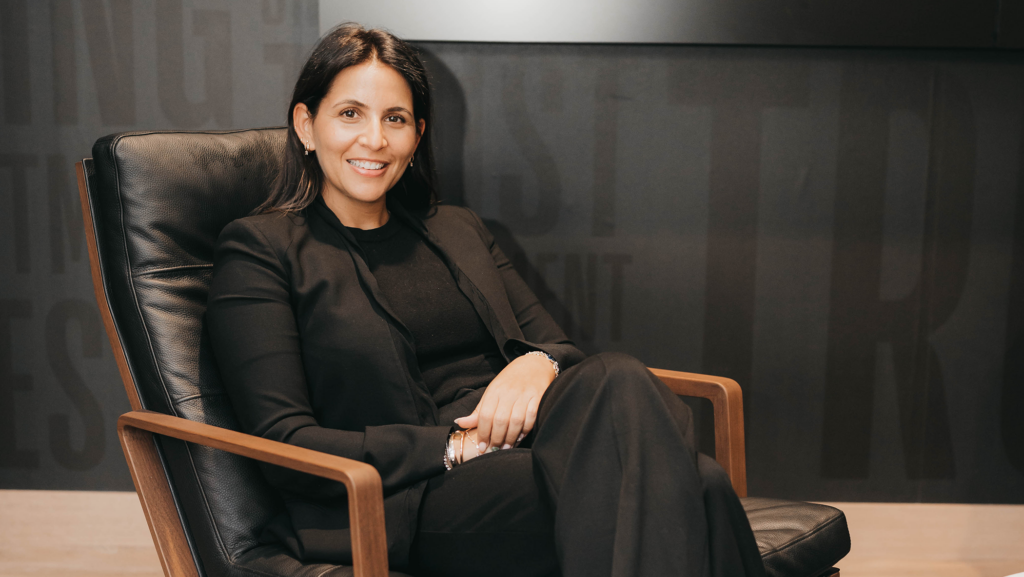
There Is No Offseason: KLUTCH Sports Group COO Fara Leff on Commanding the Sports Calendar
Michael Che Opens Up About SNL, Kanye, Colin Jost, Cancel Culture, & Comedy
Red Hook Tavern: Where Billy Durney Wants to Know Your Name
Keanu Reeves’ Next Act Is Built on Two Wheels

The Blueprint: Jessica Holtz Meets the Moment