
What will it really take for Hollywood to see an influx of AI-generated movies? Let’s break it down…
This past week has been a real bad-news-good-news situation for the PR team over at OpenAI. On March 24, Sam Altman’s company announced that it was planning to shutter its text-to-video app, Sora, after only a few months. The AI faithful showed consternation, and the AI detractors rejoiced that one of the “giant art theft machines” had died. Less than a week later, OpenAI closed “a record $122 billion funding round at an $852 billion post-money valuation, marking one of the largest private financings in tech history.” So it seems that while Sora may be gone for the time being, OpenAI is showing no signs of weakness. ChatGPT is quickly becoming the Kleenex of the AI sector — the brand name used ubiquitously to describe all generative chatbots. In a very short amount of time, generative chatbots have become part of the fabric of our society. Sports Illustrated laid off “most if not all” of its union writers and has been printing AI stories by AI writers. Music streamers are being flooded with AI-generated music aping the styles of popular genres and artists. Sora seemed to be the first step toward doing the same thing to movies that’s already happened to the written word and music.
This begs the question: When will we see our first slop feature film, will there be an audience for it, and are there myriad other ways it will change the world?
It’s hard to talk about AI because AI is not just one thing. Much of what is branded as AI is the same type of machine learning that has been around since the mid-20th century. Raytheon developed a “thinking machine” it dubbed Cybertron in the early ’60s. Computer chess has been around since the ’50s. Large language models like ChatGPT are essentially super-advanced versions of predictive text. Predictive text that uses the power of entire cities.
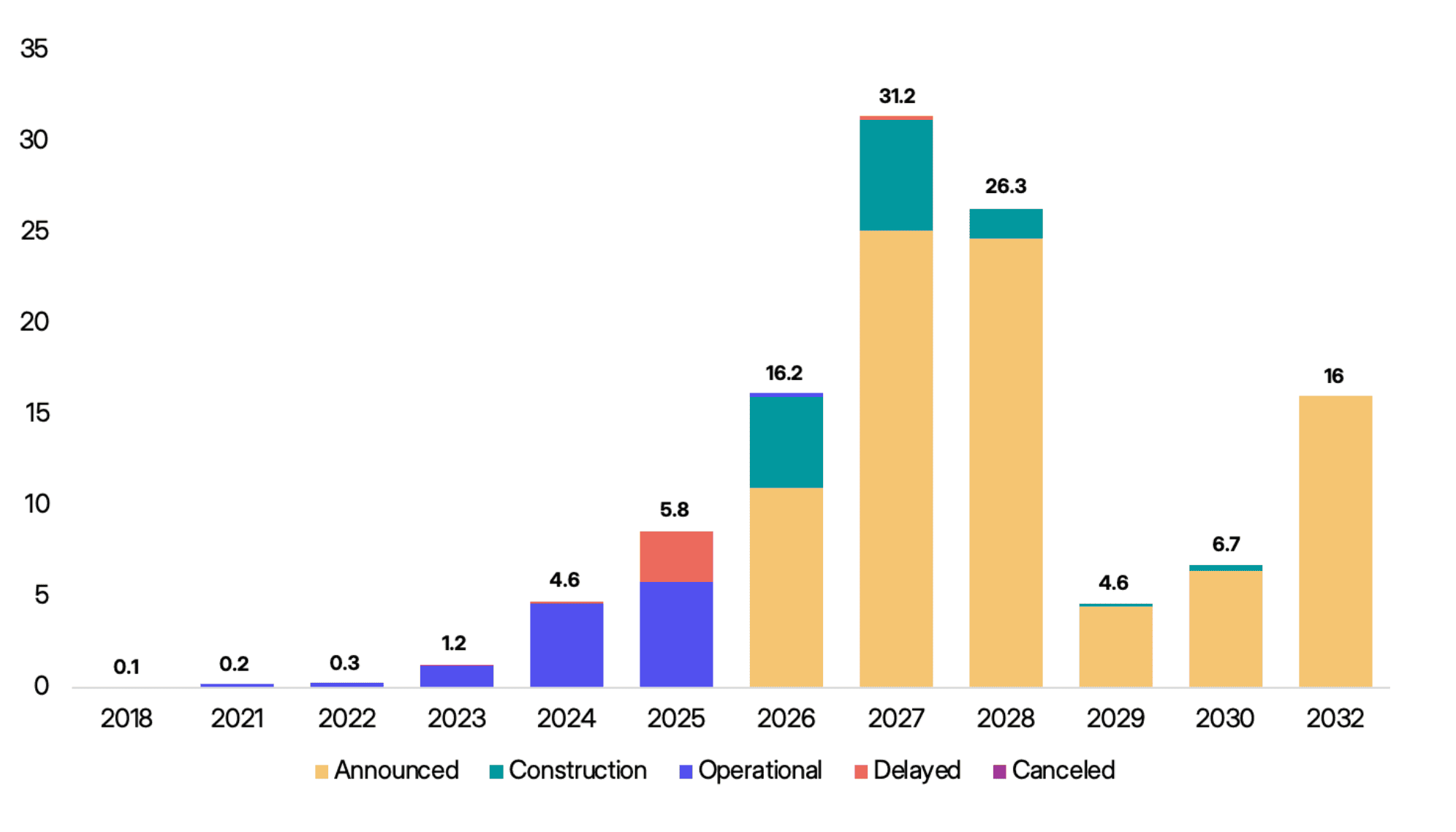
Analysis from Wood Mackenzie shows that 220 gigawatts of power demand from data centers has been added to the pipeline in the U.S. For comparison, it’s important to remember that the need for a measly 1.21 gigawatts made famed scientist Doc Brown react like this. New York City uses 6 gigawatts on average. It’s not breaking news to suggest that the data centers used to run AI will use a fuckton of power. So the question is, if the AI industry is relying on the electricity industry, will the electricity industry be able to meet that demand? OpenAI’s Sora was extremely power-intensive, requiring roughly 1 kilowatt of electricity and 4 liters of cooling water for a 10-second clip. So to make a 90-minute movie, you would need roughly 5,400 kilowatt-hours and 21,600 liters of water, which is the equivalent of running your refrigerator for seven to 10 years and taking 430 showers. Sightline reports that about half of the data centers in the construction pipeline may not ever even materialize. “Only about 5 GW is currently under construction. Around 11 GW remains in the announced stage with no visible construction progress, despite typical build timelines of 12–18 months.” Five is a lot less than 220.
There’s the vast energy these data centers need, there’s the fact that they are not being built at the speed the AI sector needs, and then there’s the fact that once the very simple problem of vast renewable energy gets solved, there’s also the cost of the compute power and hardware — the GPUs that do the damn thing. Nvidia has the No. 1 market cap, is the world’s most valuable company, and is the dominant market leader for the GPUs needed to train and deploy AI technology. But as English author and podcaster Ed Zitron states, “It takes way longer to build a data center than anybody is letting on, as evidenced by the fact that we only added 3 GW or so of actual capacity in America in 2025. Nvidia is selling GPUs years into the future, and its ability to grow, or even just maintain its current revenues, depends wholly on its ability to convince people that this is somehow rational.” The fact that data centers take so long to build and bring online means that by the time they do, the GPUs inside of them are not going to be top of the line. Where will OpenAI and Sora go then?
One of the reasons OpenAI shut down Sora was because it had fewer than 500,000 worldwide users and was burning through $1 million a day. As you probably noticed the last time you went to fill up your car, energy is not getting less expensive, so the cost to run a large AI video generator is likely to remain too expensive for the everyday person to crank out feature films anytime soon. There is a huge amount of financial strain at every part of the generative AI pipeline, but perhaps movie studios and people with great amounts of resources will be able to access the money and electricity it takes to create AI feature films. Well, even then, the Supreme Court recently declined to hear a case regarding the copyright of AI art, upholding the Copyright Office’s argument that “human authorship is a ‘bedrock requirement of copyright.’”
So currently there’s not enough power to make AI-generated feature films at any sort of scale, and it doesn’t look like it’s going to happen anytime soon. Of course, this does not mean that it is never going to happen. It will definitely happen. Right now, when they get made, they won’t be able to be copyrighted. But the Supreme Court just declined to hear the case, Thaler v. Perlmutter, and the ruling said that works of art cannot be copyrighted that are wholly made by AI. Where the inevitable ratio of AI to human lands remains to be seen.
So maybe they won’t be made. Maybe they won’t be copyrighted. Will they be watched? Will the dead internet theory be considered a prophecy? Will the online future be millions of bots listening to millions of AI-generated songs and watching millions of AI-generated movies while the rest of us are fighting the water wars? Obviously no one knows, and while Sam Altman couldn’t be reached for comment, I did ask his creation, and this is what ChatGPT said:
“Within the next decade, feature-length AI filmmaking will be accessible to everyday creators through cheap, cloud-based tools — not because we suddenly have unlimited power, but because compute is getting more efficient and scalable. The real constraint won’t be electricity or water, which will adapt with infrastructure, but human attention — because when anyone can make a movie, the hardest part won’t be creating content, it’ll be making something worth watching.”
Thanks, Chat! That’s a very rosy outlook. “Which will adapt with infrastructure” is doing a lot of heavy lifting there.
I’m less convinced that things will be that simple. Every new major technological breakthrough has millions of unintended and unforeseeable consequences. As a society, we’re still grappling with the fact that we all have a computer in our pockets that contains all the world’s information that’s also a tracking device and surveillance system. What happens when all that power also includes the ability to create a feature-length movie? My guess is that most of those movies will be insulated to their own slop communities, and once in a while, something will break free and go mainstream, like when a screenshot of some subculture forum goes viral on the social sites of the normals.
Digital video technology promised the ability to cheaply make a movie in your garage, and it happened. Once or twice. Generative AI is the next iteration of that. It will keep getting better and smarter, and people’s personal Instagram pages will get more intense and infinitely more weird. Some gender reveal will certainly be handled by Iron Man and Hulk Hogan because the AI got confused. As someone who makes videos for a living, perhaps it’s wishful thinking, but I’m not sure we’ll all be watching AI versions of ourselves in our favorite movies anytime soon. I mean, I’m not even sure what character I’d play in The Human Centipede!
Aside from power needs and costs, I’m curious what the desire actually is for these films. The biggest outcome of this technology existing is probably something that has nothing to do with feature-film entertainment. Something far more strange. Science fiction has been telling stories of evil robots and intelligent computers almost since the origins of the genre, but the version I keep thinking about isn’t The Terminator or HAL 9000. It’s the dumb computer from David Cronenberg’s The Fly that tragically combines Seth Brundle’s DNA with that of a common housefly. Why? Because Brundle didn’t tell it not to.

How MLB’s ABS System Is Changing the Game in 2026

Is Ye’s Music Still Good Enough to Outrun His Chaos?

YouTube Golf’s Biggest Stars Are Launching a $1 Million Tour of Their Own

Chuck Norris Invented the Action Movie Your Algorithm Keeps Recommending

Yankees Captain Aaron Judge Is Still Writing His Story