Boardroom is a sports, media and entertainment brand co-founded by Kevin Durant and Rich Kleiman and
focused on the intersection of sports and entertainment. Boardroom’s flagship media arm features
premium video/audio, editorial, daily and weekly newsletters, showcasing how athletes, executives,
musicians and creators are moving the business world forward. Boardroom’s ecosystem encompasses B2B
events and experiences (such as its renowned NBA and WNBA All-Star events) as well as ticketed
conferences such as Game Plan in partnership with CNBC. Our advisory arm serves to consult and
connect athletes, brands and executives with our broader network and initiatives.
Recent film and TV projects also under the Boardroom umbrella include the Academy Award-winning Two
Distant Strangers (Netflix), the critically acclaimed scripted series SWAGGER (Apple TV+) and
Emmy-nominated documentary NYC Point Gods (Showtime).
Boardroom’s sister company, Boardroom Sports Holdings, features investments in emerging sports teams
and leagues, including the Major League Pickleball team, the Brooklyn Aces, NWSL champions Gotham
FC, and MLS’ Philadelphia Union.
Chuck Norris Invented the Action Movie Your Algorithm Keeps Recommending
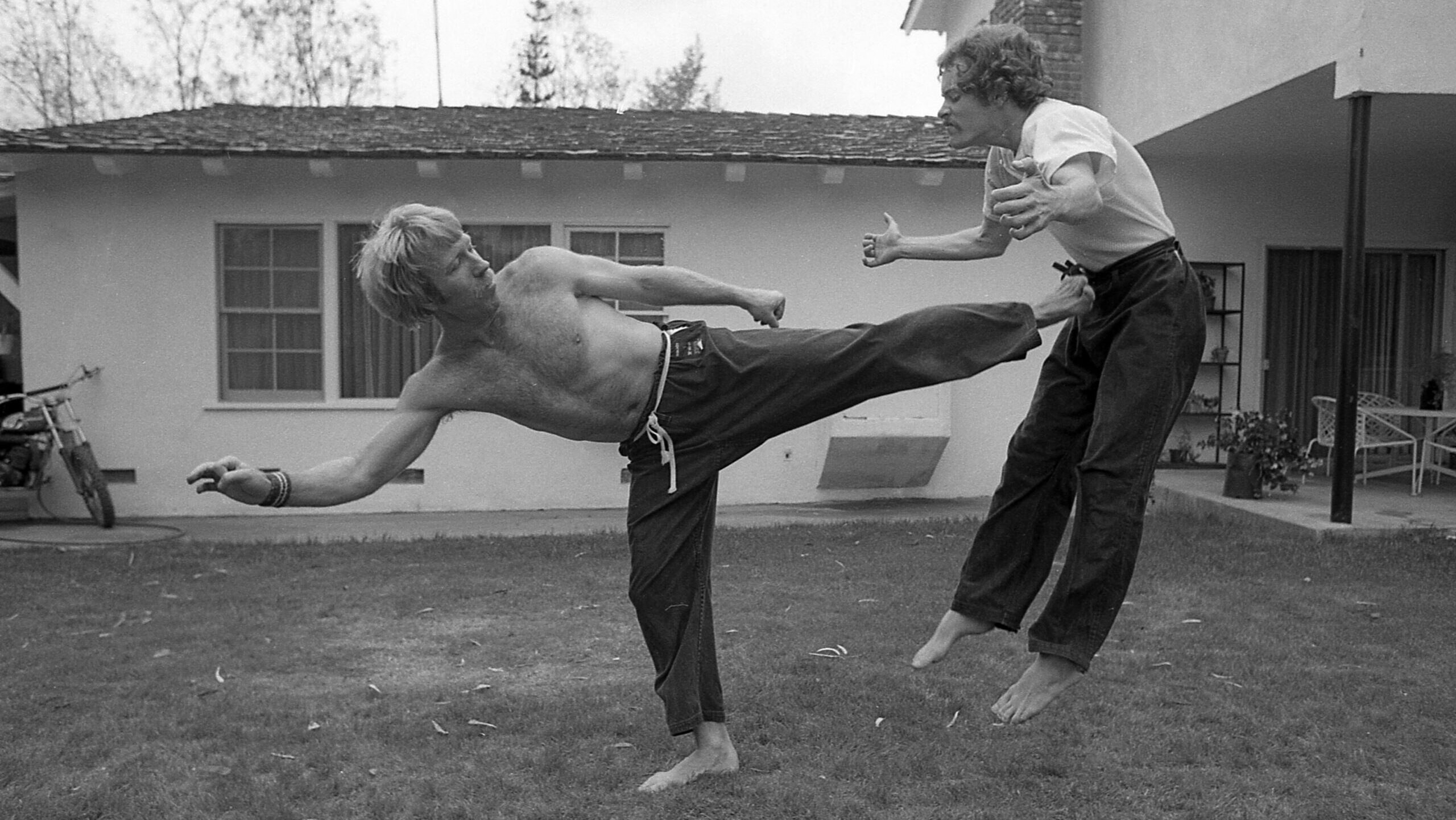
LOS ANGELES - JANUARY 1978; Action hero movie star Chuck Norris practices kung fu style moves with his trainer on the lawn of his back yard of his home in Palos Verdes near Los Angeles California circa 1978. (Nik Wheeler / Corbis via Getty Images)
Share
Last Updated: March 30, 2026
The martial arts star’s straight-to-video formula outlived him — and it’s running your streaming service right now.
Chuck Norris, star of the karate mat, screen, and internet meme, died Friday, March 20, at age 86. Never the most respected thespian, Norris made an indelible mark on four decades of culture — first as a martial artist, then as the star of low-budget action movies, then a television star, and finally, as one of the original internet memes. The product of an alcoholic father and a tumultuous childhood in Oklahoma, Norris enlisted in the United States Air Force as a patrolman and served in South Korea. It was there that he first picked up martial arts and began the journey that led to strangers on the internet making exaggerated claims about his physical abilities, mental prowess, and ability to intimidate celestial bodies. Without that experience, he would never have become a pioneer of American martial arts on-screen stars nor a forebear of the streaming economy that makes up most of what you watch. Yes, you. Your media diet is arguably as influenced by Chuck Norris as it is by Ted Sarandos.
Carlos Ray “Chuck” Norris began his career in Hollywood in the late 1960s as a martial arts trainer to the stars. It was one of his students, icon Steve McQueen, who suggested he pursue an acting career after retiring from competitive karate. But it was another friend from the movie business who gave him his first big break. While competing in the Karate Tournament of Champions of North America, he met Green Hornet star Bruce Lee. After The Green Hornet became a success in Hong Kong, Lee starred in several films from the legendary Hong Kong studio Golden Harvest. Lee’s final film released in his lifetime, 1972’s The Way of the Dragon, culminated with an epic fight set and shot in Rome’s Colosseum. Lee selected for his opponent his friend Chuck Norris.
After that break, Norris bounced around Hollywood for a few years before landing two starring roles in Breaker! Breaker! and The Good Guys Wear Black, the latter of which grossed $18 million ($94 million in 2026 dollars) on a $1 million budget, setting the stage for Norris to be the reactionary action star of Reagan’s America. Norris, a religious conservative who didn’t drink or film sex scenes in his movies, had no problem filming scenes of the violence he inflicts on the “lunatics, haters and punk-trash” overrunning America — a perfect movie analog to the Gipper’s America. A huge part of Reagan’s appeal was a rebuke to the perceived failures and social change of the ’60s and ’70s and a return to a fantasy version of the ’50s. The ’50s-set Happy Days was on TV, Hall & Oates were covering The Righteous Brothers, and here was Chuck Norris — an ’80s John Wayne, only he knew karate.
Stay Ahead of the Game, Get Our Newsletter
Subscribe for the biggest stories in the business of sports and entertainment, daily.
When the ’70s came to a close, multiple icons of the hallowed New Hollywood era released a string of ambitious yet disastrous box office bombs — Scorsese’s New York, New York, Coppola’s One From the Heart, Friedkin’s Sorcerer, and the film that became synonymous with flop, Cimino’s Heaven’s Gate — and, consequently, shut the door on an entire style of moviemaking. ’80s Hollywood became a post-Jaws, post-Star Wars boom for braindead blockbuster filmmaking (many of which I love). Larger studios saw the money that could be made from putting A-movie budgets behind what were formerly thought of as B-movie topics (Sharks! Space wars!). Smaller studios saw the money that could be made from ripping off those same movies. For every Star Wars, there was a Battle Beyond the Stars. For every Jaws, there was an Orca. This shift in genre output coincided with the rise of VHS home video, which for two decades provided a highly valuable secondary stream of studio revenue and provided an entire ecosystem where lesser stars and smaller studios could crank out low-budget genre movies to the delight of undiscerning moviegoers everywhere. What were once the type of films isolated to the grindhouses and drive-ins could now be right in your home. A plethora of films swam in Jaws’ wake, and the secondary VHS market allowed them to prosper in a way they had been previously unable.
It was under these conditions that Chuck Norris thrived. There was a large market for action movies. A new conservatism was sweeping the nation post-Watergate, with images of action heroes clad in the American flag populating the silver and small screens. Norris made eight films with schlock legends Cannon Films between 1985 and 1990, including Missing in Action, whose producers stole the idea from James Cameron’s treatment for Rambo 2, which had reportedly been floating around Hollywood — then beat Sly to the theaters. Missing in Action had the same “Vietnam but we win this time” ethos as Rambo: First Blood Part II. It set the template for Norris’ other reactionary projects like Invasion U.S.A., where Cuban and Soviet communists attempt a reverse Bay of Pigs on the U.S., and Delta Force, a fictionalized retelling of the hijacking of TWA Flight 847. Norris’ films would continue to reimagine American history where we win, the bad guys are punished, and the good guys wear black.
Chuck Norris’ deal with Cannon was modeled very much in the style of the old Hollywood system. The studio had him under contract and would slap him on a poster for a film yet to be shot. With Norris, it usually worked. His films were low-budget consumable action movies that routinely made a profit, and as the ’80s came to a close, this became the formula for an entire segment of movie releases: the action video release. Throughout the ’90s and early 2000s, this concept of taking a recognizable name, slapping their photo on a poster, and cranking out a genre film was the bread and butter of the straight-to-video economy.
Once Norris and similar stars like Steven Seagal and Jean-Claude Van Damme were no longer bankable as theatrical stars, they became fixtures in the action video world. The box office success of Taken further extended the careers of geriatric action stars. Redboxes around the country were full of “geezer teasers.” Stars like Bruce Willis, Nicolas Cage, John Cusack, and even Robert De Niro would go on to make films with titles like Heist, Vendetta, Blood Money, and Kill Chain, respectively. None of this would have happened without Chuck Norris proving that the system worked — that the formula was bankable. As the home movie market collapsed with the rise of streaming, the Redbox action movie didn’t die; it simply became Amazon’s The Tomorrow War and Netflix’s Extraction. The movies you see on your endless scroll through streaming services are there because Chuck Norris proved they were a good idea to make.
Norris would find a second star career as the lead in Walker, Texas Ranger, created by the Oscar-winning writer-director of the abominable Crash, Paul Haggis. It ran for 203 episodes and kept Norris in our homes and on our screens long after he was a bankable movie star. It also calcified the persona of unflinching toughness that would be parodied on the internet in one of the earliest viral memes, iterated upon and repeated all across the internet. More people under the age of 35 probably know Norris as a meme than as an action star or as the first major American martial arts movie star. Would we have John Wick without Chuck Norris? I’d argue no.
Whatever your opinion of Chuck Norris’ acting, politics, or athletic career, what is undeniable is the impact he had on the culture writ large. He defined a specific kind of Reagan-era jingoistic filmmaking, an economy of film distribution, and an entire genre of internet joke. Look around, and you’ll see we’re all still living in Norris’ America.