


Why is it that the more an athlete wins, the more the goalposts shift? Exploring how success reshapes expectations, normalizes greatness, and changes how athletes are judged over time.
This story originally appeared in Boardroom’s Summer Issue print magazine and has been adapted for online publication.
I watch a deep playoff run get dismissed because it didn’t end in a ring. A 40-point game expected, not celebrated. Conversations about legacy growing louder than the games themselves. Every possession framed as something historical. Athletes discussed not as people in motion, but as finished stories before they are even complete.
Because legacy, at its core, isn’t just what someone did. It’s the narrative we decide to attach to it. And that narrative is often shaped less by reality than by expectation.

The higher an athlete climbs, the less we acknowledge how difficult it was to get there in the first place. Winning once is remarkable. Winning again becomes expected. But it doesn’t get easier; it gets exponentially harder. More games. More pressure. More adjustments. More people studying every tendency, every weakness, every pattern. The margin for error shrinks while the demand for perfection expands.
What once impressed us quietly becomes the minimum we require. The achievement doesn’t grow in our eyes, even as the difficulty does. It just resets the baseline. Wins start to confirm what we already believe should happen. Losses, though, carry weight. They linger. They get dissected. And over time, they begin to reshape how we see the athlete altogether.
We normalize greatness so quickly that it stops feeling like greatness at all.
One of my favorite moments from the 2026 Winter Olympics was the way Eileen Gu responded when asked if she viewed her Olympic results as “two silvers gained or two golds lost.” She didn’t just answer the question; she reframed it. She spoke about how every medal is equally difficult. How the framing itself misunderstands the sport. How the world raises the bar without acknowledging how high it already is.
I felt that again, recently talking to Jayson Tatum. I asked him about the relationship between achievement and expectation—how success seems to widen the gap between what someone has done and what people expect them to do next. How his perception has been shaped by the disconnect between success and achievement. He said something simple and honest: If you ask any superstar whether they feel unfairly judged, most would say yes, at least to a certain degree. Not out of frustration, but because it comes with the territory.
To be clear, the expectation of greatness isn’t unfair. It’s foundational. This is what they’ve signed up for. To compete, to improve, to chase something higher than what they’ve already done. The standard is supposed to be demanding. That’s what separates the elite from everyone else. But at some point, that demanding has turned into dismissive. And in that shift, we stop recognizing just how rare it is to meet the expectation at all. There’s a difference between holding someone to a high bar and pretending that bar isn’t already incredibly difficult to reach.
None of this is meant to soften the value of winning. Winning has to mean something. I’d argue it means everything. It’s the clearest measure we have, the standard everything else is chasing. Championships matter. Outcomes matter. They’re the reason the games are played and the reason the stakes feel real. But acknowledging that doesn’t require us to flatten everything that falls short into failure. It requires us to understand just how difficult winning actually is, and to respect the difference between not winning and not being great.
Because the way we talk about athletes doesn’t just reflect what happened. It shapes what it means.
The way we frame wins and losses, what we choose to count, what we choose to ignore — it all becomes part of the record. Over time, those opinions harden into consensus. That consensus becomes history. And once it becomes history, it’s almost impossible to correct. We can get the story wrong and still have that version become permanent.
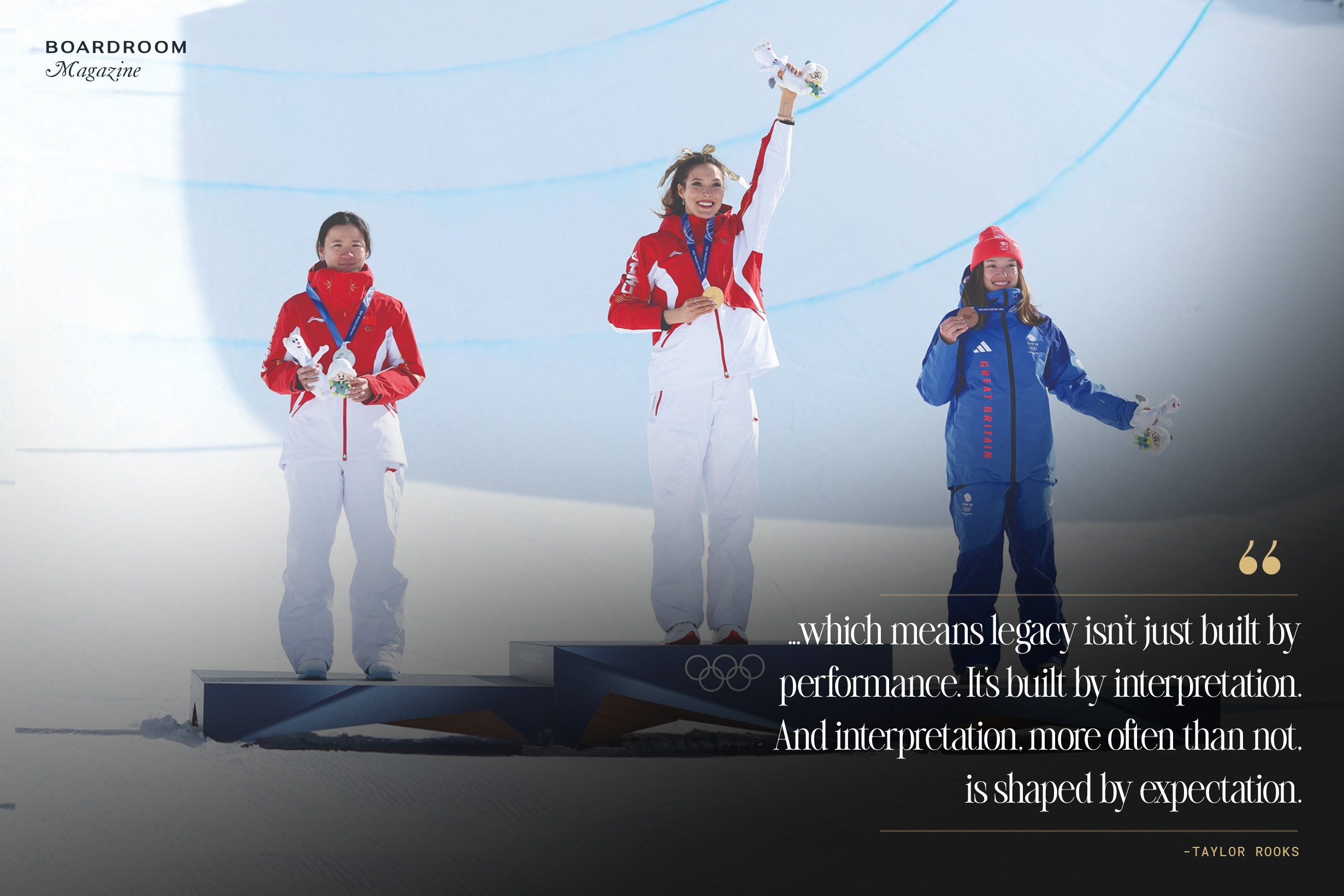
Which means legacy isn’t just built by performance. It’s built by interpretation. And interpretation, more often than not, is shaped by expectation.
We should never ever lower the bar. But we should acknowledge it.
Because without acknowledging the difficulty, any conclusion we draw about greatness is incomplete at best, and wrong at worst.
Read More:

The Blueprint: Jessica Holtz Meets the Moment

The Power Broker: Emma Grede Is Just Getting Going

Quiet Power: Imani Ellis on CultureCon, Creators, and Learning to Let Go

The Long Game: How LeBron James and a Few NBA Friends Might Elevate the Game of Golf

Savannah James and April McDaniel on Navigating Money, Friendship, and Business