

White has turned his competitive drive into entrepreneurship, building WHITESPACE, founding the Snow League, and shaping the future of the sport.
Shaun White is carving down the mountain with his WHITESPACE x Moncler co-branded board to go along with his chocolate brown corduroy Moncler fit, cutting clean lines through the snow as his eyes scan the terrain for every possible launch point. It’s 2026, four years removed from his official retirement from competitive snowboarding, but the muscle memory hasn’t faded. White still makes time to rip, sharing the Corvatsch mountain in St. Moritz, Switzerland, with friends and a select group of Sapphire Reserve cardholders as part of his ongoing partnership with Chase Sapphire.
Hours later, he’s airborne, headed to Italy for the 2026 Winter Olympics, where he was seen broadcasting throughout and enjoying the festivities. Within a single 24-hour stretch, one can see the full scope of what White’s life looks like now. The competition clock may have stopped, but the momentum hasn’t.
This is Shaun White in his next era: an athlete turned entrepreneur, moving with the same precision off the mountain that once defined his runs on it. Every partnership is deliberate. Every appearance is calculated. Whether he’s carving fresh powder, building a brand, or commanding a broadcast booth on the global stage, White remains exactly where he’s always thrived, at the intersection of performance, culture, and purpose.
“Whether I knew it or not, I feel like I was getting a crash course in business and how to run a company, or at least how these brands that were very successful ran their operation,” White said in an interview with Boardroom inside the Carlton Hotel in St. Moritz. “I think as time went on, as I got older, I started taking more interest in it. And then it really took off in retirement, just because it was like, OK, well, what’s the next 10, 15 years look like? I would say it really caught on toward the end of my career, but I’d always been kind of doing those things.”

From the moment White burst onto the action sports scene as a teenager, business has followed close behind. That tends to happen when you’re a three-time Olympic gold medalist and the most decorated snowboarder in X Games history. But White was never just a competitor; he was a brand in motion, even before he fully realized it himself.
The turning point came in 2019 with the passing of Jake Burton, the founder of Burton Snowboards and one of the most influential figures in White’s career. A longtime Burton ambassador, White suddenly found himself at a crossroads. Losing a mentor forced him to step back and take stock, not just of where he’d been, but of what he wanted to build next.
“Nothing makes you think more about life than when somebody passes away,” White told Boardroom. “You’re just kind of like, ‘Gosh, what does my career and legacy look like?’”
That moment of reflection became the spark for WHITESPACE, White’s personal brand and creative vision brought to life.
Fashion had always been part of the equation. With WHITESPACE, White wasn’t interested in simply slapping his name on a product. He wanted to create something that could stand shoulder to shoulder with the legacy brands that once defined the space. The results speak for themselves. WHITESPACE has quickly earned credibility in both performance and fashion circles, including a high-profile collaboration with Moncler, one of the biggest names in luxury outerwear.
“I think it was realizing that skiing and snowboarding have always been a high-end sport,” White said. “It’s like golf. Whether the core of us wants to admit it or not, it is. It’s a leisure sport and a luxury sport.”

Part of the breakthrough came when White realized the goal wasn’t to chase what everyone else was wearing, but to plant a flag that was unmistakably his. He points to a pair of Christian Louboutin shoes as the perfect example.
“I didn’t even know the name of the shoe brand for a while, but I just knew the red sole. … You see the stripe on the [WHITESPACE] board, you’ll know it’s us,” White said. “It was like our calling card, just like the shoe or Moncler’s rooster. It was just like our thing, and that was great. No one’s doing that.”
The idea of recognition without explanation became the guiding principle. The stripe wasn’t decoration, it was a signal, the kind of detail that tells you exactly who made it before you ever read a logo. That instinct to simplify and distill identity into a single, repeatable detail mirrors how White approached competition for years. Find the lane no one else is in, own it, and make it so recognizable that it doesn’t need an introduction.
“My name alone is going to maybe get us through the door, open the door, but it’s not going to get us all the way because buying a board is like a big commitment. We took a lot of time to earn the consumer’s trust with the boards being great, and now we’re in this really wonderful place where word is out that they’re really quality boards and not just me throwing a namestamp on it,” White said.
By now, White’s influence stretches well beyond WHITESPACE. This winter, he’s also the face of KITH’s Team USA campaign for the 2026 Winter Olympics, a collaboration that feels less like a pivot and more like a natural extension of everything he’s been building. The athlete who once defined a generation of halfpipe riding now moves between snowboarding, fashion, and culture with the same ease he exhibited during his legendary runs — calculated, fluid, unmistakably himself.
True to form, the partnership didn’t materialize through layers of corporate choreography. It was simple and organic. White happened to be in New York at the same time KITH Founder Ronnie Fieg was preparing to shoot the campaign. The two longtime friends connected, and just like that, White found himself fronting Team USA on KITH’s global stage. No forced reinvention or hard rebrand. Just alignment.
Fun fact: White says that’s also how his viral Central Park clip — jumping over Shane Gillis on a snowy day — came together. After catching Gillis’s show at Madison Square Garden the night before, the two connected over text the next day. The rest is history.
But it’s not only fashion houses paying attention. Brands well outside the snow and style ecosystem are finding common ground with White’s worldview, including Chase Sapphire, a partnership he admits he never would have imagined earlier in his career. Back then, sponsorships were solely about performance and podiums. Now, they’re about experience and access.
What resonated wasn’t a traditional endorsement pitch, but Chase Sapphire’s emphasis on bringing people together, curating once-in-a-lifetime moments that cardmembers from around the world might otherwise never experience.
“The idea of bringing people together with sport and bringing them somewhere amazing that people dream of coming to … it’s a special thing,” said White. “So when I got the call from [Chase Sapphire] to come do this, I was like, ‘Yeah, of course. I’d love to do that.’”
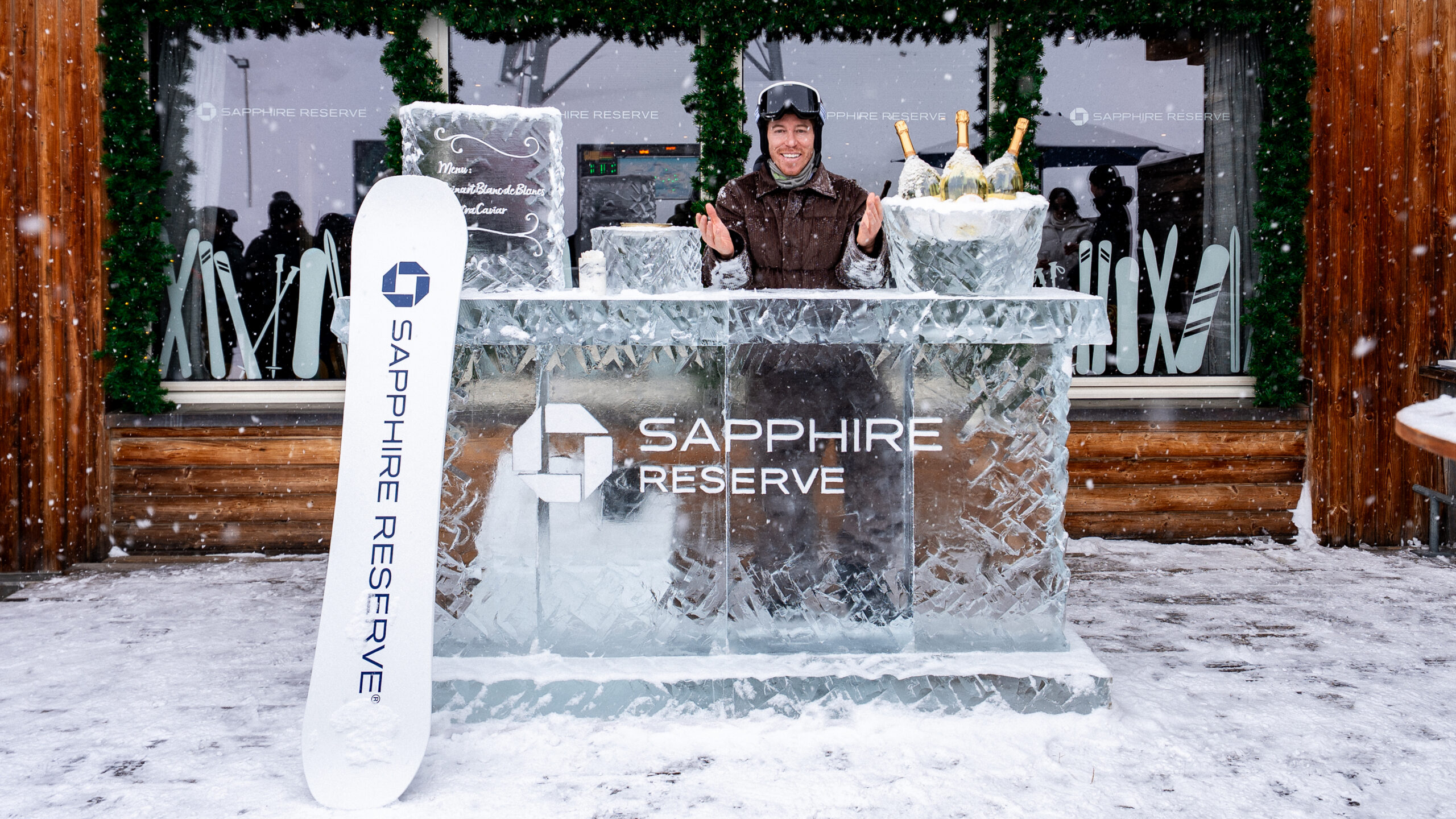
Sharing Corvatsch with a small group in St. Moritz wasn’t a transactional appearance; it was an extension of the same community-driven ethos White has leaned into post-retirement. Even if he himself won’t be boarding at the upcoming Sapphire Reserve trips to Jaipur or London, the through line is clear: connection over clout, experience over exposure.
One scheduled highlight of the Switzerland trip was for White to strap in and deliver a classic halfpipe run for guests, a reminder of the competitive force that once redefined the sport. Weather had other plans, however, and while attendees were disappointed that they wouldn’t get to see The Flying Tomato in full flight, the most disappointed may have been White himself. It was clear the competitive fire hasn’t faded when he carved freely down the mountain earlier in the day, scanning for side hits and natural features, as if the judges were still watching.
“I didn’t really retire because of a lot of physical reasons,” White said. “It was more just like the mental of doing it for so long, what it takes to be at the top. I feel very fortunate that my sport and sports — I guess skating, as well — I can still enjoy them leisurely. I feel like I’m still doing the same things I was doing, just no pressure to compete.”
Because if there’s one thing this next chapter has proven, it’s that White doesn’t need a start gate to move with purpose. He’s simply taken that competitive edge and redirected it. Case in point: The Snow League.
If WHITESPACE is his design laboratory, Snow League is his structural play, a founder’s move aimed squarely at the future of the sport itself. Built to create sustainable earning opportunities for riders, the league gives athletes something White spent years fighting for: a legitimate, consistent platform to make a living doing what they love. It’s not just another contest series; it’s real infrastructure.
And in true White fashion, the details signal intent: Snow League didn’t settle for generic hardware. It tapped Tiffany & Co. to design its trophies, a choice that reframes how snowboarding presents itself to the world. The message is subtle but clear: This isn’t fringe anymore. This is premium, global, valuable.
Still, for all the luxury signaling and high-end partnerships, White is careful not to let the culture drift too far from its roots. No matter how much the sport evolves, even in his competitive absence, he wants snowboarding to remain expansive, not exclusive.
“Tapping into that [luxury] market and catering to those kinds of people and doing events in towns that cater to that audience, but not forgetting the person roughing it in the van. Bring them along, but let’s also usher in this new era of the sport,” White said.
Pushing the ceiling higher without raising the floor is the same balancing act he’s mastered throughout his career. Invite new money and new audiences into the ecosystem, but keep the door open for the kid chasing lift tickets and sleeping in parking lots. Grow the sport without losing its soul.
That’s the real throughline of White’s second act. Not just building brands, not just stacking partnerships, but reshaping snowboarding so the next generation has more opportunity, more access, and more belief that what they love can actually sustain them.
Like his career and the companies he’s built along the way, White continues to evolve without losing sight of what brought him there, proving that progression means nothing if you forget the foundation it’s built on.
Read More:

The Blueprint: Jessica Holtz Meets the Moment
The Power Broker: Emma Grede Is Just Getting Going
Quiet Power: Imani Ellis on CultureCon, Creators, and Learning to Let Go

The Long Game: How LeBron James and a Few NBA Friends Might Elevate the Game of Golf
Savannah James and April McDaniel on Navigating Money, Friendship, and Business