


Backed by Jay-Z’s MarcyPen Capital Partners, the longtime friends and business partners have brought Crown + Conquer, Let It Break, and ‘Everybody’s Crazy’ under one roof with Signed.
This story appeared in Boardroom’s Fall Issue print magazine and has been adapted for online publication.
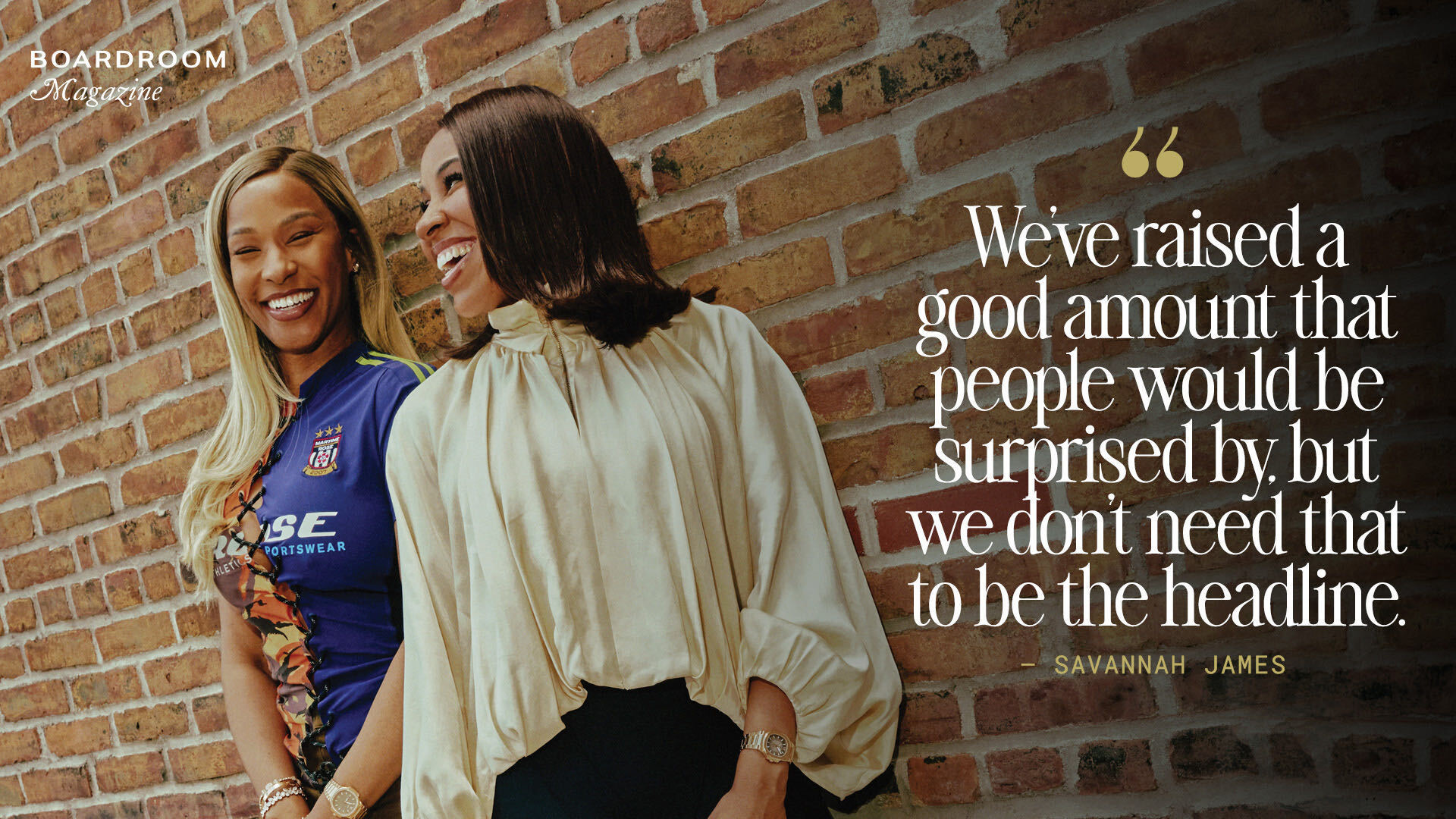
Much like the persona she displays on TV and across social media, Savannah James is Ms. Congeniality in person. She’s warm and kind to everyone she meets, shaking hands with a bright smile and a polite nod as she makes her way through Boardroom’s Chelsea office. She’s here with her longtime friend and business partner, April McDaniel, to discuss their newest venture, Signed, a holding company that will sit above all their other endeavors. But that cordiality briefly dissipates when I put my recorder on the table between the three of us. They both pause and shoot me a side-eye as if I’m trying to pull something over on them.
“It’s just my recorder,” I say.
“OK,” says McDaniel, still a bit hesitant. “I was like…”
The tension eases when she and James let out a laugh and we’re able to get on with the interview and talk about why they’re here today. They’re here to talk about what they’ve built. Not just the new entity, but the totality of it all. Crown + Conquer, McDaniel’s decade-old creative agency, healthy and referral-fed, which has turned down three separate offers to sell. Let It Break, the wellness collective the two of them run for women who, as McDaniel puts it, are maestros of everything and last on their own to-do lists. Everybody’s Crazy, a podcast built on the reckless premise that you let strangers call in and say whatever they want — no vetting, no note cards, nothing. And now Signed, the holding company folding all three into one. It may all seem a bit unconventional: three established businesses rolled up rather than spun out, backed by MarcyPen Capital Partners, the global investment firm created by the merger of Jay-Z‘s Marcy Venture Partners and Pendulum Opportunities. But it makes sense if you consider the context.
They understand the way they read from a distance. Untouchable, unthinkably curated, unmistakably secure. Despite that, James and McDaniel will tell you that nobody has figured it out; that even with their success they’re still working to make it all make sense. That’s the point of the podcast, the point of the wellness operation, and, frankly, the point of the holding company, as well. Getting VC dollars isn’t a given. The data shows that black women get roughly one-third of 1% of all venture dollars. Crunchbase says startups with black female founders received a total of just 0.06% of venture funding in 2018. It’s difficult to build no matter what your status is. Even if you have one of the most famous last names in the country.
For the length of the conversation, they are funny, guarded, sometimes talking over each other and sometimes finishing each other’s sentences — about equity splits and legal invoices and the exact moment an investor told a woman doing $15 million dollars a year in revenue that her business was “cute.”
The interview that follows is about business and growth. And friendship. And belonging. Underneath all of that, it is about the cost of being seen on your own terms. Savannah James has a word for what they have made. “We call it rare.”
Boardroom: What are you on the road promoting?
April McDaniel: We’re launching a holding company called Signed, which we’re really excited about—taking all of the businesses we share together and rolling them into one ecosystem for efficiency, for creative vision. In addition to promoting Everybody’s Crazy, our podcast.
You’ve been working together for a while now, with multiple companies. Can you name a moment where you had a disagreement you had to work through?
Savannah James: Little things, but nothing a conversation doesn’t handle quickly.
McDaniel: In partnership you can agree to disagree, which I don’t think I believed maybe five or seven years ago. I thought it was very black-and-white—a right and a wrong. Now I think you can have two opinions and figure out a way to hear everybody and still make an executive decision that makes sure everybody feels heard. I don’t know that I felt like that coming up in the industry.
Is there a moment you can point to that changed that?
McDaniel: Ownership changed that. When you work for somebody, there’s one way for it to go. When you work for yourself, anything is possible. Before Savannah and I were in business together, I owned my agency on my own. There was no partner. That’s been a growth in being a different type of founder this go-around… Similar to the way Rich [Kleiman] runs Boardroom: He puts people in place who are good at what they know. You hire somebody who’s better at it than you. Some things you may not have an answer for, which is OK as long as the person you entrust does.
Most new shows with new hosts are tightly scripted. Yours is the opposite—the call-ins, it’s madness at times, even though it seems contained. Why that format?
James: We wanted to do something different. The podcast space is very same-same. We wanted to be expressive and show our personalities, and also touch people. We’ve often talked about how people think we’re untouchable. When we get some of our calls, people are like, “Oh, my God, I can’t believe I got through. Is this really April? Is this really Savannah?” And it’s like, yeah—we’re just trying to talk to people who have some form of crazy going on, because everybody does.
Is there a moment where you thought, This is a terrible idea?
McDaniel: Never. It’s so much fun. When you hear something and think, This is crazy—that person does not think it is crazy. That show brings me so much joy because it’s very human. A lot of the world we operate in is very curated, and in some ways inauthentic—what people want to show, how they want to look. That takes the lens off of it. Even our reactions are in real time. Everyone used to say, “How are the calls vetted?” We don’t really vet them. When you call in, you can say what you’re calling in for, but you can also get on the line and say anything. People are just showing up as their transparent selves. And a lot of people are lonely. We get calls from all over the world. It gives people an opportunity to vent and understand that we’re listening.

With Crown + Conquer, brands have changed, and what consumers want from brands has changed. What have you learned over that time?
McDaniel: To stay true to myself. I’ve had Crown + Conquer for 10 years. What’s been interesting is trying to conform to what brands want when brands don’t really know what they want. As we started to build our own ecosystem, building a world for ourselves has been empowering—identifying the right clients who understand who we want to be, and not making us into who they want us to be. We want to build worlds. We don’t just want to do experiential, or just talent, or just the creative. We want to own the full moment. When this agency started, all we did was experiential. Then Covid hit and it was, We have to pivot… So the last year I’ve taken the time to shape our identity. We just finished a campaign with the Los Angeles County Museum of Art, in the art space, which is unconventional for us…. Crown + Conquer is successful, and 90% of our business is referral-based. It’s not like I’m going out saying, “Hey, do you want to work with us?” I don’t operate like that.
What have you learned working on this business, Savannah?
James: A lot. This all came about from personal development journeys April and I were on on our own. At the time, I was a mom, trying to figure out who I wanted to be. I didn’t feel like those spaces were available to me, or that I could be part of a women’s group I could benefit or learn from. So with Let It Break, it’s more about who you are rather than what you do—coming with a selfish attitude of wanting to pour into yourself so you continue to operate from a glass half full.
McDaniel: Women are maestros of a lot of things. Giving yourself a minute to give back to yourself ends up last on the list. We felt there was a need for an environment that felt safe, so people could relax, relearn, release. We also felt a lot of the wellness community was gatekept.
Gatekept in what way?
McDaniel: I’m the guinea pig of the group—I go do all the crazy stuff. I did [Hoffman Process, a retreat], for example. But everything was attributed to, “Oh, Justin Bieber went there, it’s not affordable.” And it is affordable—you can sign up. There’s a level of exclusivity, especially in L.A. “This is the best masseuse, the best acupuncturist; you can’t get in for a year.” It doesn’t feel like it’s meeting you where you are. Some of the things I’ve done have been very expensive, and there are aspects we’ve been able to take back to our community. I’ve gone back to a teacher and said, “Could you come teach the Let It Break community?” So then that that person is not paying what I paid, right, cuz they don’t need to be in a one-on-one class with the person. So really like you’re only you only know what you know.
Getting into Signed, the holding company—why right now?
McDaniel: We have three very successful businesses, and what we saw was scalability and skill set. I know what I know, Savannah knows what she knows, and we’re not experts at certain aspects. You have three very different businesses: a creative agency, a subscription model, and a media component. There was a level of expertise that was missing… It was very clear we needed a creative lead, and a COO—somebody who understands media, subscription models, agencies.
Black women founders get less than a third of 1% of all VC dollars. How did you approach MarcyPen?
McDaniel: Pendulum came to Crown + Conquer. It’s a healthy business—it had cash in the bank, it didn’t need an investor. I sat with Robbie [Robinson] for probably a year. I’d go to his office every month and say, “Why do you want to give me money? I don’t need any cash.” What drew me in is they were also African American. I did it because I love the people, and then those people challenged every entrepreneur misconception I thought I knew. They were like, “This is cute.” I said, “Cute? I’m doing $15 million.” What Pendulum gave me in 2021, they don’t do anything less than $50 million now. If you’re not around the right people to push what you think is the end-all, be-all, you’re never challenged to evolve.
What lessons have you taken out of this, Savannah?
James: This is the first time. The businesses I’ve had have all been self-funded. There’s a huge responsibility when you’re taking money from people. Working with MarcyPen, there’s a level of believability and trust. But getting people to buy in is hard—because you believe so much, and if I’m telling you I believe in this, then you should too. But that’s not the case.
There’s a level of responsibility to taking investment that people should take seriously. We could raise $10 million—do you need $10 million? Do you know how much equity you’re giving away? As Black women, we don’t have the same grace. They’re waiting for you to fail. We’ve raised a good amount that people would be surprised by, but we don’t need that to be the headline.
Five years out—is it scale and exit, or scale as big as it can go?
McDaniel: I’ve had a few opportunities to exit Crown + Conquer—three, to be exact, that were a shit-ton of money. I don’t know if that’s my journey. I love being me, and when you sell, there’s something you have to be OK with giving [up.] I’m not there yet. We’re scaling to be happy, to be purposeful, to have joy. One of my goals is to be like Time Inc.—a company that helps change the world. That doesn’t always mean a $150 million business. It may be in the number of lives we touch, the number of women we inspire. We’re doing things that are unconventional. We bring a different light to wellness, to media, to the agency model. We’re just different.
Read More:

Red Hook Tavern: Where Billy Durney Wants to Know Your Name
Keanu Reeves’ Next Act Is Built on Two Wheels

The Blueprint: Jessica Holtz Meets the Moment
The Power Broker: Emma Grede Is Just Getting Going

Quiet Power: Imani Ellis on CultureCon, Creators, and Learning to Let Go