
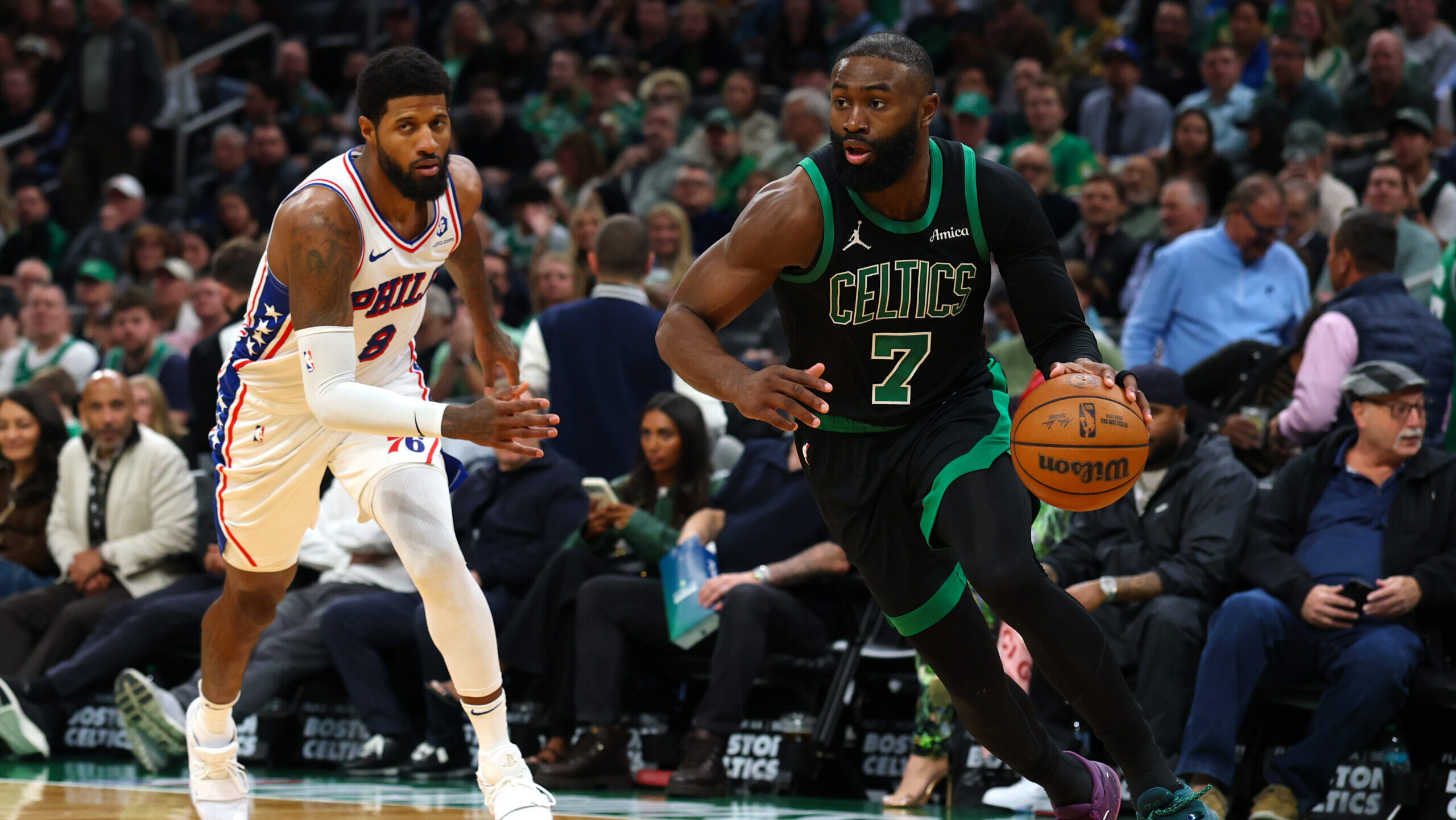
Philadelphia stunned the NBA by trading Paul George for Jaylen Brown last week. Here’s why Mike Gansey’s blockbuster deal could reshape the franchise’s championship window.
Full stop, I was not excited about this upcoming Philadelphia 76ers season. Not even a little bit.
The Sixers had just been swept out of the playoffs by the Knicks in the second round — a team that went on to win the whole thing — and the offseason was shaping up to be exactly the kind of quiet, underwhelming stretch that Philadelphia fans have become all too familiar with. Kelly Oubre and Quentin Grimes walked. Dean Wade got signed, which is fine — Wade is a perfectly solid rotation player — but he is not the kind of move that makes you look up from your phone. And then there’s the whole Paul George situation, which was still hanging over everything like a storm cloud that refused to move.
It was looking, frankly, like another season of managed expectations and carefully worded press releases about culture and development. Then, new president of basketball operations, Mike Gansey picked up the phone. And everything changed.
The trade is stunning by any measure. The 76ers are sending George, two first-round picks in 2028 and 2031, and two second-rounders to Boston in exchange for Jaylen Brown, the 2024 Finals MVP, a five-time All-Star, and one of the most productive players in the Eastern Conference over the last decade. Philadelphia doesn’t just shed the most albatross of a contract in the league in one clean motion. They replace it with one of the best wings in the game, coming off the best season of his career.
That’s not a good trade. That’s a franchise-altering trade, and it was made by a first-time front office decision-maker in his first major move on the job. Gansey, the former college basketball grinder who worked his way up through Cleveland’s scouting department, just did something in his first week that Daryl Morey — one of the most celebrated executives in the history of the sport — never managed to do in his entire tenure in Philadelphia: He fixed the PG problem.
Let’s talk about what getting out of that contract actually means, because it’s hard to overstate. George was owed $54.1 million this season and had a $56.6 million player option for 2027-28, a total of over $110 million for a 36-year-old who averaged 17.3 points and 5.3 rebounds in his second season with the Sixers and spent a quarter of the year serving a suspension. In any other trade scenario, the 76ers would have had to attach significant draft capital just to get another team to take that deal off their hands. Instead, they got Brown for it. As one league executive put it this week, you could make the case that Philadelphia essentially got Jaylen Brown for free. That is not hyperbole; that is just the math.
Now consider what Brad Stevens had to do on the other side of this trade. Stevens has been one of the most respected executives in the NBA since transitioning from coaching, coming off winning Executive of the Year last season. He built one of the most consistently excellent teams of the last decade. He is calm, methodical, and almost never reactive. And yet here he is, trading his cornerstone wing — who, by the way, never asked to leave — in the immediate aftermath of getting eliminated by the 76ers in the first round, after failing to land Giannis in what would have been an earth-shattering blockbuster.
This is Stevens panicking. It might be the first time anyone has ever been able to say that sentence with a straight face. The Celtics missed on Giannis, turned around, and traded Brown to a division rival. Jaylen Brown called himself “excited and disappointed” in the same statement. That tells you everything about how this went down in Boston.
Which brings us to the motivation angle, and this is the part that should genuinely scare the rest of the Eastern Conference. Brown doesn’t just arrive in Philadelphia as a consolation prize. He arrives as a player who finished sixth in MVP voting last season, who has played in more wins than any player in the league over the last 10 years, and whom his own organization tried to trade numerous times over the years, and when that didn’t work, shipped him out of town anyway without a phone call. That’s fuel. That is the specific kind of disrespect that turns good players into great ones and great players into something else entirely. If Jaylen Brown comes to Philadelphia with a chip on his shoulder the size of the Liberty Bell, the 76ers are the direct beneficiary of every slight Boston just handed him.
And the roster he’s walking into is genuinely frightening. Tyrese Maxey was the league’s fifth-leading scorer last season. Joel Embiid is a two-time scoring champion when healthy. VJ Edgecombe is a walking playoff moment — the kid hit big shot after big shot in his first postseason and didn’t blink, just winked — and is only getting better. Now add Brown, and that’s four legitimate options on any given night, four players who can take over a game in different ways, and a coaching staff in Nick Nurse that knows exactly what to do with that kind of versatility.
The contract continuity is also worth noting. Brown is owed $57 million this season, $61 million next, and $64.9 million in 2028-29. Maxey’s extension kicks in. Embiid is locked up. Edgecombe is on his rookie deal through this window, which means the Sixers have two clean seasons to compete before they have to address what paying Edgecombe looks like when his extension comes due. The window is real, the runway is defined, and for the first time in what feels like years, the variables are actually manageable.

None of this is guaranteed, of course. We’re talking about the 76ers, after all — the franchise where the improbable somehow becomes routine. This is the team that watched rookie Zhaire Smith nearly lose his life because of an undiagnosed peanut allergy, saw Markelle Fultz seemingly forget how to shoot, endured Ben Simmons‘ confidence completely evaporate, had fans uncover the infamous BurnerGate scandal involving Bryan Colangelo‘s secret accounts, and even somehow traded away hometown kid Mikal Bridges — whose mother WORKED FOR THE TEAM — on draft night, only to watch him eventually celebrate a championship with the Knicks years later.
Simply put: Something always seems to go sideways in Philadelphia. And that’s not to mention the annual collective holding of breath in Philadelphia any time Embiid hits the floor, though some of those fears are somewhat eased by Brown’s arrival, bringing one of the league’s most reliable iron men to a roster that has desperately needed one thing over the years — health. On top of that, Brown and Embiid have history; Brown literally called Embiid a flopper on a livestream after their playoff series. Chemistry will need to be built. And the depth behind the starting five is still thin enough that injuries could unravel everything in a hurry.
But here’s the bottom line. The 76ers just escaped one of the worst contracts in basketball and landed one of the best two-way players in the sport in the same transaction. Whether you think Brown is slightly overrated — and there are many people who do, this writer included — the relevant comparison isn’t Brown against the ideal. It’s Brown against what the 76ers had before. A focused, motivated Jaylen Brown coming off his best season is infinitely preferable to a suspended, declining Paul George at $110 million over two years. That’s not even a debate.
Philadelphia fans were bracing for another quiet summer. They got a blockbuster instead. Credit where it’s due; Mike Gansey walked in the door and immediately made the biggest and best move this franchise has made in years.
Now let’s see what they do with it.
Read More:
Red Hook Tavern: Where Billy Durney Wants to Know Your Name
Keanu Reeves’ Next Act Is Built on Two Wheels

The Blueprint: Jessica Holtz Meets the Moment
The Power Broker: Emma Grede Is Just Getting Going
Quiet Power: Imani Ellis on CultureCon, Creators, and Learning to Let Go