Inside the Derby della Madonnina: Inter vs. AC Milan at a roaring San Siro, where a century-old rivalry, big business, and global ambition collide.
Around the turn of the 20th century, rules and customs in Italian soccer limited the number of foreign players teams could carry. When the Milan Cricket and Football Club, better known as AC Milan, was founded in 1899, it adopted this custom as well. In response to some club members protesting what they considered an antiquated rule, they split off to form their own club, Internazionale (now known as Inter Milan), in 1908.
A year later, the two clubs — one wearing red and black, the other blue and black — played each other for the first time in what’s known as the Derby della Madonnina, named after the statue on the top of the Milan cathedral, more commonly known as the Duomo. Over the last 116 years, the Milan Derby has become known as one of the great rivalries in all of sports, with fans filling the iconic San Siro stadium, which the clubs share, at least twice a year for city and Serie A supremacy between two billion-dollar brands. AC Milan is worth $1.5 billion on revenues of $433 million, 14th on Forbes’ annual soccer franchise valuation rankings, while Inter is just behind them in 17th at $1.15 billion on revenues of $430 million.
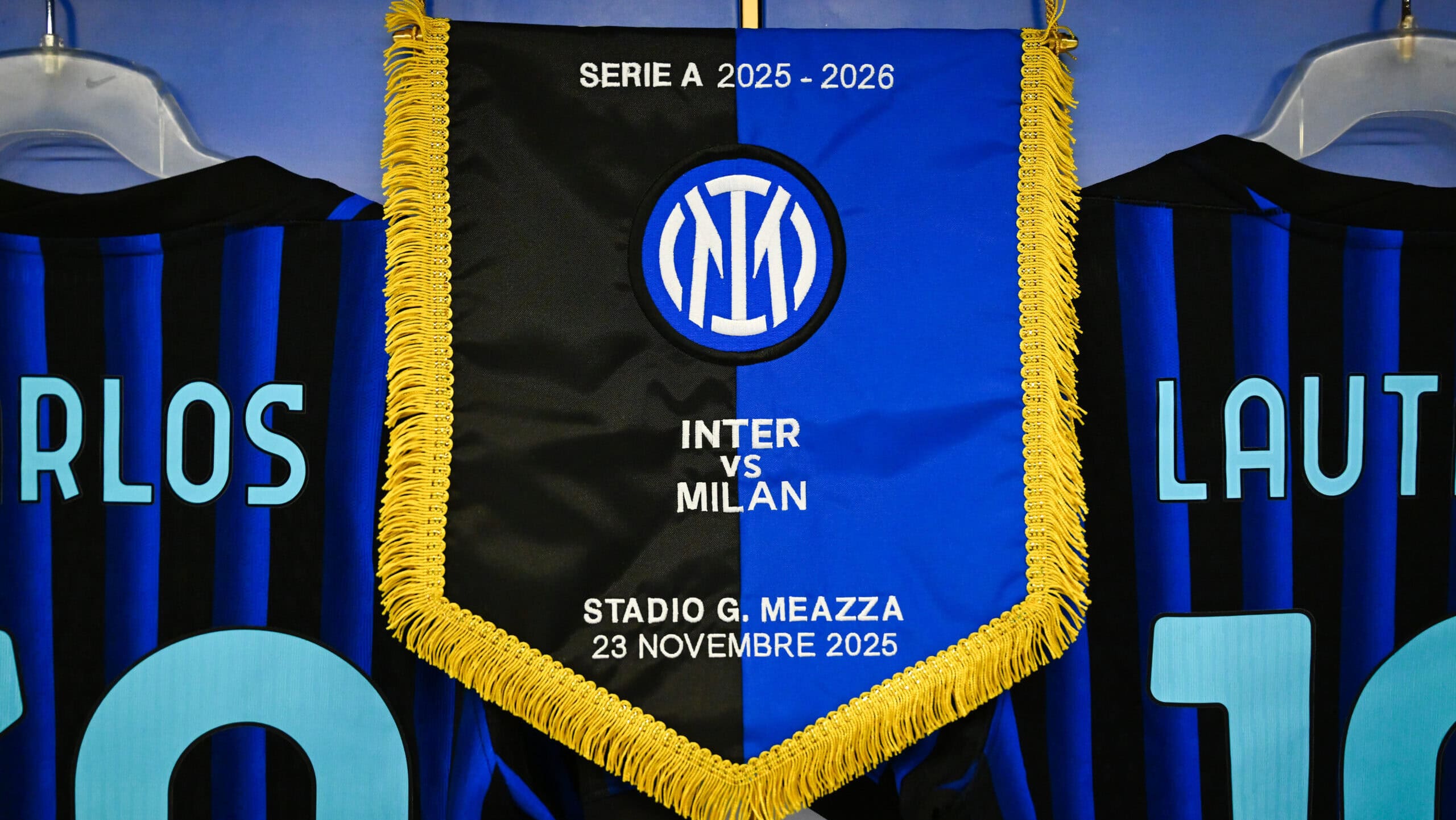
In Italian football, teams can place a star on their jerseys for every 10 Serie A titles they’ve won in their history. While Turin-based club Juventus laps the field with 36 league championships and three stars, Inter Milan won its 20th championship and second star on April 22, 2024, with a 2-1 win over AC Milan, perhaps one of the most satisfying wins in club history because AC Milan is still stuck with 19 domestic championships, one short of their second star.
“This is absolutely one of the jewels of the Serie A season,” Michele Ciccarese, the league’s commercial and marketing director, told Boardroom last week. “The culture that you’re going to experience when you come to the San Siro is when you will really feel the Italian passion for football.”
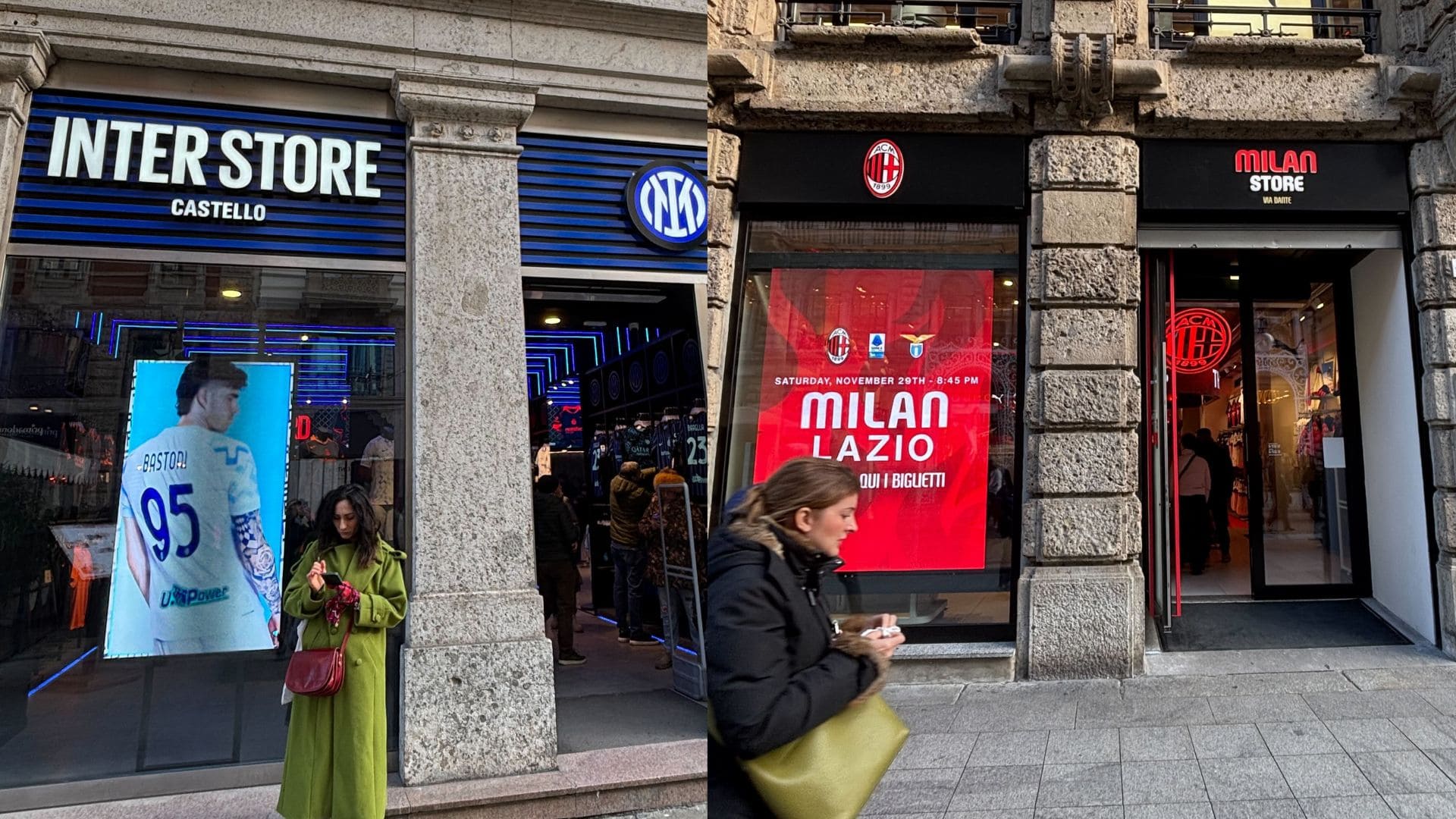
This past weekend, I joined Inter Milan and select journalists and influencers to experience the Milan Derby for myself, with a series of behind-the-scenes interviews and experiences designed to immerse myself within the club and this incredibly intense rivalry. This was on the condition, of course, that I don’t use any quotes from anyone from AC Milan. That’s how deep the rivalry goes, which extends from the pitch to the streets of Milan, where an Inter team store sits at 16 Via Dante in a touristy shopping area near the Duomo, and the AC team store resides at 12 Via Dante.
There are, however, similarities between the teams. Both clubs are owned by American private equity investment funds. RedBird Capital Partners purchased AC Milan in 2022 for $1.2 billion, while Oaktree Capital Management assumed control of Inter in May of last year after Chinese holding company Suning defaulted on a $428 million loan payment to Oaktree, which enabled Oaktree to take control of the team.
“Our initial focus is operational and financial stability,” Oaktree managing director Alejandro Cano said at the time.
After landing in Milan last Thursday morning and freshening up at our hotel, the group took a van to Inter’s business headquarters in the north of the city center. A tour of the building ensued, including the club’s sprawling rooftop, its impressive trophy room where new players are introduced, chats with some of the team’s executives, and a presentation on its international growth strategy. I then left the group to chat with chief revenue officer Giorgio Ricci, who stunned me when he said that Inter Milan last year turned a profit for the first time in its history.
With the help of making the Champions League final, finishing second in Serie A, and advancing to the knockout stage of the Club World Cup, Ricci said the club generated $100 million in revenue from the San Siro for the first time and earned more than $100 million in sponsorship, media, and consumer revenue. Inter’s presentation claimed a global fanbase of 533 million with 83 million social media followers and a TV audience of 396 million.
“In order to achieve our goals,” Ricci, who started with the new ownership group after coming over from Juventus, said, “we need the very well-balanced mix of on and off the pitch performance and understanding that part of the private equity world means being really forward-looking. I’m impressed how much ownership cares about this club and looks at it not just from a financial standpoint but by how much they help leverage the strength of the Inter brand.”
Ricci called this current season one of sustainability, consolidation, and growth for Inter Milan. Soccer teams get more broadcast revenue the better they perform in domestic and European leagues, so the club needs to continue excelling on the pitch. Globally visible international competitions like friendlies, the Champions League, and the Club World Cup are important to reach key international markets like the U.S., China, and Saudi Arabia because Serie A is not as strong or lucrative as its counterparts in other major European countries like England, Spain, and Germany. Success on the pitch will clearly help stadium revenue, merchandise sales, and sponsorship earnings, but Ricci wants to build financial sustainability independent from Inter’s weekly wins and losses.
“We need to be much more aggressive and finding ways to increase our reach, audience, and ways to engage with potential customers and fans around the world,” he said. “That’s a very important challenge, and it starts with working on our strong authenticity and the emotional bond we have with our fan base.”
Inter aims to grow its fan base and the bonds that bind them through content and storytelling off the pitch, through various collaborations and lifestyle activations that tap into markets outside Europe to fill the gap left by the relative lack of Serie A competition. Two such examples were unveiled in the days leading up to the Derby, including a new partnership with Red Bull and a new team fragrance called Inter 19-08 that, per its presentation, helps the club establish itself “as a status brand that expresses success, visibility, and social positioning.”
That branding and positioning, Ricci said, is what makes the Milan Derby so important to Inter.
“For all the internal and external stakeholders,” he said, “the Derby truly represents the essence of our sport, our industry, and our brand. It’s a peak event that basically legitimizes our essence. We need to export it at our best every time.”

Intermittent snowflakes flurried about Friday morning at the Inter training facility, about 40 minutes northwest of Milan, in a town called Appiano Gentile that’s geographically closer to Lake Como than it is to the San Siro. Players trained in the raw cold before star Swiss defender Manuel Akanji, on loan from Manchester City, spoke with select media.
The next night, Inter and events company Fashion Meets Football threw a dinner introducing a new fragrance, meant to evoke a mix of the leather of the ball and the grass of the San Siro pitch, at Michelin star restaurant Horto. As the wine flowed and intricately designed dishes were served, Inter legend Christian Vieri discussed what it’s like to compete in a Milan Derby.
“You train every day to play these games,” he said, “where the whole world is watching. Every hour before the match felt like 10 hours. Just 1-2 kilometers from the stadium, you have 30, 40,000 people crowded on the road. And 35-40 minutes before the game, warming up, you already have 70,000 people singing your name. No one was sitting down. It’s the best feeling in the world.”
As one of my media colleagues astutely described, the San Siro looks like a 19th-century spaceship. On the corners of the enormous slab of concrete that serves as the stadium’s foundation are tight spirals of pedestrian ramps that seem as endless as the history of the historic venue. The San Siro was built in 1926 and has been the home to both Milanese clubs since 1947. The last major renovation to the grounds took place in 1990.
As the San Siro gets ready to host the opening ceremony of the Winter Olympics in February, Inter and AC Milan have made major strides in preparing for a future outside the stadium. Earlier this month, the clubs jointly purchased the San Siro from the city for $226 million with plans to hire architects Foster + Partners and Manica to build a new 71,500-seat stadium in time for the 2030-31 season. Foster + Partners is known for its work on major stadium projects like the new Wembley Stadium in London.
A new San Siro, Ricci said, is vital for the positioning of the club. It opens up new avenues for revenue from luxury boxes and corporate hospitality, new technological advances, and a naming rights deal that will benefit both Inter and AC. And while at one point the two teams were considering building their own separate arenas, there wasn’t enough space in the city to build them, so now the clubs split the cost of the new venue.
“The aim is not to build the best stadium in Italy,” Ricci said, “but one of the best stadiums in the world.”
Inter Milan and AC Milan sharing the San Siro makes for many unique logistical challenges. As our vans pulled into the home team’s below-ground parking garage three hours before kickoff, LED boards lit up in Inter’s patented blue and black. A blue carpet draped atop a flight of stairs leading to the luxury entrance’s main atrium would have to be replaced with AC red following the match. So would all the photos of iconic Inter moments on the walls outside the home locker room.
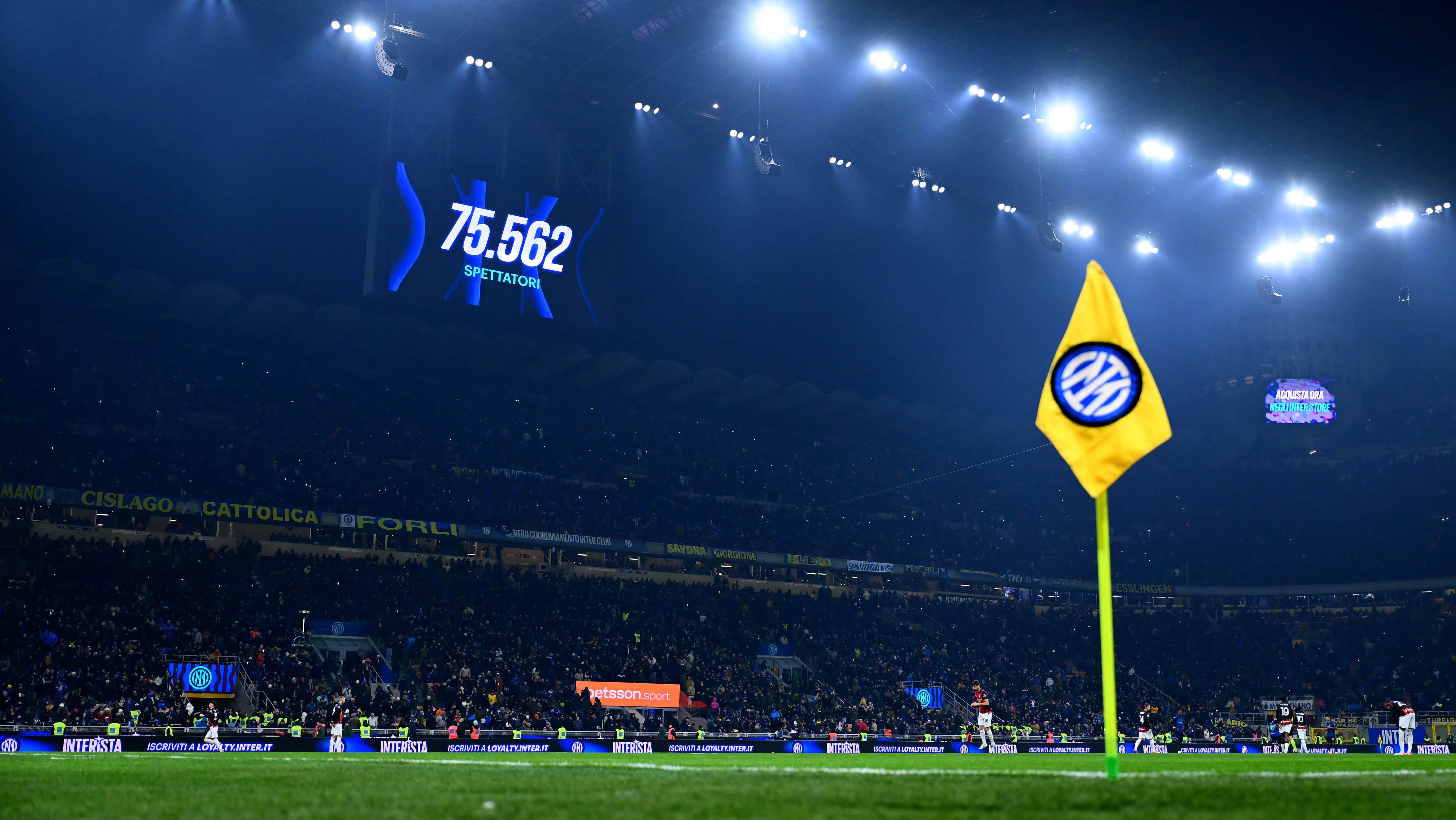
After we glided through the tunnel toward the San Siro pitch, we were told that the right side of the stands always held the AC fans during the Derby, while Inter fans always occupied the left side. As the 8:45 p.m. start approached and the players arrived to warm up, so did the roars from the crowd that Vieri still vividly recalls nearly 20 years after his last Derby.
That noise becomes even more powerful depending on how steep the stands are on top of the pitch, an element missing from most modern stadiums because of the new suite levels required in modern venues. An Inter official told me that plans are to maintain the same slope as the current San Siro for the next building, to keep the same crowd noise and atmosphere that’s helped the Milan Derby remain such a sporting and cultural touchstone.
“While other rivalries between smaller provincial teams might elicit more passion, the derby between AC Milan and Inter is the most visible on a global scale,” Matt Rizzetta, the founder and chairman of Underdog Global Partners, told Boardroom. “It serves as more than a simple rivalry between two Serie A teams; rather, it is a stage for Italian football to display its product to the world.”
In front of 75,562 raucous fans at the San Siro, Inter got off to a furious start, hitting the post twice but failing to score in the first half of a fast-paced match. In the second half, American star Christian Pulisic scored on a rebound tap in the 54th minute for AC to make it 1-0. Twenty minutes later, a foul in the box gave Inter a penalty shot to tie the game, but Hakan Çalhanoglu‘s strike was parried away by goalie Mike Maignan to preserve the lead. And despite maintaining nearly 64% of the possession, Inter fell in the first of two Derby matchups of the season.
As the final whistle blew on the match and our weekend in Milan, the right side of the stadium rocked and pulsated with joy and elation, while the left side of the San Siro quickly and solemnly filed out of the building, dejected but already looking forward to the next time Inter would get a crack at besting their bitter enemy in one of the flagship rivalries in all of sports.
Read More:
Inside the Making of the Coolest Golf Collab of the Year (So Far)

Shaun White’s Second Act: Redefining the Business of Snowboarding
Beyond the Game: Chris Paul, Candace Parker, and Kristyn Cook on Legacy & Leadership
Floyd Mayweather-Manny Pacquiao Set For Rematch on Netflix

Kalshi’s Tarek Mansour on Prediction Markets, Regulation, and the Future of Truth in Finance