

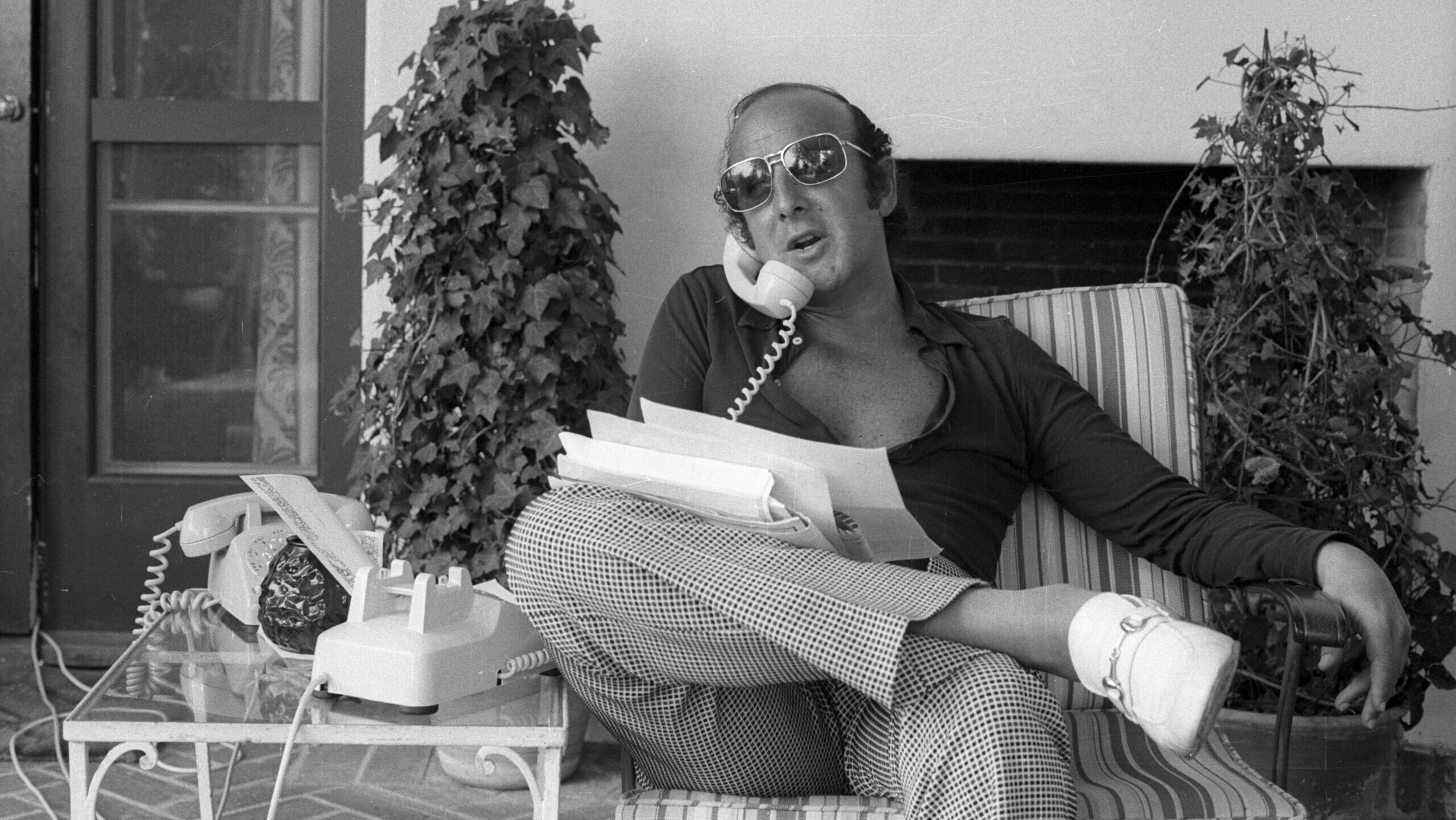
The Harvard-trained lawyer who knew nothing about music became the most important ears in the industry’s history.
When talking about Clive Davis, the legendary music executive who died Monday morning at the age of 94, it’s probably best to start with the names. Whitney Houston, Aretha Franklin, Janis Joplin, Bruce Springsteen, Santana, Alicia Keys, Aerosmith, Billy Joel, and Earth, Wind & Fire. And there’s more, of course. Over the course of his storied career, Davis became as much a household name as the artists he discovered and championed. Such was the velocity of his impact on popular music. He didn’t just make hits — he changed the way the music industry and fans thought about what a hit could be.
Davis got his start in the legal department of Columbia Records. He knew nothing about music. After graduating from New York University magna cum laude with a degree in political science, he earned a full scholarship to Harvard Law School. From there, he joined a small New York City law firm before moving to Rosenman, Colin, Kaye, Petschek & Freund, which had CBS as a client. A former colleague tapped him to be assistant counsel of CBS’s Columbia Records. A year later, at age 29, he became the label’s general counsel. “I was plucked out of a law firm to become chief lawyer for Columbia Records three years out of law school. I did that for five years,” he told Gayle King in 2022. When he took over CBS Records in 1966, he was far from the most knowledgeable about music. “I knew nothing about music,” he once said in a documentary about his life. In a PBS American Masters interview, he explained that in order to get up to speed and hone his own taste and point of view, he just listened. “So what did I do when I first took over? I watched. I listened. You don’t become an instant expert. So often people get a title and they feel they’ve got to act on it. I did not feel I had to act on it.”
Some may see that admission as a weakness, but going into the role understanding — and being comfortable with the idea — that he didn’t know it all likely allowed him to really develop his taste. As Davis acclimated to his new role, he studied the Billboard charts and honed in on what he believed made a song a hit. In 1967, he attended the Monterey Pop Festival, which he credited with changing his outlook on popular music. “I arrived in Monterey and went to the festival grounds and was literally stunned. It was a culture shock — everything was different. People had come from Haight-Ashbury, from other parts of San Francisco, from all over the West Coast,” Davis said. “They were in flowing gowns, with long hair. And here we were in our preppy New York clothes… I remember we just looked so alien amidst this visual outpouring of love and peace — people greeting you with flowers, sometimes putting them in your hair.”
One of the most impactful moments of his life was about to unfold as a then-unknown group hit the stage with a front woman whose voice moved Davis in a way he had never experienced. “I was sitting in the audience, and this group I’d never heard of came on, just billed as Big Brother and the Holding Company. Then this female dervish came on the stage. She was hypnotic, compelling, electrifying — she shook and sang and conveyed soul like no singer I had ever seen before. Of course, it was Janis Joplin.”
He signed Joplin immediately. But more than discovering a new act, Davis realized that change was afoot not only in America, but within himself as well. “My gut told me I had to sign this artist, that I needed to follow my instinct and move from the purely business arena into the creative,” he said. “I was totally unsure whether I had ears or the talent for picking artists. I had never been trained for it. Before that moment, it had never occurred to me that I would be signing artists. But I just knew I had to move to the forefront and trust this instinct.”
Davis called it “the most important epiphany” of his life. It was the moment he realized he needed to step away from business imperatives and fully trust his gut and his instincts when signing and working with artists. The man who arrived at one of the biggest music labels in the world as a midlevel attorney came to understand that the magic wasn’t in the boardrooms, but out among the people. He realized that the future would be decided not by industry insiders, but by the audience. That realization led him to transform the staid culture at Columbia, including pushing staff to consume music media such as Rolling Stone magazine.
Those same gut instincts led him to bring a host of now-legendary talent to Columbia, including Santana — whom he also signed after seeing him perform at Monterey — Bruce Springsteen, Billy Joel, and Pink Floyd. Profits soared as he turned the label into a pop music powerhouse. But it was after Davis was fired from Columbia in 1973 that he truly came into his own.
The following year, Davis renamed Bell Records to Arista and quickly began building a diverse roster that included Gil Scott-Heron, Lou Reed, Aretha Franklin, and Dionne Warwick. The latter two were already superstars looking to get back to the top of the charts. Davis helped them do just that. Greater success came when Davis signed Warwick’s cousin, Whitney Houston, in 1983. The two would spend the next two years working on her self-titled debut, with Davis intimately involved in the creative process — helping to pick producers and songwriters, and not relenting until he felt they were nearing perfection. The obsession paid off. Whitney Houston spent 14 weeks at No. 1 on the Billboard 200 and produced three No. 1 singles. The Houston-Davis partnership lasted for the majority of her career, while their friendship lasted until her death in 2012. “She had a voice, an innocence, a power and a beauty that was so stunning,” Davis said of Houston. “She had a vocal genius. She could transform a song and make it different.”
Davis had an innate ability to seek out artists who could turn a niche genre into pop gold. But he had his limits. He admitted that he’d “never get rap music.” However, much like the Monterey festival, he knew a cultural phenomenon when he saw one. To make sure Arista had a foothold in the rap world, he partnered with artists and executives who knew the space intimately. That’s what led him to back L.A. Reid and Babyface in creating LaFace Records, and to partner with a young, brash A&R executive who, after being ousted from Uptown Records, wanted to start a new imprint called Bad Boy. Through those partnerships, Arista helped bring names like Usher, Toni Braxton, OutKast, TLC, the Notorious B.I.G., 112, and Faith Evans to mainstream audiences.
But what, exactly, made a Davis hit a hit? In his words, the alchemy of a hit record is “the combination, imperatively, of music with a chorus that lingers. Lyrics are very important, they affect your mind, your body, your soul. And when you have a classic is when you have that wonderful combination of music and lyrics that you can’t get out of your head, and you find yourself in the shower the next day singing, wondering where did I even hear this?” Take a moment to think about all the legendary songs Davis had a hand in. Now think about that quote. You see it, right? “How Will I Know.” “Saving All My Love for You.” “I Will Always Love You.” “Maria Maria.” “Smooth.” “Fallin’.” “The Boy Is Mine.” “That’s What Friends Are For.” “Juicy.” “You Make Me Wanna…” “Nice & Slow.” “U Got It Bad.” The list could literally go on and on. If you are of a certain age, his fingerprints are all over the songs and albums that shaped your life. The songs you cried, loved, danced, and just vibed out to. So, when talking about or remember Clive Davis, perhaps it’s best to focus on the music instead.
Read More:

The Blueprint: Jessica Holtz Meets the Moment

The Power Broker: Emma Grede Is Just Getting Going

Quiet Power: Imani Ellis on CultureCon, Creators, and Learning to Let Go

The Long Game: How LeBron James and a Few NBA Friends Might Elevate the Game of Golf

Savannah James and April McDaniel on Navigating Money, Friendship, and Business