

After this year’s WWDC, Apple’s stock price took a tumble. Boardroom explains why the company’s AI announcement is right on time.
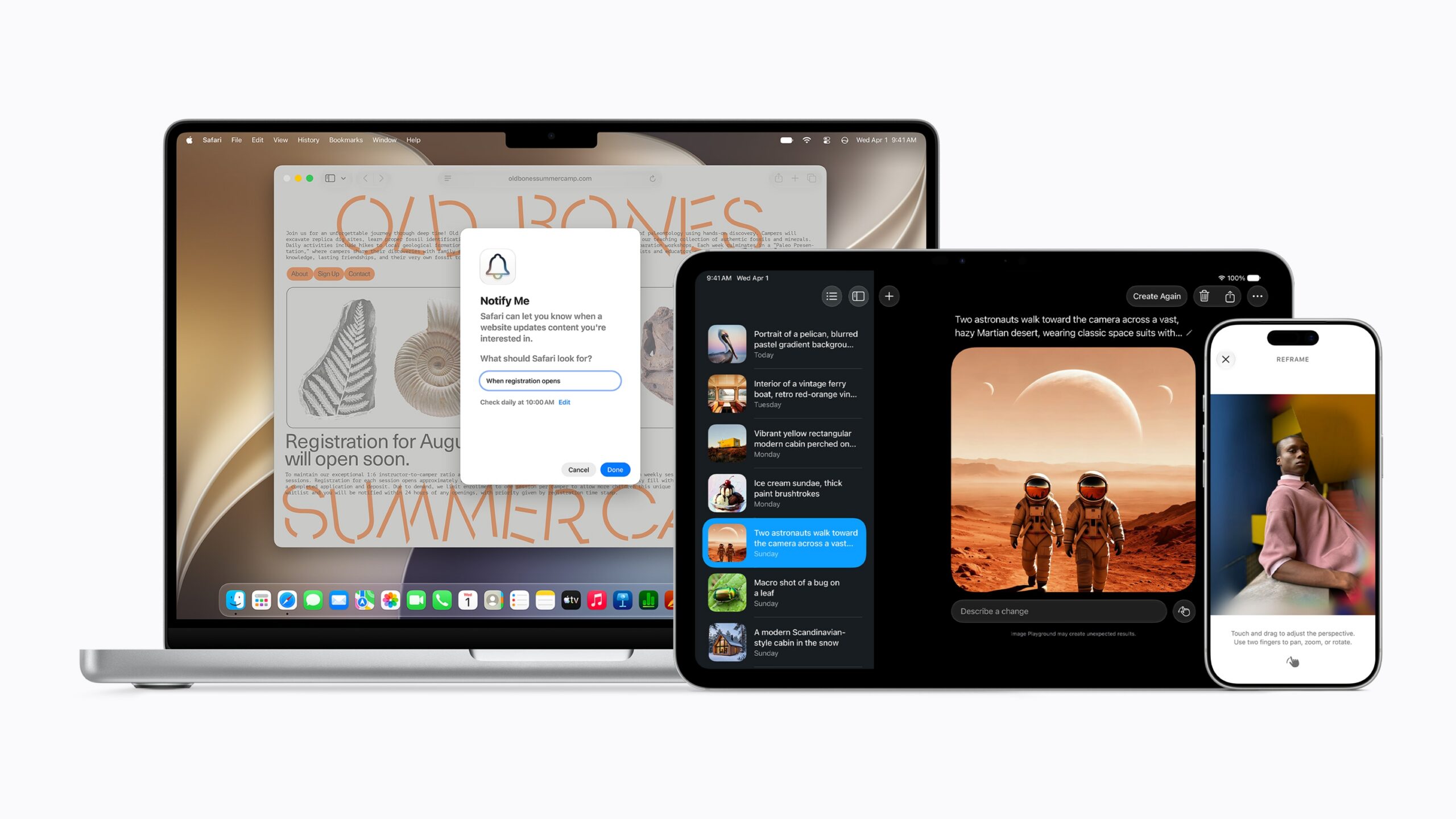
On Monday, June 8, Apple unveiled plans that consumers and investors had been waiting two years to see. During the keynote for its 2026 Worldwide Developers Conference (WWDC), the Cupertino company announced plans to completely revamp its Siri virtual assistant with help from Google Gemini as well as a number of new AI tools and features that will arrive on iOS, macOS, and iPadOS later this year.
It’s been a long time coming. So, why did its stock price drop immediately after?
To answer that question, you have to go back to 2024, when Apple announced a suite of new products bundled together under the Apple Intelligence banner that never fully materialized. The promises made two years ago were great. So great, in fact, that Apple had to pull back on some of them. Namely, the features outlined in a commercial starring Bella Ramsey that aired before the release of the iPhone 16. The spot featured the The Last of Us star using a “more personal Siri,” ostensibly powered by Apple Intelligence, that was more context-aware and able to understand things on your phone screen, allowing it to, as the commercial showed, cross-reference apps to remind you of the name of a person you’ve already met.
It all looked cool and, more importantly, useful. Unfortunately, those features never came to pass. Mark Gurman at Bloomberg reported that the features highlighted in the commercial wouldn’t arrive in time for the iPhone 16’s release. In fact, according to Gurman’s reporting, they weren’t going to be ready until 2025 at the earliest.
The change resulted in a class-action lawsuit brought by consumers who purchased the iPhone 16 because they thought it would come with the AI features touted in Apple’s press materials. “Apple promoted AI capabilities that did not exist at the time, do not exist now, and will not exist for two or more years, if ever, all while marketing them as the breakthrough innovation,” a lawyer for the plaintiffs said. Turns out they were right. Apple settled the lawsuit with a $250 million payout.
Why would Apple, one of the most valuable companies ever created, lie to its customers about future AI products? Wall Street. Some believe Apple just got a bit too far ahead of its skis and, for the first time in a long time, overpromised things it couldn’t technically deliver. “The fiasco is that Apple pitched a story that wasn’t true, one that some people within the company surely understood wasn’t true, and they set a course based on that,” wrote tech journalist John Gruber. But the why of it all could be traced back to its board and the investors it serves.
“One certainly gets the sense that Apple, after tons of industry hype and incessant questions from analysts, very much representing the concerns of shareholders, felt like they had no choice but to be doing something with generative AI,” wrote tech analyst Ben Thompson. “In other words — and yes, this is very much driving with the rearview mirror — Apple didn’t seem to be working on generative AI because they felt it was essential to their product vision, but rather because they had to keep up with what everyone else was doing.”
At the time, everyone else — Anthropic, OpenAI, Google, Facebook, and Microsoft — were at war with one another, working to produce the best AI products they could muster. Companies were poaching talent and rushing to release models that outdid the last one released by their competitors. Over the past two years, AI companies have come to dominate not only the tech world but the U.S. economy as well. AI and AI-adjacent companies now make up roughly half the value of the entire U.S. stock market, according to Reuters.
So, it makes sense that Apple, the No. 1 consumer electronics company in the world, believed that it needed to do something in the AI space, but there were a few problems. It would be silly to believe Apple, even with its late start, could not amass the engineering expertise needed to build world-class AI products. One of the hurdles it would have to overcome lies in its brand promise. Apple is a company rooted in artistic creativity and privacy. AI, for all its glory, rubs uncomfortably against both of those ideals, but for the sake of this story, let’s focus on the latter.
Large language models work best with massive amounts of data. In order for them to best assist you, they need to have access to all of your personal data. If, for example, you wanted your AI assistant to do what we saw in that Ramsey Apple commercial, it would need access to your emails, your contacts, and your calendar. It would send that data to its data center(s), do the computing, and send its answers back to your device. To most, that doesn’t pose a problem. That’s how many services we use today work. But that’s not how Apple works. When it finally announced Apple Intelligence, the service hinged on most of the work being done on-device and what it called Private Cloud Compute (PCC). Whenever the AI request was too complex to be done on your iPhone, iPad, or MacBook, it would send it to Apple’s own cloud servers running customized Apple Silicon chips. Unlike other services, Apple said it never retains your personal information and what little info does touch its servers is not accessible by Apple employees.
The other hurdle is cost. It’s no secret that AI is expensive. According to analysts from TS Lombard, the U.S. is on track to spend 2% of its GDP on AI and data center infrastructure in 2026. That amounts to anywhere from $700 billion to $800 billion. That’s nearly what we spend, as a nation, on defense. If you were wondering why you keep reading stories about data centers being built in cities and towns that don’t want them, this is why. It’s the largest industrial boom the country has seen in decades. In order to keep pace with the state of the art, Apple would need to join the party and dip into its coffers. As of Q1 2026, Apple had just shy of $70 billion in cash. Seems like a lot on paper, but when compared to its competitors, it comes up short. Alphabet and Amazon, for example, have around $127 billion and $123 billion, respectively. Getting up to speed would take a large chunk out of that sum, and right now it’s unclear how worth it that investment would be.
Right now, two of the leading AI companies, Anthropic and OpenAI, are not profitable. The former says it’s on track to have its first profitable quarter in Q2 of this year, while the latter is projecting to lose $14 billion by the end of this fiscal year. Of course, profitability is not an indicator of future success and earnings — the most famous story is that of Amazon, which was unprofitable for most of its existence. But it’s not hard to understand why Apple, which infamously burned $1 billion trying to make a car, is not rushing to light a bunch of bread on fire in hopes of dominating the AI market. Especially when all of the AI companies still need to go through Apple.
One of the major hopes of the AI era is that it will eclipse and sunset the mobile era. The mobile era, of course, was the period of time when we all shifted our lives from desktops and laptops to the mobile computers we call phones. Apple and Google came to dominate that era with the iPhone and Android, but really, it’s Apple that came away the winner here. Android is the No. 1 mobile operating system in the world by number of users, but iOS and the iPhone is the No. 1 mobile platform by influence and impact. It’s why the App Store is the standard. It’s why software developers build their apps for iOS first, then for Android. While companies search high and low for the device that will come after the smartphone and free them from having to pay the iOS and Android tax, Apple and Google continue to be the platforms through which everyone is experiencing AI.
Think about how you use AI, if you use it at all. You likely open an app on your phone or tablet or access it through your web browser on your laptop or desktop. There’s a great chance someone cracks it and figures out the device that we all didn’t know we needed. OpenAI’s Sam Altman and Jony Ive, the designer behind the iPhone, are betting — and hoping — that such a device should exist. A few others have already tried: We’ve seen devices like the Rabbit R1, which was an overhyped gadget powered by cheap smartphone components that couldn’t live up to its promise. Or the Humane AI Pin, a device that was slightly too big for what it was and, like its name suggested, pinned to your clothes. The idea was that you would speak to it, and it would speak back or display information on your hand using lasers or something. It didn’t work. Nothing has, really. As of June 2026, the best AI device is your smartphone. And the best smartphone by most measures is the Apple iPhone. So even though it bungled its AI rollout, Apple is still in an enviable position.
The situation kind of rhymes with its position on search engines. In 2002, Apple agreed to make Google the default search engine for its Safari browser. At the time, it made sense — Google smoked every other search engine. This was back when Google was just Google. There was no Alphabet. No AI summaries. Just the search box and the blue links. As Safari grew, Apple and Google came to a revenue-sharing arrangement that would extend into 2007, when Apple unveiled the iPhone. By 2014, when it became apparent that Apple was dominating the smartphone game, Google began paying $1 billion. You could easily access other search engines through your iPhone, but most people didn’t bother. That’s why Google opted to gradually increase the fee it paid over the years to a whopping $20 billion by 2022. Google’s search business is one of the — if not the — best businesses in modern tech. Apple could have devoted resources to try to topple it or, at the very least, compete with it as it did with Safari and Maps. Instead, it opted to be the platform through which most people accessed the service.
Even its other hardware is outpacing competitors when it comes to AI. While Microsoft and hardware companies like Dell and HP focused on marketing “AI PCs,” Apple quietly improved its M-series chips, far outpacing chips from rivals like Intel, AMD, and Qualcomm. So much so that enthusiasts began to snatch up Mac Mini computers to run models and OpenClaw locally. It got to the point where Apple began to experience shortages due to massive demand. In an effort to compete with Apple, Nvidia recently announced its first consumer computer chip, the RTX Spark. “RTX Spark brings everything NVIDIA has built — CUDA, RTX, our AI platform — into a single superchip,” said founder and CEO Jensen Huang. “Local agents. Frontier models. Creative workflows. RTX games. All on a laptop. This is the new PC. The personal AI computer.” It’s a big claim. One that many hardware makers are hoping holds up.
Because right now, if you are a consumer or enthusiast looking for the best AI hardware, you will find yourself on Apple.com. It’s unclear for how long that will be the case. Apple has a bullseye on its logo, and every company is hoping to dethrone it as we head into an AI future.
Did Apple drop the ball? Undoubtedly, yes. But that doesn’t mean it’s behind. That just means it’s playing a different game.
Read More:

Michael Che Opens Up About SNL, Kanye, Colin Jost, Cancel Culture, & Comedy

Red Hook Tavern: Where Billy Durney Wants to Know Your Name

Keanu Reeves’ Next Act Is Built on Two Wheels

The Blueprint: Jessica Holtz Meets the Moment

The Power Broker: Emma Grede Is Just Getting Going