

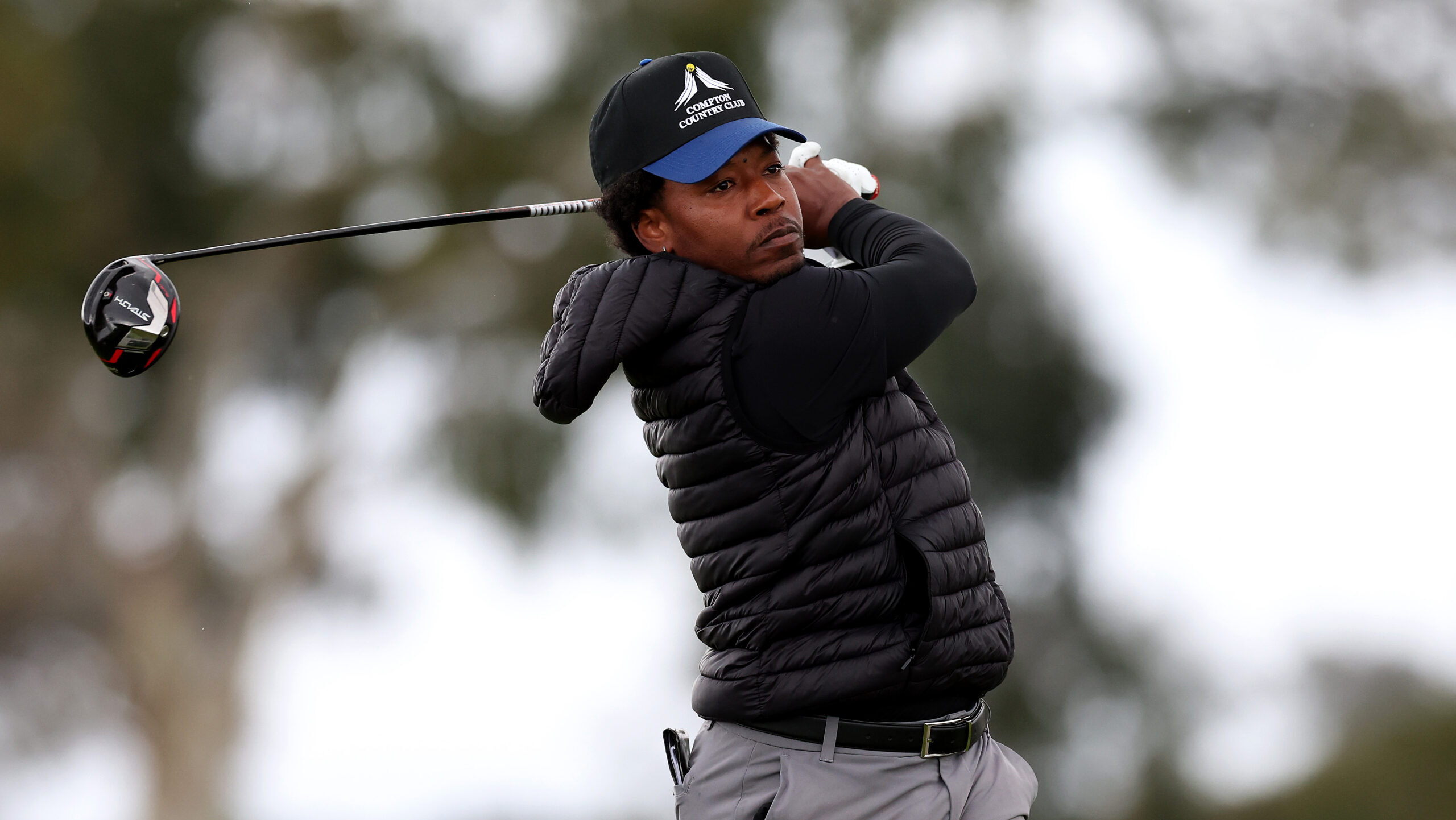
Seven years caddying at LACC. A Long Beach Open title. A brand called Compton Country Club. Aaron Grimes built his own path to the PGA Tour, now he has to finish it.
Aaron Grimes has always been one of a kind. After all, how many golfers do you know who grew up in Compton? The Los Angeles-born athlete fell in love with the game when he was 8 years old, after he participated in a lesson with his family. His parents were introduced to the game and promptly grew to love it following a church outing at a course. When Grimes first started playing, he had only one objective: “I was obsessed with backspin. The whole point of playing golf for me was just to get the ball to spin back.” After he accomplished that feat, he quickly realized that he was more than pretty good. He broke par a few years after he first started playing and routinely finished at the top of local tournaments.
The problem, though, is that unless you’re loaded, you’re disadvantaged as a junior golfer. The game is so expensive, and clubs are so exclusive that even a middle-class kid like Grimes had to grind twice as hard, considering he couldn’t travel nationally for tournaments or work with top coaches.
Grimes went to Cal State Northridge for college and used his Division I golf years to get as good as possible. He supplemented that play by working at the ultra-exclusive Los Angeles Country Club, caddying to help make ends meet. Since then, he’s been grinding on mini tours, participating in the minority-focused APGA events, and working his way to Q-School, where he’ll have a chance to earn a card on the Korn Ferry or PGA Tour. He also makes an occasional appearance at events for the upstart Grass League, the “world’s first High Stakes Par 3 Golf league.” He’s also been profiled by the United States Golf Association. We caught up with Grimes to chat about his POV as a Black golfer, giving back to his hometown of Compton, and playing in honor of his late father.
The conversation below has been edited and condensed for clarity.
Boardroom: When was the first time you picked up a golf club?
Aaron Grimes: I was actually taking a family lesson. It was myself, my dad, my mother, and my sister. My parents got introduced to the game through a church tournament, and they enjoyed themselves that day and decided that we’d pick it up as a family. That very next week we started taking family lessons. I was 8 years old.
At what age were you like, I’m actually really good at this?
I was probably 13 or 14 years old. I was going into eighth grade when I started realizing that I was a little better than most of the kids that I competed against in tournaments. I got pretty good pretty fast and broke par fairly quickly after I started playing. I think it was three or four years after I started playing.
Were you obsessed with the game growing up?
My obsession started with the short game. I was obsessed with backspin. The whole point of playing golf for me was just to get the ball to spin back. I got pretty obsessed with that as a kid. Seeing the ball go forward and then spin back was what hooked me into the game.
What course did you grow up playing at?
There was this course called Victoria Golf Course. After school we’d go to the Compton Par 3 Golf Course. My dad would take me and my sister when we got out of school and we’d go over there and play with his buddies. He would gamble against them and would have my sister and I play and we’d beat his friends. They didn’t like that too much over at the Compton Par 3 [laughs].
I know you went to Cal State Northridge. Where would the team practice?
Our tournament golf course was Wood Ranch Golf Club in Simi Valley. We’d practice at MountainGate’s Lakeside course and Porter Valley.
After college, did you know that you wanted to pursue being a professional golfer?
The whole point of going to college was to see just how good I could get. I knew I wanted to turn professional when I was in high school, but I was a little bit afraid to say it just because I didn’t come from a background of being able to travel nationally and compete. I knew I was good in my area. Once I got to the Division I program and I started playing against guys on a national basis and started having some success against those guys, I was like, Yeah, I can definitely make it as a professional.
Are you from a working-class background?
I’d say middle class. I was able to play golf and compete in tournaments. I went to a good private high school—St. John Bosco—but we didn’t have the extra money to send me off to go compete in New Jersey or Florida at those AJGA tournaments.
How difficult is it for someone that doesn’t have resources to take private lessons and join a club to excel?
It’s extremely difficult. My parents made a sacrifice. They sacrificed their free time and their extra money to see to it that I had the best coaches we could afford; they made sure I had an advantage playing golf if that was something I wanted to do. I chose to do it. Still, though, throughout college I was actually working. I’d go to school, practice Monday through Friday, and then I caddied at LA Country Club Saturday and Sundays. I was trying to figure out a way to finance my competitive golfing efforts.
When you graduated, did you stay on at LACC?
I turned pro in 2016 and I caddied at LACC until about 2023, just because I didn’t have any sponsors. No one took the chance on me. I didn’t have any of the big deals out of college like the top players do. I had to support myself. I ran up some credit cards and the money I’d make caddying, I put directly into playing golf tournaments. If I played well, I could keep playing, but if I didn’t, I’d have to go right back to caddy and make some money.
You’ve embraced alternative avenues, like the Grass League and the social aspect of modern golf. When did that pivot to full-time golf begin?
The U.S. Open went to LACC and there was some time that I wasn’t able to work. I had to find a job, and my uncle has a car shop. He allowed me to come work for him for a couple months while I wasn’t able to work at LACC because they were shut down preparing for the U.S. Open. I was working there and I was like, Man, I do not want to do this 9-to-5 thing. I went all in on the golf stuff. I was like, You know what? Everything I got, all the money I got, I’m dedicated to it and I’m going to really give this thing a go. I got really lucky and Topgolf ended up coming in as a sponsor. It wasn’t crazy money or anything like that, but it was enough money where I could go play maybe four or five events and not have to worry about where the money was going to come from. That started the real full-time play where I was just able to solely focus on golf and I could focus on my development. That was in 2023.
Less than a year later, I won the Long Beach Open and that kind of freed me up. Topgolf was still a supporter in 2024. It freed me up to really play golf full-time and just focus solely on competing — not only with my practice, but taking care of my body like a professional golfer should. That’s how the full-time journey started. I was lucky that I had to stop caddying. It’s quick money when you’re caddying. It comes in quick and you can spend it just as fast. When I didn’t have access to that, I was forced to really stick with professional golf.
Is the Long Beach Open a mini tour?
Yeah, the Long Beach Open is a mini tour event. It’s one of the bigger ones. There are a handful of big mini tour events around the nation, and I consider the Long Beach Open one of the majors of mini tours because it brings out a lot of guys. The prize money is up there for mini tour events. It brings the better players to it, and guys come from all over the nation to play it.
Are you still playing on mini tours?
Yeah, I’m still trying to develop my game to get on the PGA Tour. I play on the mini tours to try to stay ready for Q-School every year. A full schedule on the mini tours is about 25 to 30 events. That’s what my year looks like heading into Q-School, which is at the end of fall. I try to get in about 20 to 30 events throughout January to September or so on the mini tours.
How’s your season going so far?
It’s been slow. I’ve only played one event this year, back in January — besides the Grass Clippings event. I was actually dealing with some family stuff, so I had to put golf on the back burner for a while. This summer, I’ll amp up the events, and hopefully I get close to 20 before September rolls around.
Talk about what Q-School is and what makes it so hard.
I think Q-School is the hardest test in all sports. You’ve got to put up close to $15,000 throughout the whole process. If you get through the whole thing, it’s about $15,000. Signing up for Q-School costs $6,500. You’re putting that much money on the line just for the opportunity to get your card on the PGA Tour or Korn Ferry Tour, and there’s no guarantee. You have to finish within a certain range at each qualifying point. Depending on if you have to go to pre-qualifying school, it can be a four-step process, but normally it’s a three-step process. You got the first stage, the second stage if you advance, and the third stage from there. There will be about 80 to 90 guys at each stage, and only the top 15 or so will get to the next stage. It’s a dog fight for sure. Guys are pretty on edge that whole week. Everyone at each stage is good enough to play on the PGA Tour and win on the PGA Tour.
Talk to me about the Compton Country Club Initiative.
It started with me and my cousin Chris, who is a co-founder with me. We started it to pay homage to where I come from and the Par 3 in Compton that’s currently shut down. I was fishing for some support and my cousin was like, “No, let’s just make your own support and let’s come up with something dope.” We’re both into fashion, we really like wearing hats, and we’re both from LA, so we like the New Era fitted caps and snapbacks. We were just like, “Man, why don’t we just do something? Let’s make a hat or something.” With the name, I think I just mentioned to him, “Man, it’d be dope if we could get the Compton Par 3 and turn it into Compton Country Club.” We put it on a hat and started an initiative behind it to garner some support for me on my professional journey. It started as a way to pay homage to where I came from, the golf course I grew up playing at, and to keep my career going.
What’s it like being one of the only — if not the only — Black golfer at a lot of these events?
I play on a developmental tour that promotes minority players, but outside of that, I’m always one of the only few. At Q-School, for instance, it was myself and another guy who plays on the tour built for minority players. We got these looks. I went to Alabama for Q-School this year for my first stage. People didn’t expect me to be there. When they hear I’m from Compton, they really don’t expect me to be out there. I get asked time and time again, “How did you get into golf? What in the world? How does someone from Compton pick up the game of golf?” I always say anyone who’s curious enough or courageous enough to pick up the game can do it. It’s about having access to it and then caring to do it. I hate to say you get weird looks, but people do stare and I give them a head nod back. I let them know that I know they don’t expect me to be here, but I’m here anyway, man.
It’s awesome for kids to see someone playing and succeeding.
There’s nobody out there right now. Besides some of the guys who get sponsor exemptions, there’s no one out there with a full card anymore.
Does that light a fire under you to keep going?
I got my own selfish reasons to keep going, but that definitely plays a part — wanting to see more people that look like me out there and maybe inspire people that look like me to get out there. I just want to be a great golfer in general, but I happen to be Black at the same time. It falls under the umbrella.
What do you have coming up tournament-wise?
May 12-14 I have an APGA event at Glen Echo Country Club in St. Louis. I’m going to go out there and do my thing, man. It’s my first time playing real competitive golf since my father passed.
I’m so sorry to hear that.
It’s all good, man. I’m looking forward to representing him and quieting my mind again because competitive golf is the only place where my mind is quiet. He was the reason I picked up the game and the reason I was able to even chase the dream. I want to keep that going for him.
Read More:

The Blueprint: Jessica Holtz Meets the Moment
The Power Broker: Emma Grede Is Just Getting Going

Quiet Power: Imani Ellis on CultureCon, Creators, and Learning to Let Go

The Long Game: How LeBron James and a Few NBA Friends Might Elevate the Game of Golf
Savannah James and April McDaniel on Navigating Money, Friendship, and Business