From world championship dives to TikTok bloopers, the Canadian cliff diving athlete has built a global digital community centered on honesty and bravery.
Professional cliff diver Molly Carlson is afraid of heights, but only if there’s no water below.
It’s a contradiction that makes sense once you see her in action, launching herself off platforms taller than buildings into open air. The 26-year-old Canadian has built her career on that contradiction, turning the thrill and terror of high diving into both a profession and a movement.
Carlson has been diving for most of her life, starting as a young athlete and competing for over a decade before high diving even entered the picture. Everything changed five years ago when a 20-meter platform was built at her home pool in Montreal.
“As soon as I tried it for the first time, I fell in love,” she told Boardroom in an exclusive interview. “I was like, am I addicted? Am I an adrenaline junkie?”
@boardroom The Red Bull Cliff Diving World Series isn’t just a sport — it’s a spectacle of skill, fearlessness, and creativity. Boardroom takes you inside the event. #redbull #cliffdiving #sports ♬ original sound – Boardroom
That first leap didn’t just stick; it set her on a path that now takes her around the world.
What keeps her coming back isn’t the adrenaline alone. Carlson is open about living with anxiety, and she says the dive itself gives her something she struggles to find anywhere else.
“My brain is always go, go, go,” she said. “The special thing about high diving is that those three seconds in the air are silent in my brain. It’s just me and the air and just magic. I chase that feeling every single time.”
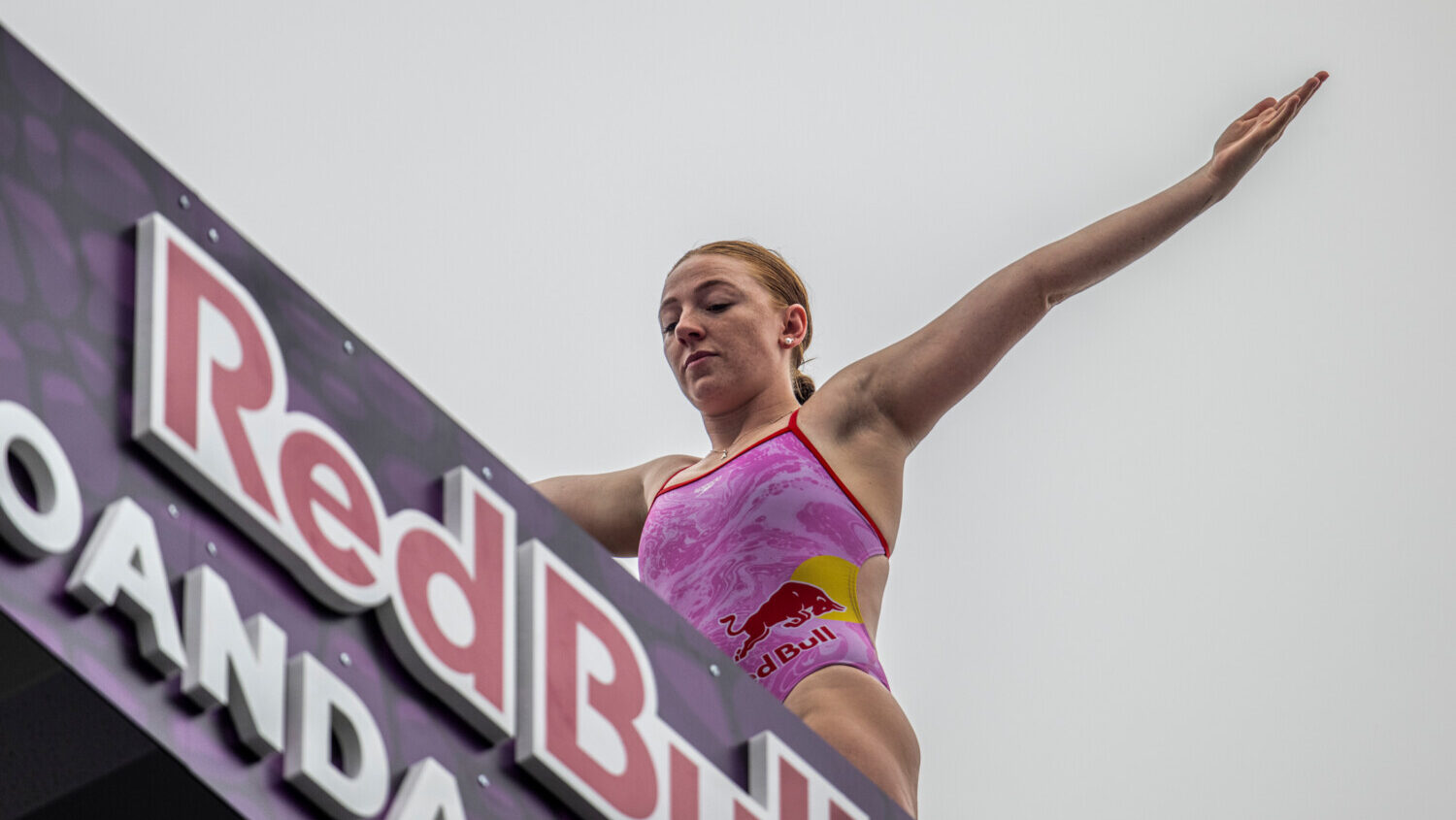
I met Carlson at the Red Bull Cliff Diving World Series Championship in Boston, where the crowd held its breath as she stepped onto the edge of the platform. While other athletes blast music or jump around to get hyped, Carlson prefers to lower her energy rather than raise it. Her pre-dive ritual is a cycle of box breathing — inhaling for four counts, holding, exhaling for four, and holding again.
“I dive my best when I have a low heart rate,” she explained.
That calm shows in her performances, but so does her humanity. She shares the nerves, the stumbles, and the doubts as openly as the triumphs.
That transparency is what fuels her growing fan base. Carlson has become more than an athlete. She’s also a creator who has mastered the balance of sport and storytelling. She’s built an audience of 3.9 million on TikTok, 2.8 million on YouTube, and another 769,000 on Instagram. Her clips range from viral dives to moments where she admits she’s terrified to behind-the-scenes bloopers.
Early on, viewers flooded her comment section, calling her brave, asking how they could be brave too. Carlson flipped the script, reminding them that bravery isn’t just about stepping off a platform.
“Now I have these millions of people who think they’re not brave,” she said. “You are brave, just in your special way.”

Those exchanges in her social media comment sections helped Carlson create a name for her following: the Brave Gang. Her community was organically born, and today, it’s as central to her career as the competitions themselves.
“I wanted to be relatable and show that this deserves to be celebrated,” Carlson said.
That mix of extreme sport and honesty is what makes her stand out in a digital world that often rewards polish over authenticity. It’s also what’s made her valuable to brands. Red Bull and Speedo are among her partners, but Carlson hasn’t lost the sense of trust that drew her audience in. She’s proof that building a career as a creator doesn’t mean presenting a flawless image. It means letting people in on the whole journey.
Watching her dive in Boston, I realized the leap itself is only half the story. The other half happens online, where millions of people find courage in her willingness to share the messy parts. Carlson shows that bravery isn’t about being fearless. It’s about embracing the fear and taking the leap anyway.
And if you ask her, that’s something anyone can do.
Read More:
YG on Making ‘My Krazy Life’, His West Coast Legacy, & Reinventing Himself
There Is No Offseason: KLUTCH Sports Group COO Fara Leff on Commanding the Sports Calendar
Michael Che Opens Up About SNL, Kanye, Colin Jost, Cancel Culture, & Comedy
Red Hook Tavern: Where Billy Durney Wants to Know Your Name
Keanu Reeves’ Next Act Is Built on Two Wheels