

The visual artist behind album covers for Don Toliver, Bad Bunny, and Shaboozey on his Mike Tyson collaboration, card-collecting culture, and wanting his hands everywhere.
Matt McCormick‘s latest art project, “Past The Line,” started as a simple request from his friend. The visual artist, who was born in Northern California, was speaking with his friend turned business partner Patrick Ryan when Ryan noticed a painting McCormick had made of Mike Tyson. Ryan requested one of his own and began plotting a way to get Tyson himself to sign it. That idea eventually evolved into “Past The Line,” a limited-edition blind-pack print collection that marries McCormick’s style as an artist with the thrilling risk-reward gamble of buying a pack of cards.
There are eight different prints available in each of the two packs — silver and gold. Priced at $499 and $999 respectively, the packs come with a signed print of Tyson’s iconic 1986 fight against Trevor Berbick in Las Vegas. All silver pack prints are signed by McCormick, all golds are signed by McCormick and Tyson. From there, prints range from editions of 250 to 1-of-1 items. The odds are the same for each purchaser.
It blends McCormick’s love of card collecting with his passion for American icons. It’s a path he’s explored in his own creations in addition to album covers he’s created for artists like Don Toliver, Bad Bunny, Shaboozey, and more. He’s also created limited-edition works with John Mayer and Dead & Co., showcasing his unique POV alongside some of the greatest musicians on the planet. We caught up with McCormick from his studio in Los Angeles to discuss how “Past The Line” came to be, the “pinch me” moments in his career, and how art has always been a part of his character. Check out the conversation below, which has been edited and condensed for clarity.
Boardroom: Talk to me about the origins of “Past The Line.” How did it come into fruition?
Matt McCormick: I’m an artist, that’s what I do, but I also do a lot of other things. I’m really open to the idea of connecting with people in other channels. That might be through traditional art that you would see in a gallery or products, prints, books, clothing, or spaces. A lot of my art is rooted in the American experience. A lot of people know my work for cowboys and western imagery. Long before that, I started this body of work that I refer to as my story paintings. I was taking elements from my experience in life and telling these stories, but they’d be made up of ambiguous images that might not make sense to somebody else. I was born in the ’80s and grew up in the ’90s. A lot of my work references that era, like the ’96 Bulls and Mike Tyson.
As it kept going on, people were interested in my work specifically for the sports-related stuff, but it would always show up alongside these other elements. It was less about glorifying the sport and more about the place in culture. I’m, by most accounts, considered a fair-weather sports fan. I am not checking stats, but I love to watch games. Regardless, the way I worked with sports led me to doing a project with Topps. That introduced me to a collector of mine turned friend and business partner, Patrick Ryan. Patrick was at my studio one day and he saw this painting I had made of Mike Tyson and he was like, “Would you ever make one that I could gift to someone?” And then he asked, “Would it be cool if he signed it?”
That conversation led to, “Hey, let me commission this painting. I’ll connect with Mike Tyson and we’ll get him to sign the painting. We’ll make prints of the painting and we’ll get Mike Tyson to sign all the prints.”
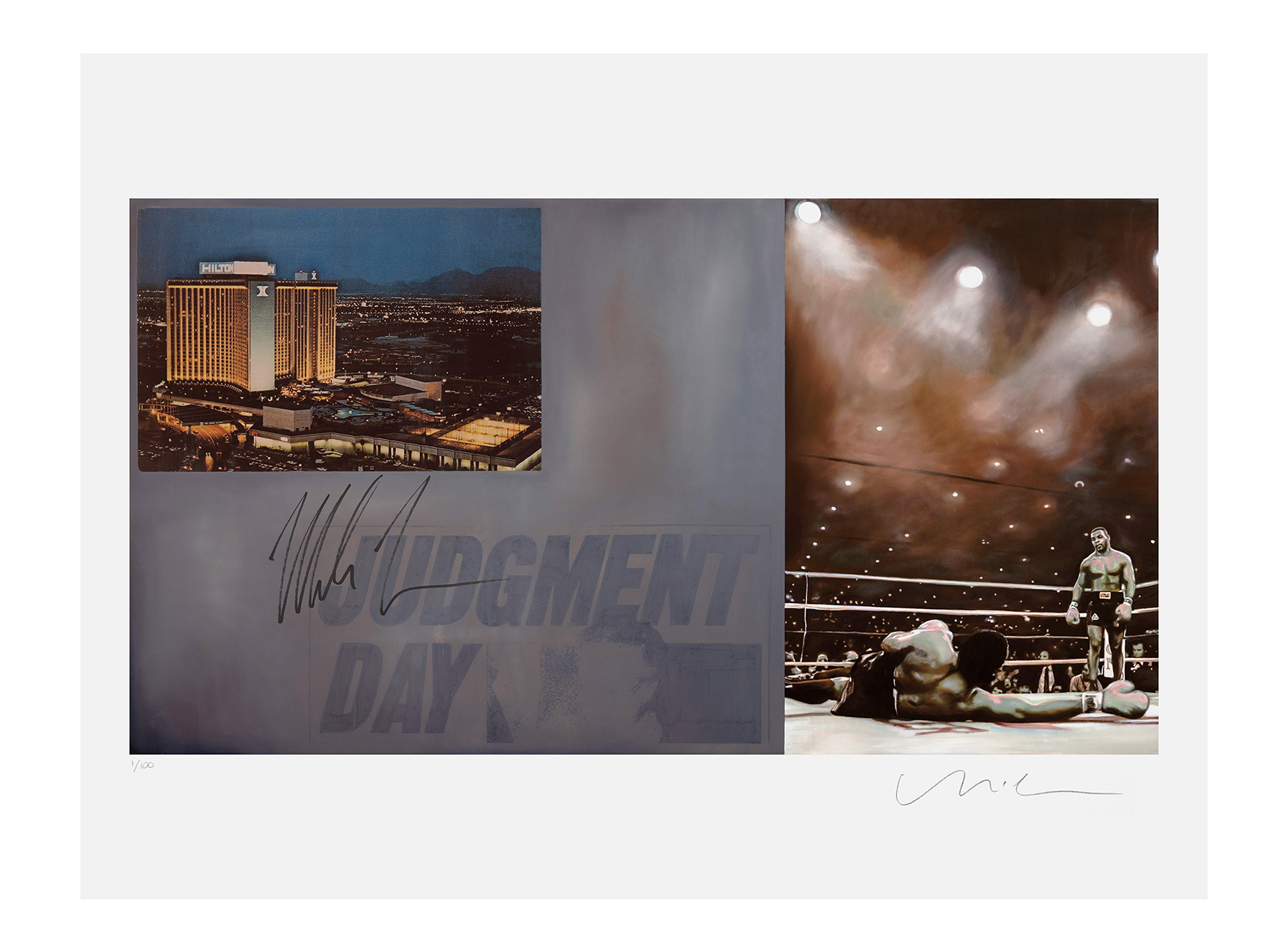
Is this how you decided to number them?
Yeah, it spiraled into this other area that I was really interested in, which was the card-collecting culture and the culture around ripping packs. It’s a gamble that people do when they’re collecting sports cards. I grew up collecting sports cards. I’m definitely not in it the way that some of the people that this is geared towards are. We were trying to find this middle ground where we could blend these two worlds and bring art to people the same way the Topps Project brought art to people. We wanted to further it and create this experience that brings the risk-reward card-collecting experience to the art world.
How did you decide on the “Judgment Day” photo for the piece?
It’s almost like collage because I took a postcard from the hotel and casino in Vegas where the fight was, and I printed that into the canvas. Then I had to tape that off very strategically and treat that in a way where once I painted it, I wouldn’t actually mess it up. The rest of the canvas was broken into these sections. One says “Judgment Day,” which was the nickname for the fight. I took a cover from the New York Post that had “Judgment Day” printed across it. I hand-painted that into the canvas to look like it was screen-printed, which is part of another series of work I do. Then I taped off the whole right side of the canvas and included another angle of the iconic image where Tyson is standing over [Trevor Berbick]. It’s an iconic image of American history. It was also a turning point from him being this up-and-coming guy to a force to be reckoned with.
Obviously most of us know the rest of the story, the ups and downs and all the stuff that came after that, but this was the beginning of him as a mythical figure. He’s just this force, and a lot of that started here.
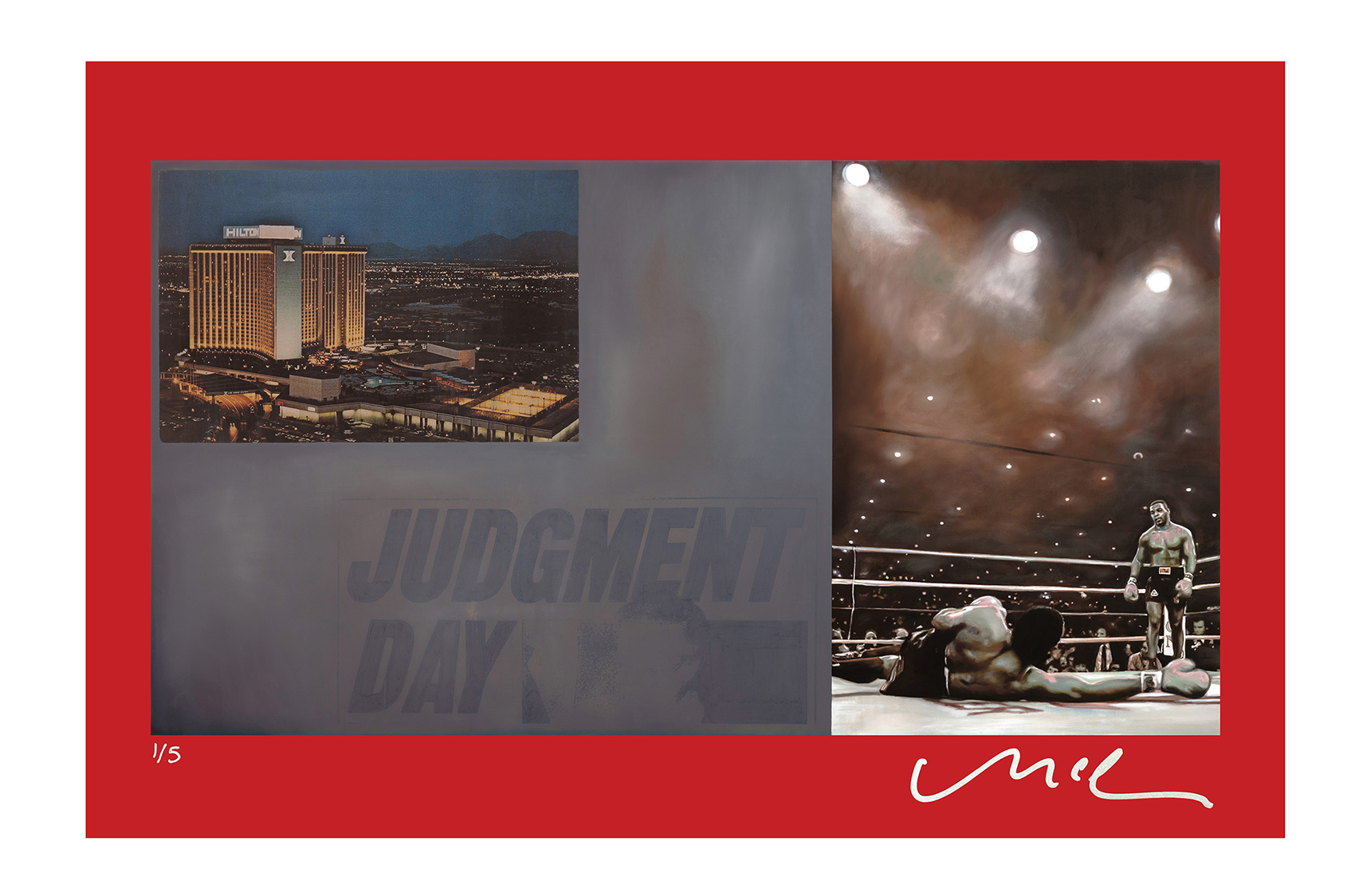
What’s it like having your signature next to his? That must be pretty surreal.
Someone the other day was like, “You know he’s the Michael Jordan of boxing, right?” I knew that, but I hadn’t registered it. When you do projects like this, you get lost in the work and the project and you don’t really have time to be in awe. There are a lot of projects I do where there are pinch-me moments.
You’ve worked with a lot of musicians, too, like John Mayer, Post Malone, and Don Toliver. Where did your love for music come from?
Music was the first art form that I really felt a sense of ownership around. I grew up in a very artistic household. My dad has been a painter my whole life — he’s probably in his studio as we speak. My mom was a photographer when I was a kid. They had an art studio, but he also played music and he’s in a band to this day. He’s about to be 77 and they’re playing gigs every weekend. Music was always a part of my experience. I was in some bands in high school and that kind of thing, but I was never good. I’ve always been a listener and a fan and a person who participates in music in every aspect outside of actually playing. When I moved to Los Angeles, I started as a tour manager for bands and I became friends with a lot of different musicians.
I worked with Odd Future and Tyler, the Creator and Trash Talk. I just met a lot of people in the music industry through all that. When I started making my art and I was tattooing in the early days, I was tattooing musicians. I was making art for musicians and right out of the gate I was getting asked to do album covers and that kind of thing.
I don’t get to be a player in the sense that I am in a band, but album art is something that has always been really important to me and has informed a lot of my life in different ways. Being able to participate through that has always been awesome. I’m in a part of my career where I have to start saying no because I am just overwhelming myself constantly. Of course, I recently got a call about a hardcore band. I grew up listening to a lot of hardcore music and my friend is managing this group and he was like, “Can you do their album cover?” I really should have said no. I was like, “Yeah, I’ll do it.” I have Shaboozey’s album coming out next month, and I want to balance this big project with a small punk band and stick to my roots a little bit. I want my hands to be everywhere.
I’m happy that music people respond to it and it works. Two years ago, they announced that album covers were eligible for Grammys. That’s now my No. 1 goal. If I could win a Grammy for an album cover, that might be that next pinch-me moment.
Read More:

The Blueprint: Jessica Holtz Meets the Moment
The Power Broker: Emma Grede Is Just Getting Going
Quiet Power: Imani Ellis on CultureCon, Creators, and Learning to Let Go
The Long Game: How LeBron James and a Few NBA Friends Might Elevate the Game of Golf
Savannah James and April McDaniel on Navigating Money, Friendship, and Business