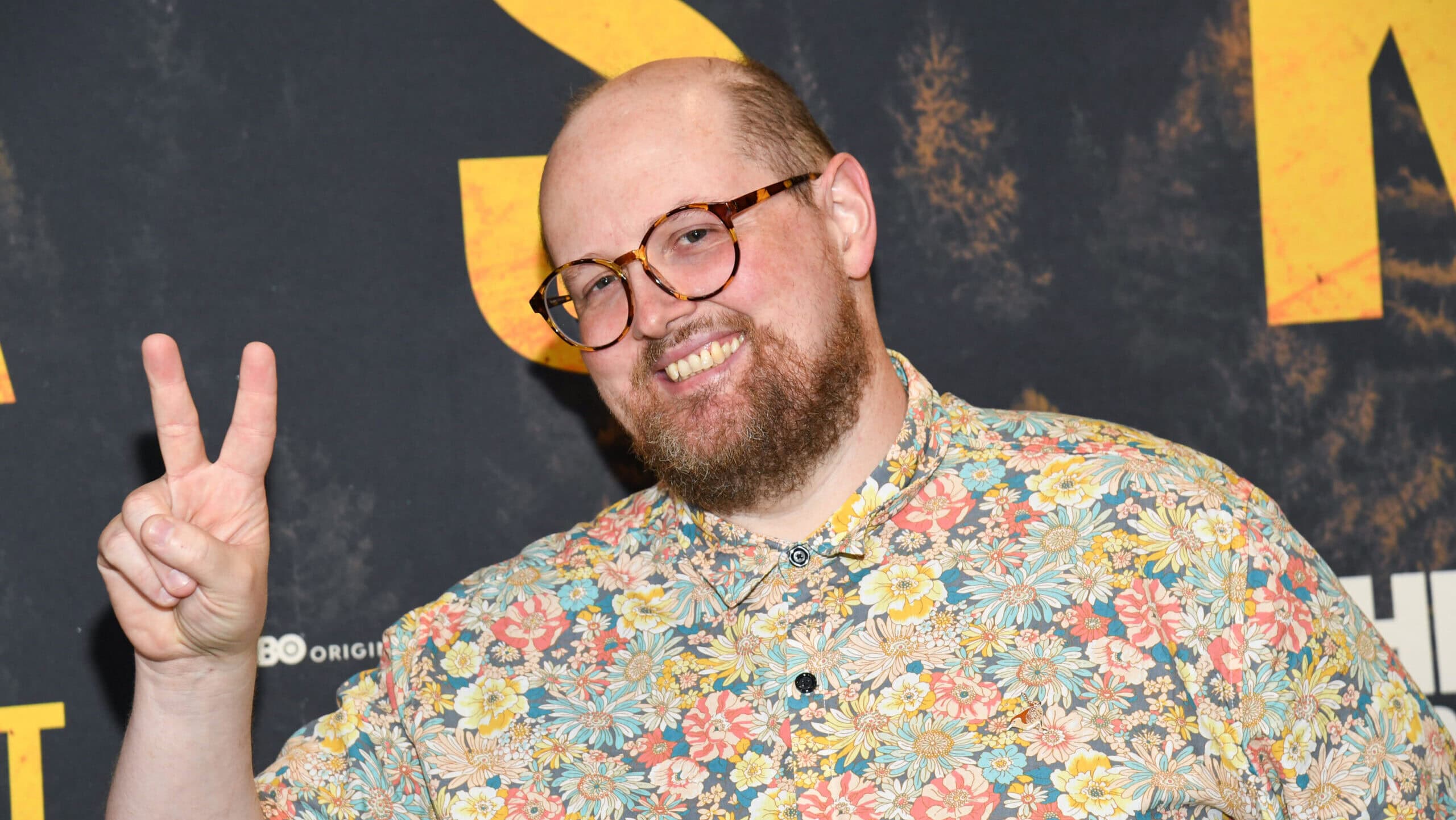
Boardroom sits down with the Task composer to unpack his path from Pitchfork’s Best New Music to shaping one of the year’s standout shows.
Long before Dan Deacon landed his most recent gig, handling the score for the acclaimed HBO television show Task, he was a successful indie musician. His albums earned him coveted Best New Music nods at Pitchfork. He operated in the nice cadence of releasing an album every few years and toured relentlessly behind those projects. When his albums began to receive less favorable reviews, though, he began to panic. As he was trying to write new music, he was plagued by worry: “I started thinking about what would happen if touring didn’t go well and my records didn’t get good reviews. How am I gonna pay my bills? How am I gonna support the family members I support? What am I gonna do?,” he explained to Boardroom from his home in Baltimore. As a hedge, he began scoring films and television projects. It became a way to find creative satisfaction in songwriting but in a way that was more collaborative and less alienating.
Now, collaboration is a key part of his work. He’s one of the many parts that make a film or TV show hum. Sure, the soundtrack for Task is particularly outstanding, but it’s just one of many, many parts of the show that made it one of the year’s best. Deacon explained his new outlook: A film score is like eggs in a cake. They’re extremely important and they help bring it altogether. They bring a lot of richness and character. But you don’t want anyone to bite into a cake and be like, ‘I can really taste the eggs,’” he explained with a laugh. “It kind of has to go unnoticed. It’s gotta add to the character as much as the lighting or costumes, in a way that helps immerse the viewer in a story.”
We sat down with Deacon to discuss how he got into the world of film scoring, the difference between releasing his own work and projects for other people, and the importance of failure in his artistic process. The interview has been edited for length and clarity.
Boardroom: I didn’t know you did the soundtrack for Task until the soundtrack came out.
Dan Deacon: That’s the problem with these “main on end” credits. I get it — it doesn’t break up the episode and most people skip them anyways, but I got a lot of e-mails after the show being like, ‘Dude, you did Task?’
Has separating your name from the music you make been an adjustment?
I don’t know if it’s been an adjustment as much as I realized media is much more segmented in non-intersecting realms than I thought. When I first started scoring, people would be like, ‘I didn’t know you did film scores.’ I got used to that. As I started scoring more, I started hearing, ‘I didn’t know you put out records and do shows.’ I thought that was why people hired me. But I was hired because people heard my work on other scores. That was weird. It’s rare [when] there’s a venn diagram in which people are familiar with both. I embrace that now and almost prefer it. It’s a completely different set of musical skills, for lack of a better word. I found that out the hard way. I didn’t know what I was doing when I started. Sometimes there’s a stigma against recording artists who get into scoring. A lot of people, particularly electronic musicians who are interested in making abstract forms of music, don’t realize it’s extremely different from making records.
Was it an adjustment period?
The first score I ever did was for Francis Ford Coppola. He heard me doing an NPR interview about how music has a unique privilege among the arts where you can put out the definitive version. The album is the best thing an artist can make at that time with the limitations of the technology, budget, and skills. Then they can play it live differently every night. It always breathes. A movie is always a set version. Even if you make different versions, it’s constantly compared to the original. A live show isn’t really compared to an album. They’re two different things but one body of work.
A play is never a definitive version. It’s always live that night and only captured in the mind of the viewer from that particular seat. He heard me talking about this, and he e-mailed me and I thought it was a scam. I went out to his vineyard and we talked about art and music. Eventually, he asked if I wanted to score his film. I agreed, but I was like, ‘I don’t know what I’m doing. I’m writing music, not cues, I’m not writing to the scenes.’ The way I learned to write music was teaching myself on a computer program. I realized I needed to do that with film composing.
In 2015 or 2016, this Baltimore filmmaker Theo Anthony asked me to work on his first feature. He was learning how to be a director, I wanted to learn how to be a film composer. That was a really enjoyable experience and I fell in love with it. I got another film, and then began to learn a bit more with each film. It got steady, and then in 2019 I got asked to do several small projects. What could go wrong? Then the pandemic happened, and I was scoring full time during the pandemic. Three of the four projects I did got into Sundance. From there, I hustled and it became the primary output of my work. I still try to do one weekend of shows a month, but that’s how it got going.
It must be nice to have deadlines, too.
It is nice. I went from being a freelancer who puts out a record every few years and tours non-stops to this.
I imagine having a family means film scoring is better way of making money than putting out records and touring non-stop.
It’s nice to be at home. I miss being on the road, but I don’t miss being on the road 300 days a year. I write as much Dan Deacon music as I can and do want to get another record out in the…future, but scoring has really spoken to me. I get to explore other kinds of music I wouldn’t get to explore otherwise. Most of my soundtrack work would disenfranchise my album listeners. I remember being a kid and getting into a band and they would go, ‘We’re changing our sound,’ and me being like, ‘Why are you doing that?’ You don’t go to a restaurant and it’s like, ‘We’re a completely different restaurant now!’ This gives me the ability to be a completely different restaurant every single time.
There are elements of your music that do have orchestral, score-style influences. I’m thinking of something like the back half of America.
That’s true. There are definitely elements of it. But I think the context and it being all instrumental is different. “Building” or “Work And Play” on Task are tracks that I would put on a Dan Deacon album. Then there are tracks like “Weeping Birch” or “Pink Batman” that could live on a score. The difference between “Okie Dokie” on Spiderman of the Rings and the “USA Suite” on America are night and day, but there’s more connective tissue between those pieces of music than “Forlorn” from Task and “Wet Wings” from Bromst. I don’t know what it is.
Are the processes unique enough that you can focus on writing Dan Deacon music and there won’t be any overlap between those ideas and what you’re coming up with for a film score if you’re doing the two simultaneously?
It has freed up making music for me as a hobby. That’s what got me into it. I was writing music because it was fun to write music. When it became my job, there was so much pressure on it. I didn’t know what Best New Music at Pitchfork meant when I got it for Spiderman of the Rings. I knew it would be great to get it for Bromst, and we got it. For America, we didn’t get it, and I was devastated. I was a spoiled little brat. I started thinking about what would happen if touring didn’t go well and my records didn’t get good reviews. How am I gonna pay my bills? How am I gonna support the family members I support? What am I gonna do? I’m gonna go back to being really, really poor.
I started thinking about how the music would be perceived while I was making it in a way that was very unhealthy for my mental health. The anxiety of making Gliss Riffer was largely about how the music was gonna land. It took me so long to get out of that headspace. I remember seeing Ian MacKaye give a talk in Baltimore and he said one of his goals was to make sure music was never his job. That’s why he started Dischord [Records]. I thought the whole goal was to make your band your job, and he quickly elaborated on it. He didn’t want his music to be tied to the economic ramifications of it. If my music is the way I pay my bills, I’m writing music to pay my bills, I’m not writing music for me. That really resonated and really, really hit. I knew I wanted to get away from that, but didn’t know how. I knew it wouldn’t be a light switch situation. I knew it would take time.
Scoring let me do that, while still giving me that exploratory creative process. I still had that collaborative experience, though, because the director would become my audience of one. By getting a cue approved, it became that dopamine hit of, ‘Yeah, it’s working.’ It started building this love of collaborating with non-musicians on music. Now when I’m working on something for me, it’s fun to open up a blank Ableton session and not worry about it. Now, I want my next record to be my next record, but it doesn’t have to be. Before, the mental pressure made it such that it had to work. My albums aren’t my livelihood, and yet I’m lucky enough to still have music be my livelihood.
It frees you up to make music without any stakes attached.
The only downside is the time. I’m not good at time management. I’m still learning how to be a father with young kids and do those responsibilities and pursue my artistic endeavors. We’ll see. Life is short.
When you signed on to Task, what was the process from meeting with the director to the soundtrack we hear now?
I got involved through the director, Jeremiah Zagar. I worked with him on Hustle and an Apple TV series called Monster Factory. I had done a TV series before, but I was always coming in through the showrunner. I had a ballet up in Philly and Jeremiah and the showrunner, Brad Ingelsby, were in town seeing a basketball game. They were gonna come to the ballet and Jeremiah wanted me to meet Brad. We met and hit it off. I was really excited about the idea. I love Mare of Easttown. We spoke about the minimalist composers we like — Terry Riley, Steve Reich, Meredith Monk — and when it got through the hurdles of HBO, we started on the scripts.
From there, Brad and I started talking about the scenes in the script and what they would need. The overarching themes of the shows are about families: both chosen and assigned. I started writing to the scripts as if they were literature I was inspired to write to. This was before I had seen any picture. The way I write is pretty dense and wide, with a lot of stems. There’s one track, “Forlorn,” that has like six piano tracks. I went up to set one day and Brad was like, ‘let’s talk about the music.’ He opened up the laptop and he had every single stem opened up as a tab. He picked up on things I didn’t even think would be that audible. The bowed vibes and alto flute, which were just there for color, became foundational motifs for the show. That showed me how in the weeds Brad would get. That collaboration is the most fun. I’ve never really been in a band. Having other people’s musical input helps me make music I would never make otherwise.
Do you feel the same satisfaction when a score comes out as when a new Dan Deacon album comes out?
It’s different. It’s definitely not the same, but I feel just as much satisfaction and pride in sharing it. When I put out my own music, it’s like, ‘Fuck, what have I done?’ There’s not that review process. That’ll be different in the future. I like the idea of working with an engineer, someone else to mix it, working with a producer. I look back and I’m glad I did all of those things DIY, but did I really like that? Or was I just stubborn, cheap, and hard to collaborate with?
I was at some lecture recently and it was about having fun. They said that people think about fun the way little kids think about fun, like, ‘Yayyyy!’ Someone who’s into model trains doesn’t react that way when they’re glueing fake trees on a hillside, but that’s really fun for them. He was talking about how fun has a gradient of appearance. It made me think about the fun I get out of my work. The nightmarish quality of not knowing whether or not what I was doing was any good was a lot of fun. It’s like a puzzle and a maze. But now, I want to collaborate in my solo work because I’ve fallen in love with collaborating on the film score side of things. Sometimes having another voice in the room is helpful.
It’s inspiring that someone as successful as you still has many different thoughts about how they want to make art. It’s never fully formed.
It’s fun to experiment. It’s fun to fail and learn from those failures. Maybe certainty is really nice, but unfortunately I’ll never know [laughs].

Pete Crow-Armstrong Still Getting Used to Calling Aaron Judge a Teammate on Team USA
How Anajak Thai Became One of Los Angeles’ Most Exciting Restaurants

Now That Paramount Has Outbid Netflix, What’s the Plan for Warner Bros.?

Inside the Making of the Coolest Golf Collab of the Year (So Far)

Shaun White’s Second Act: Redefining the Business of Snowboarding