
Boardroom went to the league’s inaugural tour stop to learn just how it plans to reframe the sport.
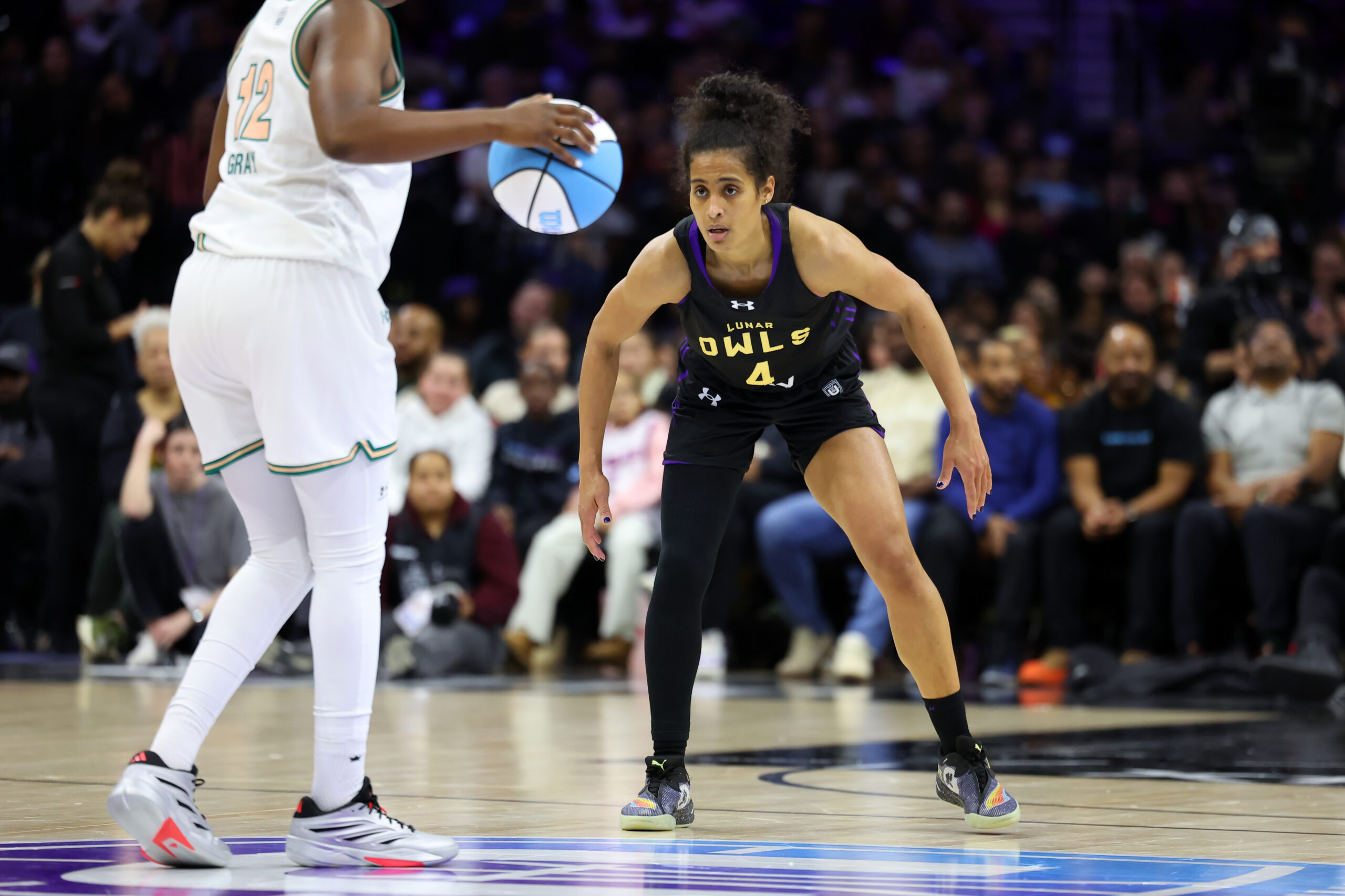
Unrivaled Basketball‘s inaugural tour stop last weekend in Philadelphia is was nothing short of historic, but more so because it was unusually straightforward. The concept isn’t new. A new-ish women’s basketball league touched down in a major hoop city for a pair of games and drew 21,490 people, a record for Xfinity Mobile Arena and the all-time attendance record for a professional women’s basketball regular season game. Though Philly is set to welcome a WNBA team in 2030, there was no local franchise or novelty messaging to encourage others to pack the venue. Instead, organizers sold the event as a promise to witness high-level basketball played by some of the best players in the world. Anything else was a fun add-on.
With 76ers faithful still filling the arena despite a lackluster run, Philadelphia is not a market that needs a lesson on how to consume basketball. It is also not a market that shows up reflexively for everything put in front of it. The high turnout suggests the product met an existing need rather than creating a new one. Anyone who’s been to Miami knows the vibes inside Sephora Area are incomparable. So on Friday, the heightened atmosphere made it seem as if there were nearly double the 21,000+ spectators in attendance.
To their credit, Unrivaled’s approach to the weekend was notable for what it did not do. By not framing the games as symbolic or putting the playoffs implications top of mind, the audience’s focus stayed on the games themselves, the players, and the competitive environment.
From an operational standpoint, the weekend functioned as a test of several assumptions at once: that women’s basketball can be a draw on the road, that a condensed format can hold attention in a large arena, and that star power translates without a home-market attachment. Oh, and despite what’s going on in the WNBA, fans are still eager to watch the best of the best play, eliminating a need for the league’s presence should collective bargaining agreements (CBA) talks continue to stall. None of those theories appeared to break under pressure.
The touring model is especially relevant here, as they are typically treated as riskier than fixed games in a repurposed 1,000-seat space due to the lack of built-in loyalty. What Philly showed is that loyalty may not be the primary driver in markets with established basketball cultures. Familiarity with the sport itself can be enough, provided the level of play is clear and the presentation does not feel performative.
It is also worth noting what did not appear to be necessary. For example, there was no evidence to me that the audience required extensive education about the league’s 3-on-3 structure. Of course if you are an enthusiast, I suppose this is simply another niche to enjoy. However, my observation was that there was no visible effort to soften expectations or reframe success metrics. The event was positioned as something worth attending on its own terms, and people made that judgment quickly.
Not only did the general public arrive in droves, there was no shortage of celebs courtside. Among the famous faces included Leslie Jones, Jason and Kylie Kelce, and Wanda Sykes, who is an investor in the league created by Napheesa Collier and Breanna Stewart.
Speaking during the event’s festivities, Collier confirmed that the league plans to hold multiple tour stops next season, with the cities and number of stops to be announced.
When Demand Isn’t the Problem
With the success of this Philly stop, an uncomfortable but necessary question arises: how much of the slow growth narrative around women’s basketball is structural, and how much is self-imposed? With buy-in from players who said this league is much more preferred than over playing overseas and provides select benefits that the W has failed to equip, what it implies is at least some constraints are not coming from audience behavior.
The crowd size, energy, and engagement did not indicate a league cautiously testing the waters in a new market. Instead, Unrivaled seemed to be responding to a product its fans already understood. While the W continues its CBA talks, Unrivaled provides an outlet for basketball fans to get their fix. Furthermore, they’re so in tuned with their audience that everything that evening felt intentional. From casually dropping gift cards from its presenting sponsor Sephora during game breaks to spicing up the pre game intros by having players enter from the stands, they curated an experience that truly feels untouchable.
A day before the games, apparel sponsor Under Armour hosted a clinic at a local Philly community center for hundreds of teenage girls. Players from Breeze BC, Phantom BC, Rose BC, and Lunar Owls BC were all present for shooting drills, photo opportunities, advice to the hundred or so attendees, and more. UA did their part by providing footwear, apparel, accessories, and other necessary resources.
Plenty of credit should also be given to Unrivaled’s product design. The league’s emphasis on talent, shortened games, and placing players at the center of the experience all contributes to its supreme visibility. Though some things mirror the W, there is little attempt to imitate traditional league rhythms. The weekend did not feel like a proof-of-concept. It felt like a wholly finished product. And as Togethxr says, “Everyone Watches Women’s Sports.”
Established leagues, networks, and sponsors often evaluate women’s basketball using imbalanced parameters they wouldn’t apply elsewhere. Lower attendance forecasts, cautious revenue projections, and incremental rollouts are treated as prudent. Philly complicates that framework. Because if a new league can achieve that scale in a temporary setup, it becomes harder to argue that similar results are unattainable with permanent infrastructure. It also becomes harder to justify continued underexposure on the grounds that the audience is not ready.
What stands out most is how little of the weekend relied on exceptional circumstances. Philadelphia is a strong sports city, but not an outlier. The players were elite, but not unfamiliar to fans. The marketing was competent, but not overwhelming. The pieces involved are available in other markets. But who is willing to take that risk? Phee and Stewie were, and that is why the event reads less as an anomaly and more as a data point.
The risk for the broader industry is not that Unrivaled succeeded once. It is that the conditions that produced the result are repeatable. Evaluating the Philly weekend as a one-off allows existing assumptions to remain intact. Philadelphia did not resolve every question. However, it did clarify one thing: when women’s basketball is presented as a complete, confident product, some markets respond without hesitation.
Michael Che Opens Up About SNL, Kanye, Colin Jost, Cancel Culture, & Comedy
Red Hook Tavern: Where Billy Durney Wants to Know Your Name
Keanu Reeves’ Next Act Is Built on Two Wheels

The Blueprint: Jessica Holtz Meets the Moment
The Power Broker: Emma Grede Is Just Getting Going