
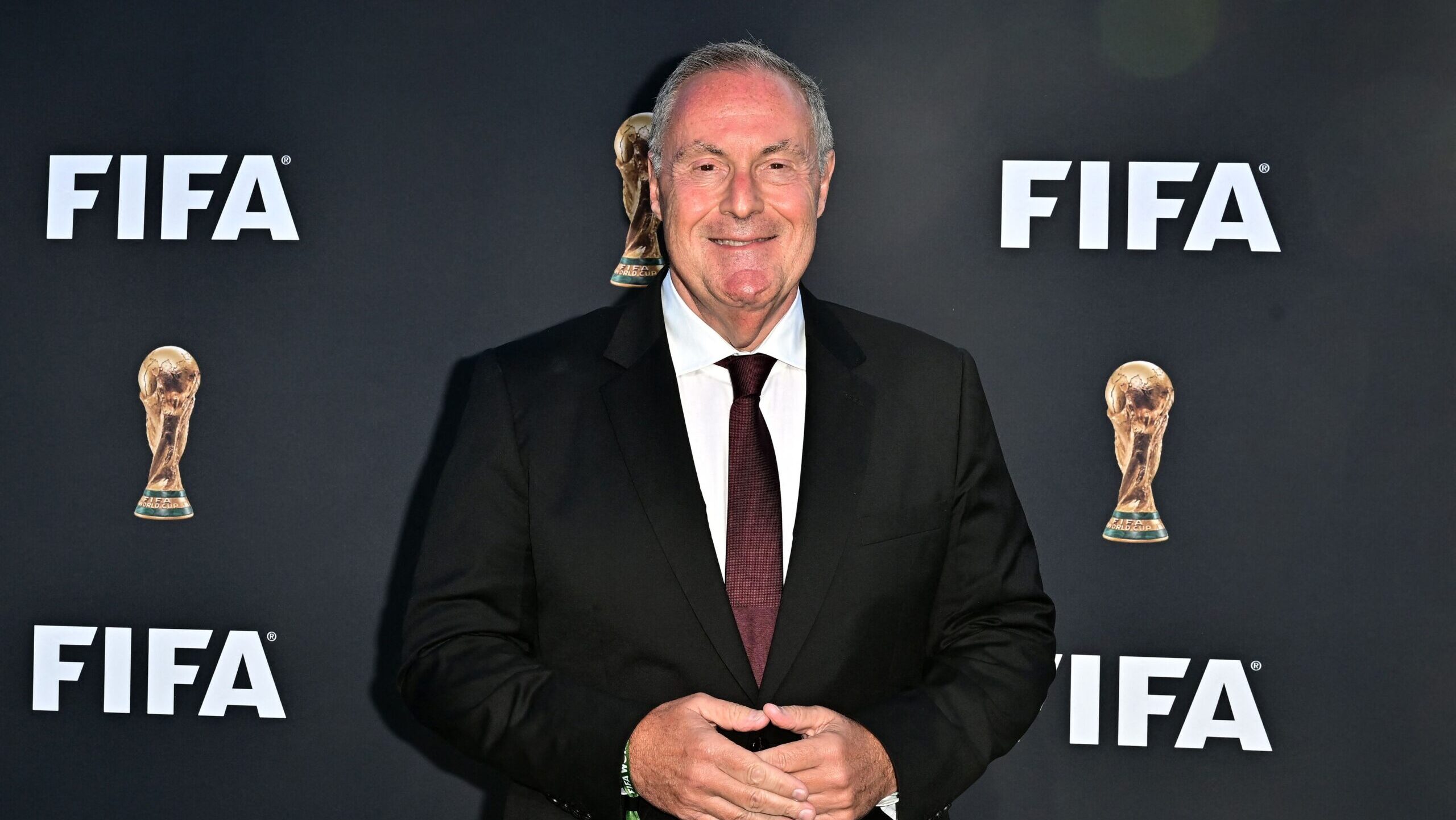
The legendary “Voice of Soccer” reflects on witnessing Argentina’s three World Cup wins, his ties to Maradona and Messi, and the meticulous preparation that’s kept him at the top.
In baseball, the late Vin Scully‘s poetic storytelling became the soundtrack of summer for generations of Los Angeles Dodgers fans. In basketball, Marv Albert‘s unmistakable “Yes!” punctuated countless unforgettable moments. Across every game and every era, these announcers have done more than describe the action; they’ve defined how fans interpret the game and react.
Yet, even among this pantheon of voices, no one has embodied the pure spirit of sport quite like Andrés Cantor, the man universally celebrated as “The Voice of Soccer.” With his boundless energy and famously thunderous “¡Gooooool!” call, Cantor transcends language and culture, uniting fans around the world in shared emotion. To know the Cantor tone is to be a proper footy fan. The large-than-life personality carries himself with passion on and off the pitch, showcasing his love for the game with everything he does. While the “¡Gooooool!” call is uniquely his, so is how Cantor talks about football. He’s analytical, funny, and jovial, while never forgetting to be educational in the process.
“I’m very, very opinionated on a match,” Cantor said to Boardroom. “The goal obviously is to stand out, but if I have to say what makes me proud is when people say, ‘Hey, you were right about such tactic or such player. I’m very proud when people recognize the things I say during 90 minutes and not only the 30 seconds of the ‘¡Gooooool!’ chant.”
Argentina: A Nation Built on Glory
Born in Argentina, Cantor has only witnessed success on the world stage. Throughout his illustrious decades-long career, La Albiceleste has bred champion after champion from the late Diego Maradona to the arguably modern-day GOAT, Lionel Messi. Cantor boasts stories about interacting with both of them, but the moments spent with Maradona are some of the most poignant of his lifetime.
“Every time we saw each other, we had good conversations,” said Cantor. “I interviewed him on the record probably three or four times. I was in his Napoli home both times that he won the Serie A for Napoli for the very first time in history. So that is unforgettable. I was at his private celebration with some of his teammates, family, and friends in Napoli. We had a kind of professional relationship, but it was very, very fun.”
There are moments in sport that live beyond replay and our realms of understanding. Maradona’s “Hand of God” in 1986 is one of them. To some, it’s just a goal. But to others, it’s mythology. When asked if he believed in the Hand of God, Cantor laughed and argued, “It was a different time of football. Now, with VAR, it wouldn’t have stood. But that’s how the game was played back then. Nobody saw him fist the ball into the net – and the rest is history.”
Of course, that history doesn’t stop with the hand. Minutes later, Maradona scored what many still consider the greatest goal in football ever — a solo masterpiece that blurred the line between sport and art. He picked up the ball in his own half, beat seven English defenders, and finished with an impossible twist of his body that defied physics.

“If you see the way he scores at the end,” Cantor explained, “he switches his body to favor his left foot. Anatomically, if we tried that, we’d probably break our meniscus and ACL together. And he had a defender on his back.”
That score defined an era long before slow-motion scrutiny, before algorithmic scouting and biometric data to explain the obvious. Football was then a mix of instinct, imagination, faith, and chance — all traits Maradona embodied.
Argentina had already been blessed with one of the best to play, so the nation was simply not playing fair when Messi effortlessly stepped up to be the modern-day hero. Incalculable titles with Barcelona and at the national level, and even more personal accolades, the only thing missing from his trophy case was the World Cup trophy. That all changed on Dec. 18, 2022, when Argentina defeated reigning champions France in a penalty shootout to claim its third title in national history. Few people on earth can say they’ve seen Argentina win three World Cups — from the stands, from the press box, and from the broadcast booth. Cantor can.
“I was a teenager in 1978, sitting in the stands, watching Argentina win their first World Cup,” he recalled. “In 1986, I was working as a credentialed journalist for an Argentine magazine, witnessing Maradona’s magic firsthand. And in 2022, I was on the call when Argentina won again. All three are dear to me.”
That sentence alone captures nearly half a century of football history, a timeline that mirrors Argentina’s own evolution as a nation and football’s evolution as a global spectacle. But it also tells the story of two men who turned a sport into a shared language and inspired thousands worldwide to juggle a ball for the first time. The 1986 triumph, Cantor remembers, carried more than athletic weight. “That game against England had a lot of political connotations,” he said. “And then Diego scored the most beautiful goal ever, the best goal in the history of the World Cup.” Maradona’s genius was emotional, almost spiritual — raw talent that embodied Argentina’s resilience and defiance on the world stage.
Preparation is Everything
For someone so polished and experienced as he, you might be shocked to know Cantor’s prepares for any match as if it’s his first time on the mic. That includes hours of studying, watching (and rewatching) matches, and an education into proper pronunciations. Kick-off for the 2026 FIFA World Cup isn’t for months away, but best believe when new nations qualify, Cantor is already locked in and head down.
“I’ve already started my preparation,” he says, pointing to a folder on his computer labeled ‘World Cup 2026.’ “Every time I watch a match, I take notes – how teams play, who takes free kicks, what their shape looks like. I watched Cape Verde’s last two matches. I’m already logging what I see.”
That attention to detail isn’t new. It’s what separates Cantor from the thousands of other broadcasters who call games. His process isn’t just about memorizing names or learning lineups; it’s about providing the same fans who excitedly tuned in to watch him work at 15 are doing the same at 45, without wondering he’s lost his “touch.”
“I can’t wait around for everyone to qualify,” he continues. “I’m watching a lot of matches already and taking notes. Once the 26-man rosters are finalized, I’ll cross-reference everything — who played, how they played, and what I’ve observed over the last eight to ten months. It’s about doing the homework the right way.”
In a world where social media rewards speed, hot takes, and instant reactions for the promise of virality, Cantor’s old-school method is not only appreciated but also necessary to maintain even a semblance of what life was like before the introduction of technology and other factors. He jokes about not needing to watch English captain Harry Kane play for Bayern Munich to know how efficiently he moves, but even that observation reveals the mindset of someone who sees the game as a living organism — constantly evolving, never finished.
“These players go through grueling European seasons,” he says. “So, even if I know how they play, I have to ask: Will they make it to next year in top shape?”
Rising Talent, Rising Stakes
With the draw less than a month away on Dec. 5, storylines are already forming about who will defy odds in the United States, Canada, and Mexico. Who will emerge as the summer’s hottest prospect? Which nation will upset a trophy contender? Those, along with others, are burning questions that fans and analysts alike will keep top of mind over the next several months. Because he’s effortlessly tuned in week by week, Cantor already has a shortlist of names to keep an eye on in the run-up to the competition.
The obvious playmakers are Lamine Yamal, barely 18 and already a catalyst behind Spain’s recent triumphs, and Real Madrid’s Kylian Mbappé, who, at just 25, has two World Cup finals and one title to his name. Jude Bellingham, Endrick, and Alejandro Garnacho — all teenagers or barely past it — are carrying the expectations of nations, sponsors, and billion-dollar clubs.
“The kid just turned 18,” Cantor said of Yamal. “He’s already won a European Cup and a Spanish League title, and now everyone expects him to carry Spain to another World Cup. That’s crazy.”
He then points to Real Madrid’s summertime signing of another Argentine prodigy, Franco Mastantuono, the youngest player to ever feature in a competitive match for Argentina, from River Plate. He’s already starting every game, and Cantor forecasts he’ll probably make Argentina’s World Cup roster. That magnifying class on emerging talent furthermore emphasizes that young talent is globalized and monetized, proving that clubs are steadily investing in their futures, betting that these teenagers can define the next decade of the sport, both on the pitch and across platforms.
And yet, for Cantor, who’s witnessed legends from Maradona to Messi, it’s still a marvel at how quickly and early these wunderkinds become overnight sensations. “It blows me away,” he said. “Players used to spend their entire careers dreaming of being called to the national team even once. Mbappé has already played in two World Cup finals, and he’s not even 25.”
That blend of humility and passion, along with natural charisma, is what makes Cantor’s career timeless. In an age where sports media often feels disposable, his voice endures because it’s built on love, not noise. He reminds us that joy is still a professional advantage.
“I’m really, really thankful,” he concludes. “Blessed to be able to do what I love the most.”
And that, to be honest, might be the real definition of success. Not the spotlight or the title, but the simple, enduring privilege of sitting in the best seat in the house, doing what you were meant to do.
Read More:
Kevin Durant Reflects on a Life Centered Around Basketball
Kevin Durant Looks at Anthony Edwards, Luka Dončić as Next All-Time Scoring Threats

Kevin Durant Breaks Down the Real Difference in Michael Jordan’s Game
NFL Stars, Celebrities Show Up For Fanatics Flag Football Classic

Kevin Durant Reacts to Passing Michael Jordan on NBA All-Time Scoring List