
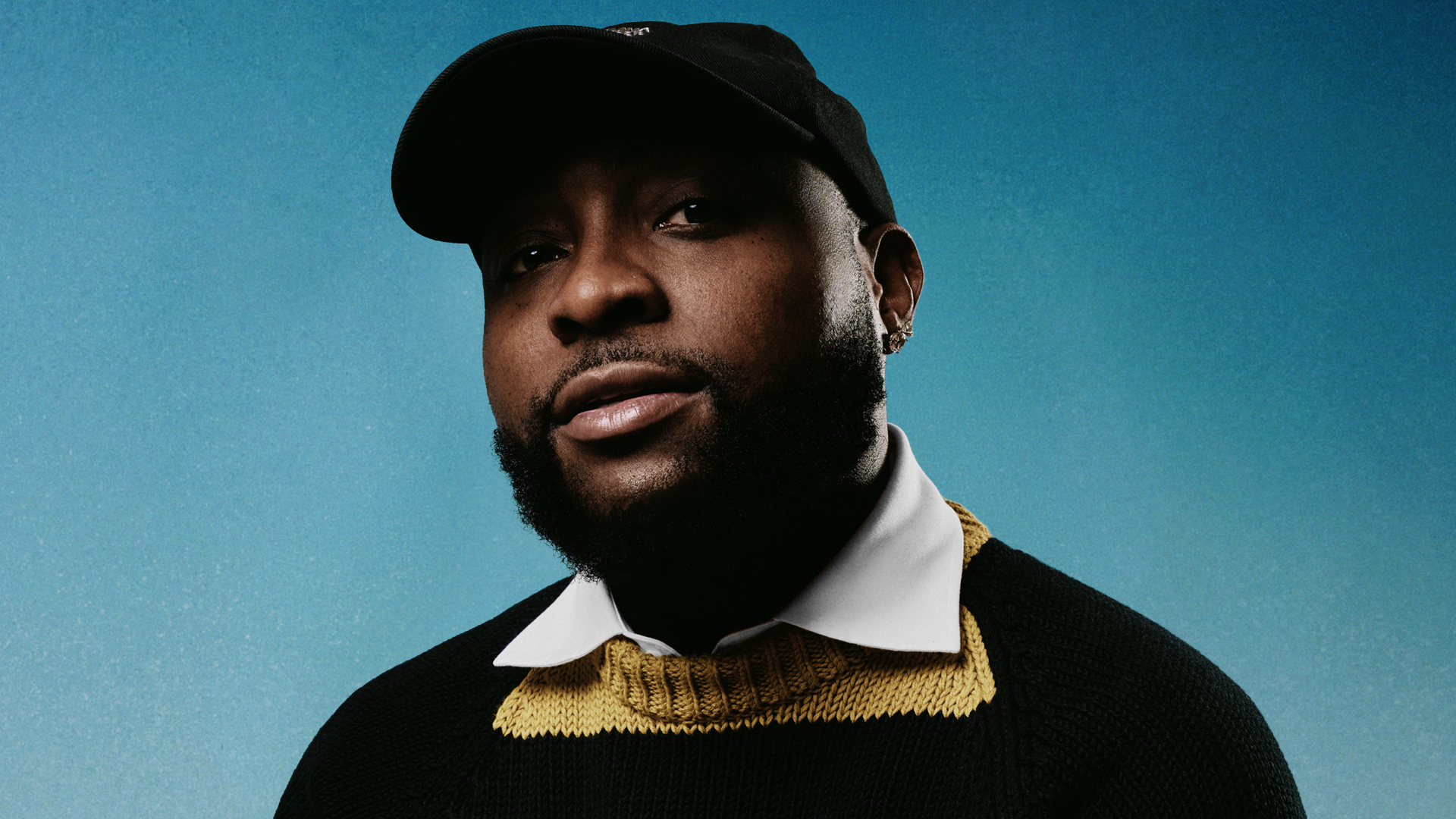
Fifteen years after “Dami Duro” turned every club from Lagos to Kingston into a sweatbox, Davido has no interest in a victory lap.
This story appeared in Boardroom’s Fall Issue print magazine and has been adapted for online publication.
Davido is in a great mood. Sitting in the green room of the Boardroom studio with a small clique, the Nigerian superstar is beaming nearly as much as the diamond ring he has on his left hand. You would be too if you managed to break onto the scene 15 years ago with a single called “Dami Duro” that turned every club from Lagos to Kingston into a sweatbox. And by the following summer, you dropped your critically acclaimed debut album Omo Baba Olowo. You would be ecstatic to look back and think about how the second single from your sophomore album, “Fall,” became the longest-charting Nigerian pop song in Billboard history. And then you couldn’t help but talk about how his third album Timeless posted 8.4 million streams on its first full day, the biggest opening ever for an African album, and made you the first African artist to top the iTunes album chart.
Who wouldn’t want to discuss how you crossed nine billion streams, closed a World Cup as the first African artist to perform at the tournament outside the continent, in front of a stadium and a broadcast north of 250 million people, sold out Madison Square Garden, London’s O2, and Atlanta’s State Farm Arena? You would absolutely want to talk about how you’re one of maybe three names you can credibly offer if someone asks who dragged Afrobeats from a regional sound into a global one that now travels further than almost anything else coming out of the Black diaspora.
Davido doesn’t want to talk about any of that, though. Especially not the part about helping Afrobeats catapult around the world. What he wants to talk about is the present and the future. Oh, and the new album Oriadé, his sixth LP.
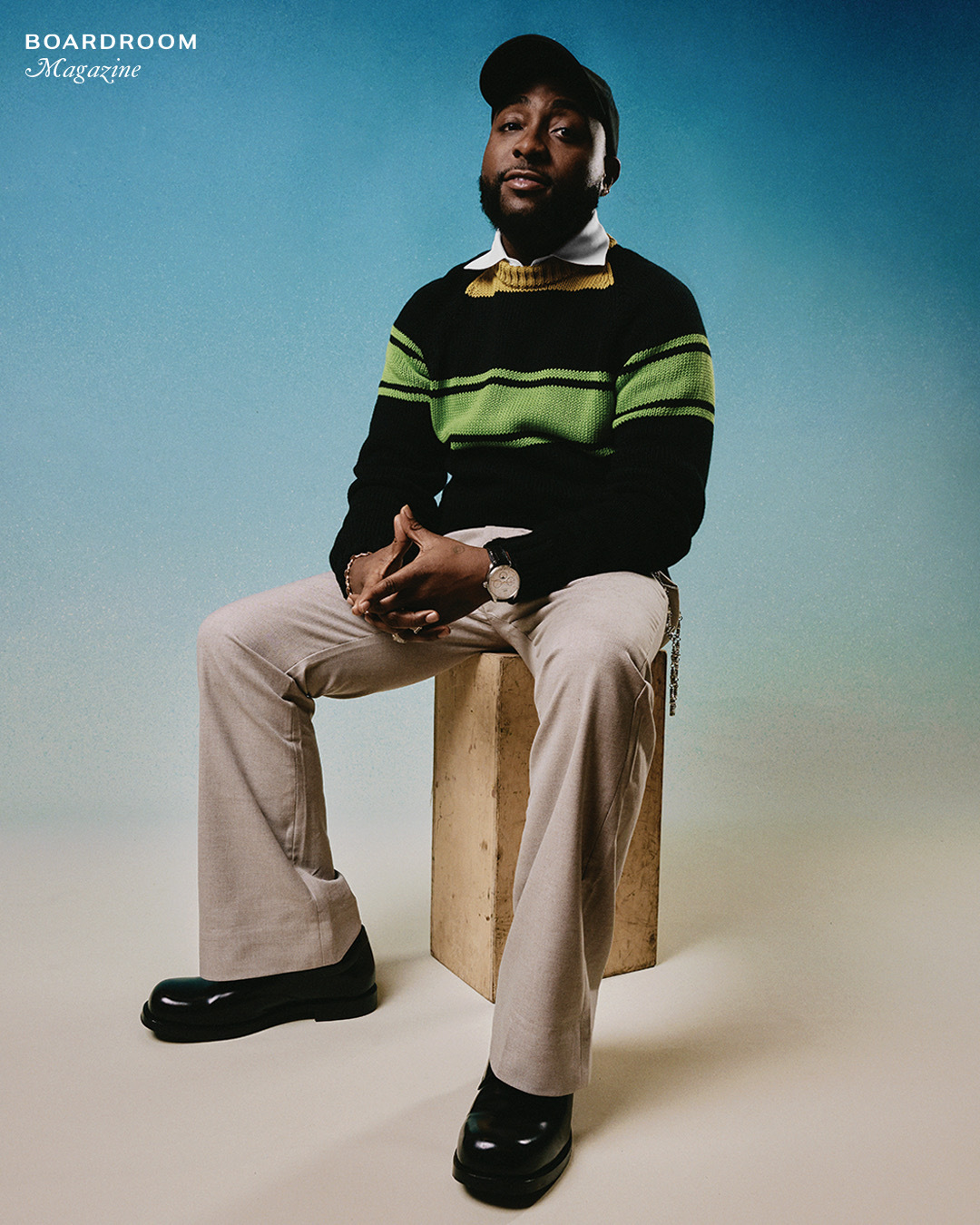
“Longevity, man. It’s been a crazy journey,” he says when his track record is questioned. “Fifteen years is long, but I feel like it went by quick for me.” He pauses on the math of it, the survival rate. “Some people don’t even last six months,” he adds. What he keeps circling back is not that he lasted but that he’s still on go. “To not only be doing it for fifteen years, but to be doing it at such a high level and to still be excited. I still get excited to get on stage. I still get excited to get in the studio, to create,” says Davido excitedly. He offers the only explanation he trusts. “Music changed my life,” he says. “So I feel like that’s the only way that I could have lasted fifteen years at such a high level.”
Born David Adedeji Adeleke in Atlanta, Georgia, in 1992, Davido’s first ambition was almost embarrassingly modest. “All I wanted at first was just to hear my song on radio in Nigeria at one time,” he says. “I just loved music. I loved the craft. I never knew that it was eventually going to get this big.” Before even that, the aspiration shrank further. “I just wanted to hear myself.”
The turn came through an older cousin, the kind of relative a kid orbits. “Everybody has that big cousin that you always mess with,” he says. The cousin disappeared for a stretch and came back doing music, and one day took a teenage Davido to a studio. “That was my first time seeing people create music ever. As soon as I saw that, I was like, ‘Yo, this is what I want to do,’” Davido remembers. He started producing, then engineering, and the choice to sit behind the glass rather than in front of the mic was a strategic way to smuggle a dream past a family that had other plans that involved David sitting behind a desk rather than a console. “I knew then in my head, my dad’s not going to let me do music. So let me just be a producer and be in the background,” he says. “Because of the type of family that I come from.”
The type of family Davido comes from is similar to the one seen in shows like Succession. His father, Adedeji Tajudeen Adeleke, is the powerful patriarch who started a company that went on to conquer the market and make them wonderfully wealthy. In this case, the company wasn’t a media conglomerate; it was Pacific Holdings Limited. Founded in 1983, Pacific Holdings Limited started off as a drilling and water treatment company before expanding into energy, banking, real estate, and other interests. So, it’s not a surprise to learn that his father wished for his son to follow in his footsteps and work in the family business, much like the scions in the HBO series. They were weary of him embarking on a music career in Nigeria, a country that until recently lacked proper music industry infrastructure and had weak copyright laws. “Fifteen years ago, being an African musician was not something to write home about,” he says. “Now, one record, you make a million dollars. It’s a different ballgame.” When the vindication finally arrived, it showed up in small, domestic ways. He says one of his sisters (he has two, both older, Sharon Adeleke-Ademefun and Ashley “Coco” Adeleke) confessed the near-miss to him plainly: “Damn, we almost didn’t let you do this!” His nieces and nephews introduce him at every new school the same way, and he lights up telling it. “The first thing they’re saying is, ‘Davido’s my uncle.'” That, he says, is the sweet part. “It’s sweet to talk about when you make it.”
Asked whether the family plays his records at their gatherings and he laughs at the idea they’d play anybody else’s. “If you play another artist, you’re in trouble,” he says. “Top to bottom, Davido.” And the guest of honor still has to sing for his supper. He knows artists who beg their relatives to keep the music off. He is not one of them. “They’re happy to say they’re proud of me,” he says. “So I just let them have their fun.”
By any sensible release calendar, Oriadé should not exist. He dropped 5ive last year, and the album before it, Timeless, which was nominated for Best Global Music Album at the 2024 Grammys, is still getting burn by fans. He knows how the timing looks. He also cannot make himself stop. “There’s never a period where I’m like, ‘Yo, I’m working on the album,’ because I’m always in the studio,” he says. The situation got worse once he took the commute from his Atlanta home out of it. “Now I got a studio in my house. All I got to do is go downstairs and work,” he says. The overflow nags at him. “Why are we sitting on so much great music?” Two of the songs on Oriadé, he mentions almost offhand, were written for a project two albums back.
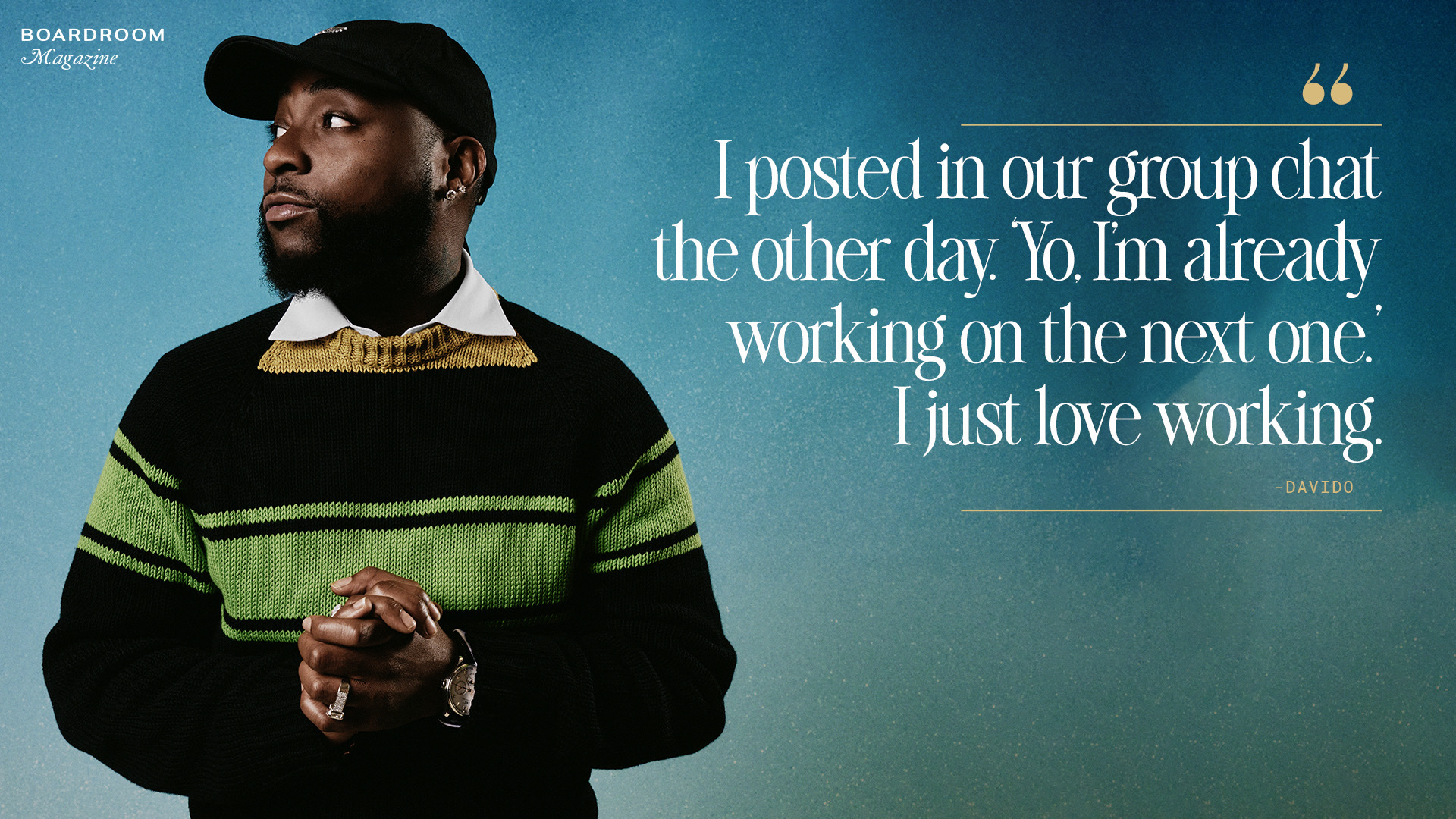
The record exists because he came off the road with energy to burn. Rather than resting when the tour ended, he hopped right back in the studio. “As soon as I got off tour, I just built my studio,” he says. “So many experiences from the tour were ideas we were recording, I just went in the lab and created this body of work, 13 songs, quick.” He is already past it, too. “I posted in our group chat the other day, I was like, yo, I’m already working on the next one,” he says. “They’re like, yo, chill.” He shrugs. “I just always love working.”
The title tells you where his head is. His debut carried a Yoruba name, Omo Baba Olowo, which means “Son of a Rich Man.” Everything after it went English: A Good Time, A Better Time, Timeless, 5ive. “Lots of time,” he jokes about the streak. Then a tour pulled him back to his first language. This year he ran 60 shows back to back through the US and Europe, and then did the thing he’d been putting off for the better part of a decade. “I haven’t done my African tour in eight years,” he says. “So we took it back to Africa.” Standing in front of those crowds reset something in him. “These are the people that were pushing you before the globalization of African culture,” he says. He came home certain about the sound of the next record. “I wanted it to be very, very predominantly African, from the producers,” he says. Even his American guests had to clear that bar. “Leon [Thomas] is American, but if you listen to that record, it’s still really, really African,” he says.
So when he again reached for a Yoruba word he chose a heavy one. “Oriadé means heavy is the head that wears the crown,” he says. He is not being modest about what that implies. “I feel like I’m in my legendary era right now. My crown era.” The royalty extends to everyone he let onto the album. “Everybody that worked on this project, to me, is royalty,” he says. He wants the people in the crowd to walk out feeling the same way. He told his production manager exactly that. “I want everybody that comes to my show, when they’re leaving, to feel like a king and a queen.”
Part of wearing the crown, the way he sees it, is passing pieces of it down. “Every album, I like to make sure there’s an artist the world doesn’t know about that I want to showcase,” he says. On Oriadé it’s a young Nigerian singer named Llona who is featured on the album’s close, “My Light.” “A lot of talented people don’t have the platform,” he says. “Each album, I like to give one artist or producer or a music video director an opportunity.” The advice he gives them is the same advice that kept him standing for 15 years: “Conquer where you’re from first,” he says. “Do a Nigerian tour, then an Africa tour. And then if God permits, you go outside and conquer the world.” He thinks the younger generation has the sequence backward. “People rely these days on Western validation so much. There was a time when African music wasn’t being played at all outside Africa, but we weren’t suffering,” he says looking toward the ceiling, as if this fact actually pains him. That belief is why the whole album points home. “That’s really why I took this album back home,” he says.
Before Davido was a global brand, he was a producer. “A lot of people tend to forget that I started as a producer,” he says. He repeats a line an interviewer once hit him with. “’Davido has been cheating y’all for the past 15 years. Why do you think he’s so good? Everybody forgets he’s a producer.’” He frames it as an edge over his peers. “Some artists can’t survive without their producers. Some can’t survive without their writers. I’m all of that in one,” he says with a smirk.
You hear the producer most in how he samples, which owes more to hip-hop than to Afrobeats. He digs for source material other artists would never touch, Elvis included, and, like some legendary rap beatsmiths, he treats a clearance problem like a puzzle to solve rather than a dead end. On Oriadé’s second track, “Amazing Grace,” an early version leaned on a Backstreet Boys sample, and when the clearance dragged, he rebuilt the song instead of waiting on it. “I was like, don’t mess with the African, I’ll switch this thing anyway,” he says with a laugh. “So I switched it, so I could pass the clearance.”
For someone with that much control, he gives up a surprising amount of it. Five of the songs on Oriadé were written by other people, and, when needed, he’ll hand off the production reins too. His reasoning is generous for a man this deep into a career. “I’ve been in the game 15 years. That doesn’t mean I can’t learn something from somebody that’s been in it three years,” he says. “With art, there’s no boundary.” He has watched other veterans harden, and he believes he knows the cause. “Some artists don’t like being told what to do,” he says. That’s why some artists are stuck. My head is open.”
There’s just one exception: He’s always the executive producer. “I got the final say,” he says.
The marquee feature on Oriadé grew out of a conversation far outside the boundaries of his music. He met Leon Thomas at the 2026 Grammys, where Thomas walked away with three of his own, and the first thing they talked about was both of them being Seventh-day Adventists. “Our first conversation was about church,” he says. Both men worship on Saturdays. He’d been tracking Thomas’s music since then, partly through their shared closeness with Chris Brown, so when the album came together he made the call. The song they cut, “Tell Everybody,” is the one he’s aiming straight at American radio. “I feel like that’s the only one America’s going to love,” he says. Leon won him over with a work ethic that matched his own. “I don’t like collaborating when it’s one-sided. Working with Leon showed me he really wanted to do it. Killed his verse,” he says.
Press him on whether he builds songs for the American market and he gets honest about the business. “I’m American too,” he points out, having been born in Atlanta. “At the end of the day, it’s still the music business,” he says. “I’d be lying if I said I didn’t have a certain demographic I wanted that song to be for.” With Leon, that meant reaching for R&B listeners. What changed this time, he says, is that the math didn’t drive the music. He chased a chart position more than once on earlier records, and he says he didn’t do that here. “That was not what I was on. ‘Oh, I need a chart, I need to sell this,’” he says. “I just wanted to deliver beautiful music.”
That intention shows up first on the opening track, “On the Road,” which he wrote coming off tour about the difficulty he has scheduling of his own life. “I talk about balancing my marriage life with my father life, with my artist life, with my CEO life,” he says. “I wear a lot of caps.”
He wears the CEO cap as seriously as any of them, and how he wears it is its own 15-year arc. He talks about how the money came before wisdom. “When I was young, I was wild. Real wild,” he says. “I was going from making nothing to getting $30,000, $40,000 a show at 17, 18. I don’t think I made wise choices then.” The correction came from his father, who pushed him to use music as a tool. “Music is just like how Jay-Z used it,” he says. “Use music to get a lot of other things.”
The other things have multiplied. There’s the Martell partnership, which he says has made him a heavyweight in the category. “We’re the biggest cognac in West Africa,” Davido says. There’s Spiro, the African electric-mobility company he backed early and watched blow up. “When we joined the company, it was worth like nine million. Now it’s worth $1B,” he says. He sees his involvement with Spiro as more than just an investment. He sees it as a mission. A way to help cut pollution and make better use of fuel across the continent. Davido and Spiro plan to hit 10 African nations to pitch the products and teach people how they work. His investing strategy is porous—if he likes the company, he’s in, sort of like an NYC rap legend. “Look at Nas. Nas invested in something and never had to do one show in his life,” he says. “I love investing in startups, because you never know which one is going to go.” He’s moved money into real estate and is still learning his way around money markets and crypto, but let him tell it: “I’m not really a tech guy.”
Behind his own ventures sits a family business on another scale entirely. “We’re about to start supplying 35% of the electricity to the whole of West Africa,” he says. “Right now we control 15%. We just built a new power plant [in Ajebamidele, Ondo State, Nigeria] [for] like $2.2 billion.” His own holdings live under one roof, Davido Music Worldwide, which he’s branched into DMW Finance, DMW Realty, and DMW Tech, and a foundation.
Even his label has bent toward the looser, more collaborative posture he’s settled into. He’s signed to Sony through RCA and has four or five of his own artists, but he’s cooled on locking talent into long deals while he’s the one living on the road. “Sometimes it might not be fair to tie somebody down,” he says. He’d rather run a creative hub than a traditional label. What he screens for hasn’t changed since he was the kid sneaking into sessions. “Talent and hard work,” he says, and he’s clear-eyed that ability is only the cover charge. “Talent is like 30, 40 percent of the whole job.” The rest is character. “Humble, keep God first, very hardworking.”
In other words, he looks for artists much like himself. There’s no sure shot to an artist getting the streaming numbers and the stadium shows that Davido’s accomplished—accolades he waves off if ever they’re brought up—but those character traits are a good place to start. He calls this his crown era, and heavy as the head might be, 15 years in, he still can’t wait to get back to work.
Read More:
Bread, Not Cred: CAA Sports’ Mike Levine on Team Over Ego, 20 Years In
Isack Hadjar Talks Favorite Rappers, ‘Iceman,’ and What Makes a True Sports Car
The 15 Best Horror Sequels to Watch This Halloween
YG on Making ‘My Krazy Life’, His West Coast Legacy, & Reinventing Himself
There Is No Offseason: KLUTCH Sports Group COO Fara Leff on Commanding the Sports Calendar