
Part 2 leans into sisterhood, spectacle, and sincerity, yet its predetermined ending and softened villainy keep the finale from reaching the dramatic heights it aims for.
There’s a particular kind of premiere energy you only feel in New York City.
It’s loud without being chaotic, glamorous without trying, and deeply sentimental in a way movie people rarely admit. That was the vibe at Lincoln Center for the Wicked: For Good North American premiere, where the cast and creative team walked the carpet to close out a promotional run that has lasted nearly two years. Jon M. Chu stepped onto the stage with the kind of enthusiasm you can’t fake, reflecting on dreaming up movies, referencing the family restaurant he grew up in, and thanking the audience with the excitement of someone still grateful that he gets to tell stories at this scale.
You want to root for him. This franchise clearly means something to him, and it’s hard not to admire the vision behind a two-part, five-hour musical epic in a movie landscape that rarely swings this big. But that excitement also made me curious: Now that this chapter is ending, where do we go from here? Is this the final stop on the yellow brick road? Or is Universal quietly setting up the ground for another run at The Wizard of Oz?
Those questions linger because Wicked: For Good edges close to the Oz mythology without ever fully embracing it. Dorothy appears, but never fully. The film wants her presence felt without taking ownership of her story. I understand the choice. This film is not about her. Still, the execution leaned a bit juvenile for me, and I found myself wondering if the restraint was purposeful or limiting.
The Story So Far
Wicked: For Good begins exactly where last year’s film left us. Part 1 established the foundation: Elphaba, the outcast; Glinda, the rising star; a fractured friendship; a kingdom in denial; and a Wizard who thrives on image more than integrity.
Part 2 shifts into aftermath mode. Elphaba is now a fugitive, retreating into the shadows of Oz while trying to protect those being pushed to the margins. Glinda steps fully into the spotlight, carrying the weight of expectation she’s not sure she earned. And Oz itself is rewriting the narrative in real time, through propaganda, public fear, and political posturing that feels eerily modern.
The film also begins to stitch itself into the broader Wizard of Oz universe, introducing certain legacy characters in ways that nod to the 1939 film without making this a prequel. It’s a delicate balance, and while some of those beats are clever, others feel like boxes the movie needed to check rather than organic storytelling choices.
This is the challenge of a film whose ending is already predetermined. It can’t reinvent the wheel, so it focuses on filling in emotional context instead of surprising the audience. I think this both worked in the film’s favor and hindered it at times.
My First Impressions
Here’s my honest take: I wanted to be swept away. I wanted to walk out as moved as the fans sitting around me — many of whom were clearly longtime devotees of the musical. But I left feeling like the film was solid, well-executed, occasionally charming, and ultimately just OK.
There is plenty to appreciate. There are visually rich sequences. There are clever character moments. Some scenes made the entire theater laugh. There are moments of intimacy that land surprisingly well. And the emotional finale, anchored by the two leads, hits the right notes.
But the central conflict — a growing authoritarian climate in Oz — never feels as dangerous or urgent as the story requires. The political tension is presented in broad strokes. The manipulation is blatant. The fear is loudly performed rather than felt. I understand why, and that’s because the ending is fixed. The film has to slide into the world of Oz as we know it, and that limits how messy or unpredictable the conflict can get.
Maybe this is where my personal taste comes in. I’m not a musical-first viewer. I’m not someone who naturally gravitates toward theater adaptations. I can appreciate the craft of it, but I personally needed more grit, more unpredictability, or more narrative momentum to stay fully locked in. It’s Wicked. I wanted to see a bit more darkness.
Instead, I found the film to be emotionally sincere but dramatically soft, landing somewhere between impressive and inert.
Still, the performances are a clear highlight, and that’s where the movie earns its stripes.
Performance Check
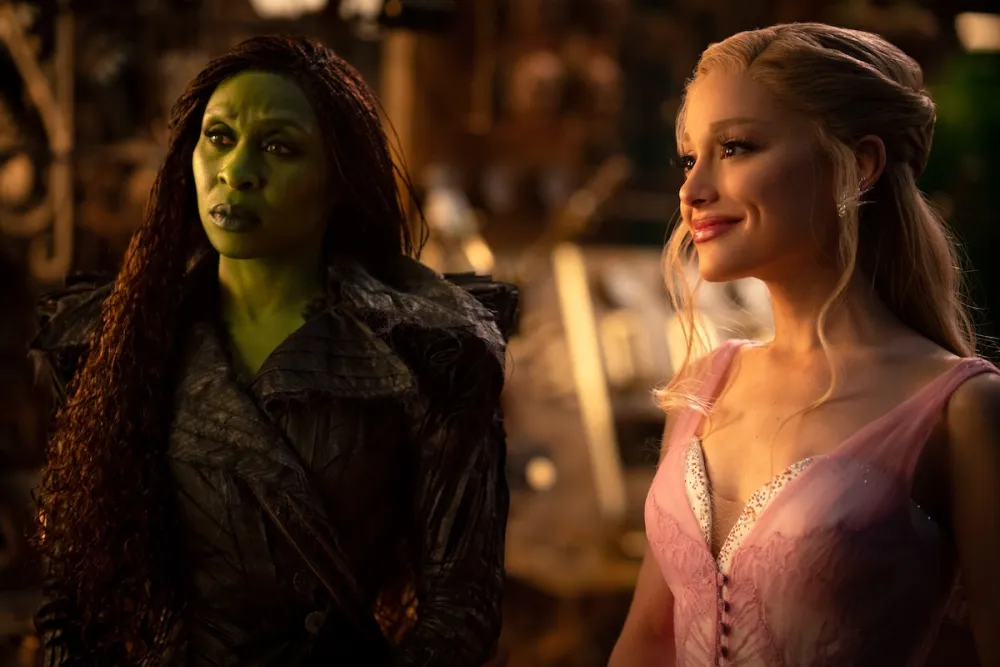
Cynthia Erivo remains the foundation of this story. She commands every scene with an emotional depth that feels grounded and raw. Her voice is as stunning as expected, but it’s her restraint that makes Elphaba feel human. She plays the role with weight and intention, grounding the film whenever it threatens to float into stylized territory.
Ariana Grande delivers a compelling performance as Glinda, who is earnest and conflicted in a way that surprised me. Her quieter scenes stand out most; moments when she lets doubt, disappointment, or unexpected clarity sit on her face without overselling anything. Her voice is pristine, but more importantly, she uses it to express vulnerability, not just power.
Jonathan Bailey is steady and sincere throughout the films. I loved how his intentions were clear across his performance, even when he didn’t speak them clearly. His performance feels more mature and defined this time around; there’s real emotional clarity in the way he plays Fiyero’s conflicted loyalties. He lets the character grow naturally into himself.
Jeff Goldblum as the Wizard provides the film with the comedic relief it needs. His timing is sharp, and he never pushes too far into camp. But as the supposed source of so much chaos in Oz, he never feels particularly threatening. The film doesn’t treat him like a true antagonist — and he isn’t.
Michelle Yeoh’s character is meant to embody the darker undercurrent of manipulation in Oz, but the role is written with a light touch that never quite lands. The conflict surrounding her feels simplified, bordering on juvenile, and the complexity of her villainy gets flattened into theatrics. It weakens the film’s tension and keeps the stakes from reaching the heights they should. I preferred her quieter scheming in the first film; she felt sharper and more effective there.
Final Thoughts
Wicked: For Good is a sincere, visually rich finale anchored by two excellent performances from Erivo and Grande. It’s polished and heartfelt, and it brings meaningful emotional closure to a story that clearly resonates with millions.
It’s also a film whose structure boxes it in. The ending is set in stone. The political conflict feels muted. The villainy is softened into something kid-friendly. And as someone who doesn’t naturally lean musical, I found myself admiring the movie more than loving it.
Still, there’s genuine craftsmanship and care here, led by performers who understand the assignment and a director who clearly believes in the world he built. And for fans who have waited years for this story to be told on screen, Wicked: For Good will deliver the finish they’ve been hoping for—steady, sentimental, and built on sisterhood.
It just didn’t cast a spell on me.
Read More:
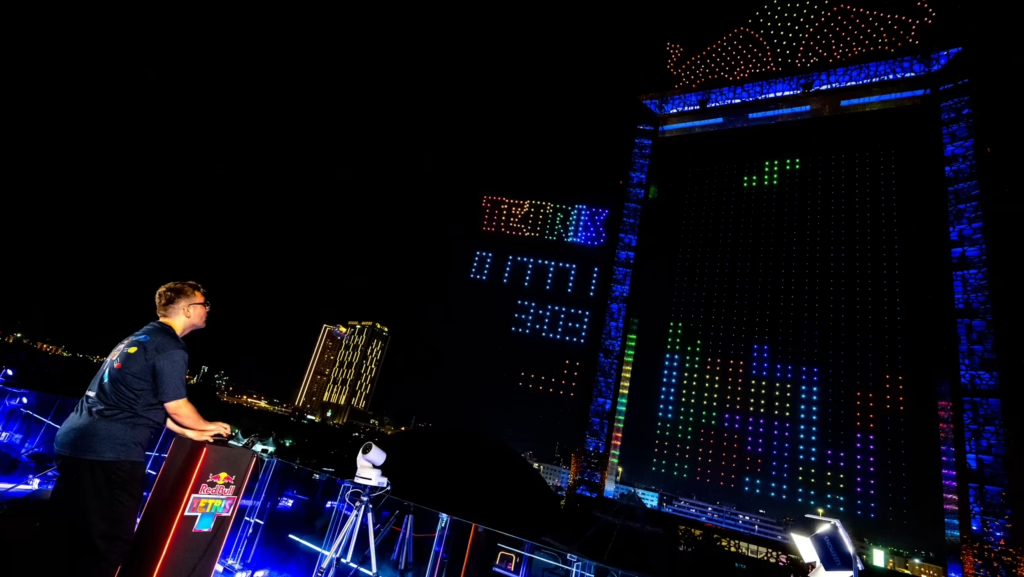
Tetris in the Sky: How Red Bull Brought a Timeless Game to Life in Dubai
Lockouts, Expansion, and Chaos: 14 Sports Business Predictions for 2026
A’One, SHAI 001, Vomero Plus, & More: The Best Sneakers of 2025
For Mark Jackson, Christmas Day at Madison Square Garden Still Hits Different
The 25 Best Movies of 2025: ‘Sinners’, ‘Friendship’, ‘Secret Mall Apartment’, and More