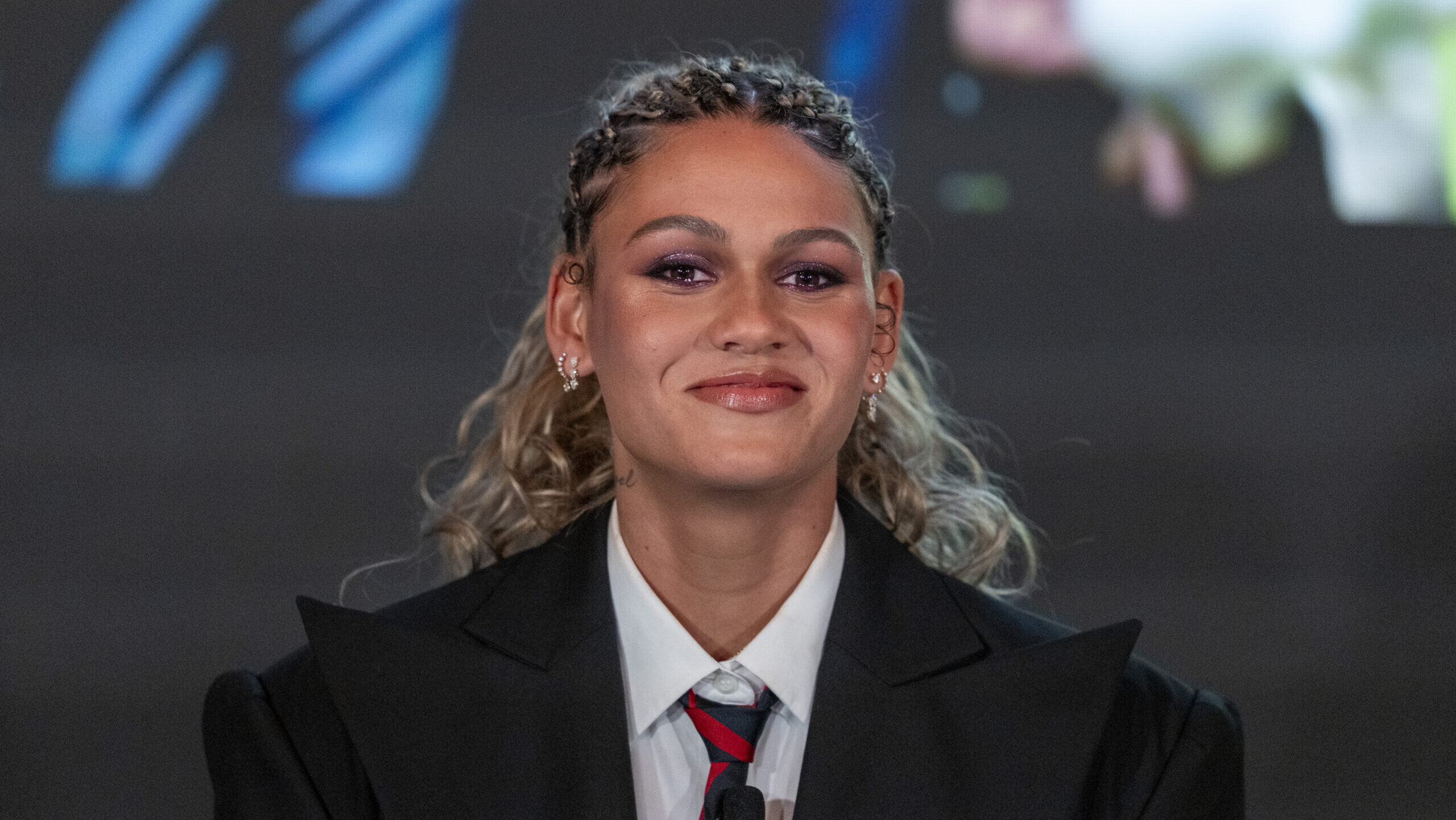
Rodman’s record-breaking deal with the Washington Spirit challenges the idea that women’s soccer stars must go to Europe to define greatness.
For a while, it seemed like women’s soccer had an unspoken rule: If you’re as good as everyone says you are, you leave the States to play in Europe. For Trinity Rodman, she’s here to show the NWSL can easily compete with the attention-grabbing offerings promised across the pond and still make millions of dollars doing so.
On Thursday, the star forward re-signed with the Washington Spirit, becoming the highest-paid women’s soccer player in the world, but Rodman didn’t just agree to what the club called a “landmark contract.” She made a choice that cuts against expectation, tradition, and old-school (perhaps unspoken) soccer protocol.
Keep this in mind: Rodman didn’t stay because she couldn’t go. Any top-flight club overseas desperately seeking a proper finisher would have countered the Spirits’ offer with haste. But the 23-year-old, who is slowly returning to prime form following a lengthy injury spell, presumably knew staying gives her more control over her career, her image, and the version of greatness she’s building.
“I’ve made the DMV my home and the Spirit my family, and I knew this was where I wanted to enter the next chapter of my career,” said Rodman about the extension. “I’m proud of what we’ve built since my rookie season, and I’m excited about where this club is headed. We’re chasing championships and raising the standard, and I can’t wait to keep doing that with my teammates and the best fans in the NWSL.”
Even outside of NWSL dominance, Rodman is a U.S. women’s national team staple, a walking highlight reel, and one of the most recognizable faces in all of women’s footy. As a frequent Spirit match attendee myself, Audi Field easily breaks season attendance records as thousands arrive to even catch a glimpse of her prowess. Europe would’ve welcomed her without question. That’s what makes this decision even more interesting, because Rodman didn’t chase the usual validation. She already had it.
Already loaded with A-listers, many of whom play alongside Rodman for the USA, there’s an initial thought that she would’ve been another star in a galaxy of stars abroad. In Washington, she’s the sun. Everything orbits her, from the team they’ll build around Rodman to the marketing to keep those coming to Audi. It’s a kind of centrality that can’t be guaranteed overseas, and motivates the NWSL to continue pushing the potential of its new class of elite players.
It’s an interesting culture shift for sure. Women’s soccer used to reward sacrifice. Playing overseas, while attractive in some regard, would take her away from the fans who fell in love with you on American soil. Who’s to say she would get the same reception fighting for the spotlight at a club where supporters have already clocked their favorite?
Visibility Equals Power
Rodman is part of a generation that’s less keen on doing things the traditional way and more interested in playing by their own rules. Loudly, on their own terms, and unrepentant to the feedback that follows. A fashion icon in the making and the face of the F50 Sparkfusion, Adidas’ first-ever cleat designed for women by women, Rodman lives at the intersection of performance and relevance. She’s elite on the field, but she also moves culture off it. Fans, particularly those in the Gen-Z space, see themselves in a bubbly personality who lets her hairstyles speak as loudly as her goals. And the NWSL, for the first time, is in prime position to actually capitalize on that power instead of exporting it.
Staying in the U.S. matters. This is where the cameras are. Where the conversations happen year-round. Where women’s sports are finally being treated like a real market instead of a niche. Rodman choosing to stay domestic is strategic because she’s betting on proximity to the audience, not distancing from those wearing her No. 2 kit.
At 23, she’s young enough that her peak is still coming, but visible enough that her value is already undeniable. That combination is rare, as most players only get one or the other. Rodman, thankfully, has both. And by locking herself into a situation where she remains the main character, she’s maximizing what that moment can become as her career continues to flourish.
The Spirit understands this as well. Paying one player like this isn’t just about winning games; it’s about aligning her to the club’s identity. With back-to-back appearances in the NWSL Championship, a title has never been out of reach, and trust will eventually be theirs. Rodman is their center of gravity, just ask billionaire owner Michele Kang.
“Trinity is a generational player, but more importantly, she represents the future of this club and the future of women’s soccer. This agreement reflects our belief that elite talent deserves elite commitment. At the Spirit, we are building something enduring: a club that competes for championships every year, invests in excellence, and creates an environment where world-class players can thrive long-term. Trinity choosing to continue her career in Washington is a powerful statement about what we are building here.”
There’s also something refreshing about the lack of apology here. No talk of “one day” or “eventually.” No positioning this as a placeholder move until they recruit the next face of the franchise. To her credit, Rodman didn’t frame staying as temporary, either. That intentionality speaks volumes, especially for youth players.
Europe will always be relevant in women’s soccer because it forever holds a theme of possibility. But history isn’t the same as inevitability. Rodman didn’t reject Europe; she just didn’t need it to define what has and will be a legendary career. And with this decision, she helped shift the culture from one that rewards departure to one that finally rewards staying, building, and owning your moment while you’re in it.
Read More:
From ‘NBA Today’ to the Australian Open, Malika Andrews Trusts the Power of Nerves

From Indie Darlings to ‘Saturday Night Live’: How Geese Became the Most Exciting Band On Earth
How Marvel’s ‘Blade’ Reboot Got Stuck in Development Hell
The Real Reason ‘Sinners’ Landing 16 Oscar Nominations Matters

Oscar Nominations 2026: Tradition, Safe Bets, and ‘Sinners’ Making History