
The professor and author who coined the term “net neutrality” joins Boardroom to talk about his new book and why the Internet is no longer free.
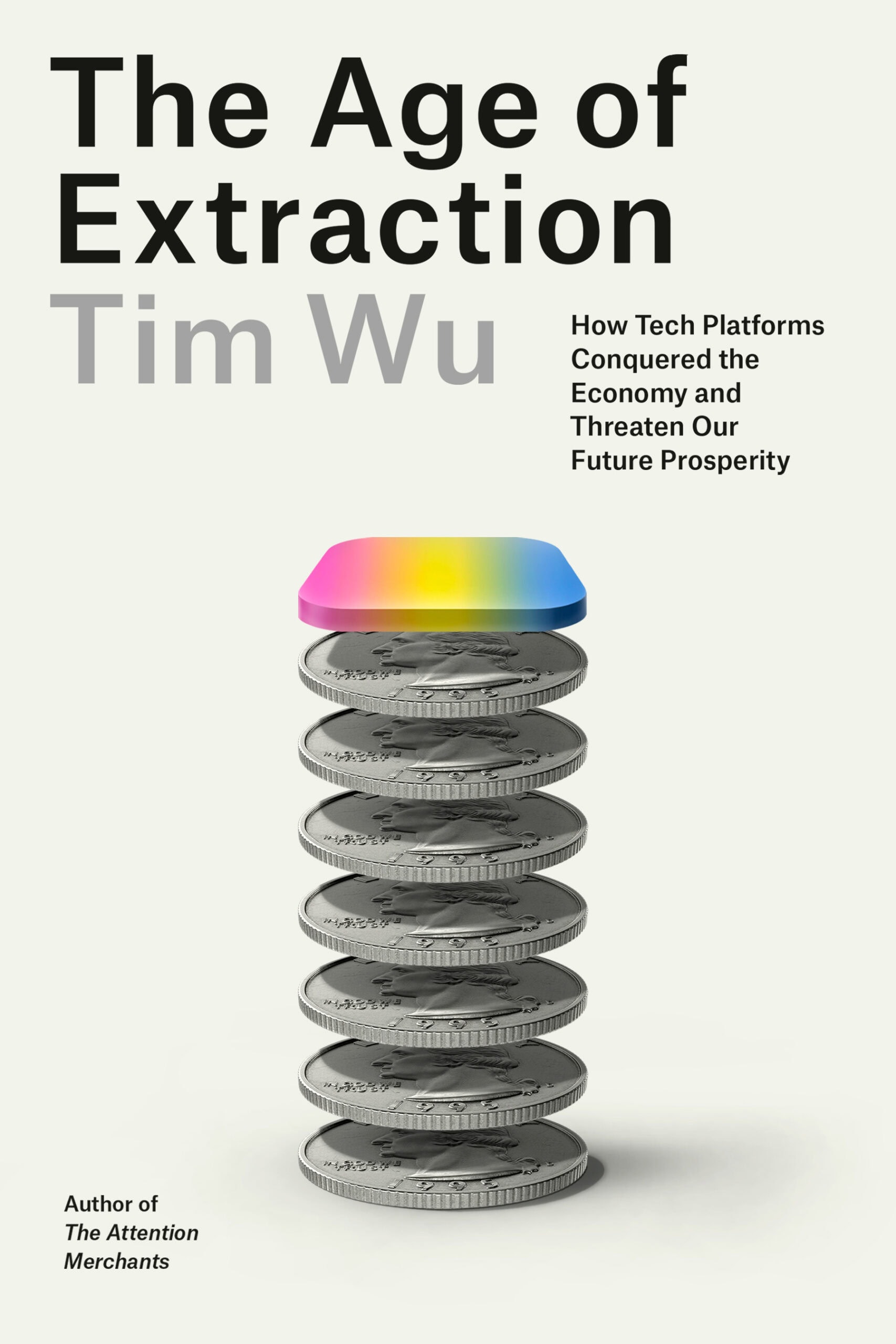
Tim Wu, the celebrated Columbia professor and Special Assistant to the President for Technology and Competition Policy during the Biden administration, has come to be a leading advocate for a decentralized economy in our current age of inequality. In his fifth book, The Age of Extraction, Wu looks at how the Internet age went from endless promises of global wealth and unfettered freedom to an ecosystem that brings extraordinary wealth to very few at the expense of many, many others.
The book begins by illustrating how the biggest tech companies in the world have become platforms in and of themselves, with Wu explaining that platform power resides “in the hosting of economic activity and the extraction of value, including the harvesting of specialized assets like data and human attention.” Wu also explains the ways in which these behemoths have become so successful at wealth extraction: “In return for an undeniable and unescapable utility,” he writes, “they are fine-tuned to take as much as possible—data, attention, profit margins—from everyone else.”
While the book expertly and engagingly outlines how we were pushed into this situation and potential ways to divest from big tech for a more equitable future, I wanted to speak with Wu because it’s increasingly difficult to be hopeful. In the near future, he doesn’t see much hope for sweeping anti-monopoly initiatives or curbing the power of companies like Meta, Amazon, Google, and Apple.
He says to Boardroom via Zoom, “I can’t say I have a lot of short-term optimism. We have to survive. In the broader context, I’m most worried about maintaining the line between the government and powerful private companies.” Taking a step back, Wu finds faith in human nature, that we are constantly working to fix our mistakes. “We were supposed to have solved all the problems of humanity. That hasn’t happened, but part of me still thinks we can learn from what we’ve done wrong in the past 20 years.” We seem to stray further and further from this possibility every day, but if we are to build a more just, equitable future, it will certainly be built from ideas like the ones Wu tackles in The Age of Extraction. Check out our full conversation below, which has been edited for length and clarity.
Boardroom: I know this has been the focus of your work for quite some time, but when did the various parts of this book begin coalescing into a presentable thesis?
Tim Wu: It started a few years ago when I began asking myself, ‘Whatever happened to that promise that the internet was going to make everyone rich?’ It was going to spread democracy everywhere and lead to this flourishing of humanity. What happened to the dream of the ’90s? I went back and read what everyone said and I thought it was very important to find out what the vision for the internet was meant to be, and then what went wrong. At some level, I’m an optimist, even in the face of disappointment. I want to figure out what went wrong and make things better.
Is it as simple in some ways as shareholder interest and maximizing shareholder value being almost antithetical to public interest?
They probably wouldn’t say that themselves, but a key decisional moment was in the early 2000s when — in a classic American/Silicon Valley/geek view — the idea was, ‘We can have everything, we can save the world, we can be good people, and we can also be billionaires. It’s all gonna work and there’s no trade-offs.’ When I was a lot younger I also really believed in that. I often believed I could have my cake and eat it too. There were genuine idealists in the early days of many of the big tech companies. They really thought they could make the world a better place, but they also wanted to be billionaires and have more money than other billionaires. They chose the traditional corporate form that U.S. Steel chose, that Dow Chemical chose. They didn’t do anything structurally to immunize themselves from the pressure of constantly increasing revenue. In some ways, it really is as simple as that decision.
If I can back that up, one-counter example is Wikipedia. I distinctly remember an article in New York Magazine 20 years ago that made fun of Jimmy Wales for not becoming a billionaire. They were mocking him for failing to cash in while all of his friends were rich. He saw what was coming. He saw that if he ran ads on Wikipedia or offered some sort of Prime Membership that it would turn to shit and become corrupted. He’s the only guy that turned his business into a non-profit. You look at it now and Wikipedia’s not perfect, but it’s pretty good. It stands for what the internet could have been.
Is it possible to be somewhere in between Wikipedia and Meta, for instance? Is there a way to ethically grow a company while still adhering to some values?
Absolutely. The original sin of Silicon Valley was wanting to have it all. A good example is a company like Patagonia. They make great stuff, they pay their employees well, and they don’t really do much evil. There was a moment that was a turning point in the history of social media, where Twitter could have become a non-profit. There was a group trying to buy out Twitter and turn it into a public network. Twitter has always made enough money to cover its costs. The reason people have been down on it is because it’s not highly profitable. Why should it need to be highly profitable? The New York City subway isn’t highly profitable but it’s still pretty useful. Not everything has to be highly profitable to be useful in society. That’s the disease, unfortunately, that turned the internet from what it could have been into what it became.
Shifting towards the way this is intertwined with the political landscape, are you surprised by how aggressive Andrew Ferguson has been towards tech behemoths?
No. I think the Republican base is very suspicious of the power of the tech platforms. The crazy thing about Trump and MAGA — while I’m obviously not a Republican and don’t agree with the movement — is I understand that it comes from a place of deep economic resentment. When it comes to tech platforms, some of it is censorship, but some of it is the sense that they’re taking too much. It’s the age of extraction. Why are they getting all the money? They were supposed to be here to make everybody rich. When I was in the Biden administration we had important Republican allies, who were as suspicious of private power as they were public.
How did the Republican Party come to represent the voice for the little person when its leader, Trump, is very much not that?
There’s a certain genius to it, though I hate to admit it. It’s not unprecedented. Mussolini was a socialist who was originally against the power of private companies. I think every authoritarian populist rises to power on resentment. It’s usually, at its core, economic resentment. The Republican Party, which earlier in its career built up the unfair economy, has now politically profited from running against it and complaining about it. They created this problem and now they’ve transfixed the nation at least in the person of Donald Trump by railing against it, while, complicatedly, being willing to do favors for them through bribes and so on. It’s so cynical that I don’t know where to start with it.
How do you remain optimistic in examining where we go from here when you see the cynicism as unvarnished as it is? There’s not much that suggests it’s going to get better.
I can’t say I have a lot of short-term optimism. We have to survive. In the broader context, I’m most worried about maintaining the line between the government and powerful private companies. The union between the State and the economy is the trademark of the most terrifying authoritarian governments. They were a marriage of private and public power. I am scared in the short-term. The long-term optimism comes from some faith in human nature and a belief that we can learn from our mistakes. We have made some serious mistakes over the last 20 years. This was supposed to be the century of human flourishing. We were supposed to have solved all the problems of humanity. That hasn’t happened, but part of me still thinks we can learn from what we’ve done wrong in the past 20 years, but we have to survive the next five years in particular. We have to have another election. Let’s put it that way.
How pivotal was the examination of AI when you first started writing this book? I imagine you had to add some chapters towards the end as the technology has begun to feel like the biggest part of the economy in many ways.
It’s crazy to write a book about tech platforms without writing about artificial intelligence. Artificial intelligence plays an interesting role in our time when it comes to the tech economy because the man on the street thinks this is the latest thing to make the tech platforms even more powerful. Inside the belly of the beast, there’s always this question of technological succession and the possibility of usurpation by a new technology. This has been the case since the telephone beat out the telegraph and the car beat the horse and buggy. People in tech realize they can be replaced. AI has the potential to actually destroy the power of the tech platforms. Part of what I was interested in in this book is that exact question: Is AI going to reinforce the power of today’s tech platforms or end up replacing them? That remains to be seen.
Are you willing to make a prediction on what you think will unfold?
This generation of leaders has held a monopoly for some period. They’ve fought off challenges — the blockchain challenge, some foreign challenges. They’re experienced and they’re good at holding onto their position; Google being the strongest example. Google has spent the past 13 years or so building up its AI capabilities in part to prevent it replacing Google. It’s pretty obvious that you can talk to ChatGPT and find out a lot of information, and at this point you’re not seeing a lot of ads. If that becomes the fault, what’s the point of Google any more? They saw that, and are furiously trying to prevent it from happening. Government and antitrust need to have their hand on the scale. I say this in the context of the Trump administration which is very unpredictable. No one should be allowed to buy the AI companies. If I was doing the Google case over again, I would have kept Google out of AI and break off its AI assets. What we want is a fight. These giants are very powerful and I think they should be fighting each other at all times. That’s a key to our economic progress.
Is AI an existential threat to these tech platforms?
Yes, although they don’t like to talk about it very much. Especially Google, possibly for the others, but it takes some more room to see how that happens. AI is the wildcard. I’m interested in its influence on the labor markets. The whole story of AI can go in one of two directions. One is happy, one is unhappy. The unhappier version of it is one where it simply fortifies the power of the existing tech platforms. It primarily becomes a technology of cost-cutting and what become surplus employees. It causes a lot of displacement and in some ways replicates what happened during the industrial revolution. You had more efficient processes, but you had a lot of social upheaval and ultimately you had an upheaval that ripened into anarchy, a number of revolutions, and a number of violent conflicts and wars. It was a pretty rough part of human history, caused by the intense industrialization of the Western world. That would be the very unhappy story [laughs].
I don’t think we want to repeat the early 20th century. They built some beautiful buildings but there was a lot of revolution and death. The happier story is a little more like the PC revolution. A lot of people and businesses had them, but they also empowered workers. They made people better at their jobs, in some ways able to do more. That’s what we would want. What direction it goes is really in our hands. I hope that the creators of AI try to map AI into something that is more augmentative of humanity than something that replaces humanity. Those are the ethics of AI I really care about: whether you augment humans or try to replace them.
When did unions stop wielding so much power in your opinion?
There isn’t a single moment. In 1953, 33% or more of the private workforce was unionized. John Kenneth Galbraith, who was a famous economist, said, ‘Of course you have the most powerful unions in the United States, because they also have the largest companies.’ There’s a natural balance and that’s how the American system works. They have a countervailing force. Now, bit by bit, not in any one moment, the unions were worn down and propagandized against. They made their own mistakes. They suffered from their own curse of bigness. One of the challenges for unions is that they were modeled on the companies that they faced — companies like General Motors. Unions have had more challenges adapting. They, in some ways, face their own bureaucratic challenges. There’s no one moment, and they’re still very important in the public sector. If you take a sector like big tech, there really isn’t a union force, even though these are some of the most powerful companies on Earth. There is not really a counterweight to them. I am a strong believer that unbalanced power of any form is extremely dangerous. A lot of companies don’t have any real checks on their power.
Can you imagine a future in which union power returns?
Yes. I think unions are very popular and people feel that something is very out of whack. The funny thing about unions is that they’re actually a market solution to the challenge of too much corporate power — as opposed to a government solution. The government protects the organization but it’s really a question of bargaining. A union, or something like it, is almost natural. The challenge, in talking about tech in particular, is that unions have never been a big thing. You’re starting from almost zero. It’s a very different culture. The other thing you might see is something like better organization of sellers on something like Amazon. Those are thousands, millions of people that are collectively mistreated. A lot of what has happened in the platform age is the idea that someone is their own business has disabled their power as sellers. Maybe the balance we need comes from the sellers of things to try and organize themselves better.
How do you convey the dire situation we’re in to people that may care but don’t want to be active in learning about the injustices perpetuated by these tech corporations?
You need politicians who speak very clearly to the economic needs of the people. I have to admit, so far, it’s been the populist right that’s been more successful. Trump has been successful by talking about China and lying about immigrants, and voters don’t trust the Democrats to stand up for them in this context. You see the split inside the party. The part of the party that’s the economic populist faction is getting the message across. They don’t necessarily do it with complicated economic theory, but they’re clear about reestablishing a balance of power so it’s not all about corporations and corporate profit. We’ve been fighting about this since Occupy Wall Street. The fact that the Democratic Party, which is meant to be the party of the great working middle class, has not really stood up for them.
Are there any Democrats you’re particularly excited about?
I’m here in New York.
Are you a Zohran guy as well?
Of course I am! People have tried to throw a million different things [at him] but he’s just talked about affordability and what it means to live here. I live in New York. We do fine, but I know so many people that just struggle with living here. That’s the message. You stay away from random distractions and stick on what people care about, which is their material conditions. What most people are ultimately interested in is their material wellbeing. They care about their values and things like that, but at their core, material wellbeing matters a lot to them. They want politicians who are going to help them. He’s been successful. I think the more progressive side of the Democratic Party has shown again and again that they have the messages that voters are listening to, but we keep getting in the way of our own messages.
I first became interested in anti-monopoly work when Lina Khan took over as head of the FTC. Was that a watershed moment for the movement?
Lina and I met when I ran for office in 2014. We were testing out these things when myself and Zephyr Teachout ran against Andrew Cuomo. We managed to get something going, partially on these messages. Lina was part of our campaign staff and one of our policy people. Obviously, she was a star. She was an extraordinary law student and was my colleague at Columbia. She has been an extraordinary face for anti-monopoly. It was surprising to people when she was appointed chair of the FTC because she was 10 years younger than every other candidate. I think in order for anti-monopoly to have vital energy, it needs people like Lina, who weren’t constantly buffeted by the idea growing up that you have to defer to economic reasoning and the market always being right. She’s seen over a long scope of history that what we’re talking about here is power. She communicates that very effectively.
Do you know what you’re going to be doing next?
I’m at some level in exile as a part of the progressive wing of the Democratic Party. I look back at the Biden administration and I think we should have done more to curtail the power of big tech and make it very visible. The Democratic Party needs to fully embrace the affordability, kitchen table economic messaging that has been successful; to make it clear to voters in a convincing way that we will be on their side. That’s politics. In my own role as an academic, the second half of this book is in some ways a statement of a political philosophy. I would like to use the next couple of years to develop that more deeply. The political theory of the anti-monopoly movement, beyond where it is. We’ve been obsessed with the battle between communism and capitalism for so long that we lost sight of other critical alternatives. Most particularly, we lost sight of balancing power and decentralizing economic and public power. I want to write a political manifesto for people who believe in a decentralized and anti-monopoly economy.

How Jordan Brand Is Building With Women, Not Around Them

Beyond the Feed: How [untitled] is Building a “Sacred Space” for Musicians

How Stephen Curry’s Underdog DNA Redefines the Hero’s Journey in ‘GOAT’

Kevin Durant, KITH’s Ronnie Fieg, & Rich Kleiman on Sneakers, Legacy, and Culture

JuJu Watkins Showed Where the Game Is Headed at Chase Freedom’s Cashback Courts