The Ohio State athletic director breaks down the business of Buckeye football, NIL and revenue sharing, AI in college sports, and more.
Last December, a CNBC ranking of the most valuable collegiate athletic departments in America placed Ohio State University first at $1.32 billion on $280 million in annual revenue. And that was less than a month before the Buckeyes football team won the College Football Playoff, the program’s first national championship since the 2014 season. Ranked first in the nation again, looking for its second straight title, Ohio State is the odds-on favorite to win it all at +175 at FanDuel SportsBook heading into its annual Big Game matchup against archrival Michigan.
Overseeing this empire in Columbus is athletic director Ross Bjork, who took the helm on July 1, 2024, and previously held top roles at Texas A&M, Ole Miss, and Western Kentucky. The 53-year-old was in New York City back in September following a huge opening-week win against Texas and spoke about revenue sharing and NIL, the CFP and conference realignment, AI and sports betting, and the ongoing gray area in which he and fellow universities currently have to operate.
The following was edited for length and clarity.
BOARDROOM: What’s something you think fans completely misunderstand about how football decisions are made at your level as athletic director?
ROSS BJORK: Here’s how I view my job: My job is to ask, Do we have the right culture? Do we have the right leaders impacting the young people — meaning coaches, staff members — within the football program? Do we have the right facilities? Do we have the right infrastructure? Do we have the right resources? And in this world, do we have the right NIL infrastructure, both primary revenue-share dollars that the institution can now provide, and then third-party NIL opportunities? My job is to put all those things in place and then get out of the way.
I’m not involved in play-calling, recruiting decisions, game planning, or anything like that. What we do is we provide the resources to allow the coaches and the athletes to thrive. I think most people understand that, but a lot of times, you stub your toe, you lose a game. Then they want somebody to blame, and sometimes the AD has to be the pin cushion, and that’s okay. We’ll accept that responsibility if that’s what it takes. If we can always deflect from our athletes and coaches, and they need somebody to point to, sometimes the AD gets too much credit and sometimes too much blame.
Obviously, AI is becoming increasingly prevalent across every position, every job, and every profession. What role does it play in your job?
It’s still emerging in many ways. I believe it has a big upside for our future in terms of how we can be more efficient, how we can maybe write primary sourcing articles using AI, how we can create video content and storytelling. You still have to have authenticity of the author and the primary source, but AI can be a great supplement at Ohio State. Our university is taking a big lead in the AI space as it relates to education. We’ll be able to tie into that in many ways. They’re basically saying, you should be fluent in your business class, but also understand how AI could impact that class and running a business in the future. You should be fluent in both subject matters.
The other thing that is somewhat AI-related is sports performance, wearable technology, or rings. We use the Catapult system, which tracks GPS. You can use a lot of AI technology as it relates to performance. What you’ll see in game planning as we move forward is coaches using AI to break down film or break down tendencies. I’m sure we can plug in different formulas now and say, What’s the tendency of Texas’ offense based on one game? So you’re going to see some of that. I don’t think anyone has captured the market yet on what it truly means for college sports. We’re all going to evolve.
The other piece about AI that I think about is we have all this data from our fans. We have their email address, their customer profile, their trend, and purchasing data. This person purchased x amount of merchandise, x amount of tickets. So how do we use AI to better serve our customers in the future? We’re mapping it out and strategizing, but haven’t fully deployed it yet. It’s a huge opportunity.
There was an article in July of last year in which you said that Buckeye football players received around $20 million in NIL compensation in the previous year. How much do you think that total is this season?
People were throwing out different numbers about roster values, so we’ve gone away from sharing numbers. What I did in July of 2024, somebody had a really high number, and I said, “No, let me just correct the record.” And that’s where the $20 million came from. But look, we have $20.5 million of revenue share that spreads across the entire athletic department. We are very aggressive in the third-party NIL world with sponsors and partners who want to support athletes. We’re always going to be on the leading edge of whatever the numbers are, whether it’s the biggest budget, the biggest NIL portfolio, the biggest Nike contract, the biggest sponsor portfolio. But we’ve gone away from stating specific NIL numbers because it just leads to narratives that are unfair a lot of times to the athlete. Just let the athletes go play. Everyone knows they’re making money. Everyone knows there’s lucrative contracts for these athletes, but they’re still college students. Let ’em go play the games.
What’s your concern over the future of non-revenue sports with the $20.5 million era that they have to share in?
At Ohio State, we have 36 sports, which is the largest of any of the Power 4 conferences. So we want to maintain a similar experience to what we’ve always had. It may look a little different financially, but we want to maintain a very similar experience. We’ve added over 90 scholarships, and more than half of those are for female sports. Some of the rhetoric out there is a little concerning because it’s not accurate. People think that women’s opportunities are being diminished. But this is a time where we can put more emphasis on showcasing the value of Olympic sports and having a broad-based program while constantly being challenged by funding it. So it’s going to be a constant battle.
We’re going to always have to find new revenue. We’re always going to have to make sure we manage our expenses. We’re always going to have to make sure that we schedule really smart, where maybe we’re not getting on airplanes with our Olympic sports. Maybe it’s more of a regional type schedule to just make sure that our expenses are in line. But given all the dynamics here, the elevation of the conversation around Olympic sports and saving Olympic sports in our country, to me, that conversation has never been as elevated as it is now. People are asking, ‘What’s going to happen? Now that we are paying revenue share dollars in 2025, can we maintain Olympic sports?’ We want to maintain our Olympic sports.
One of the things that does not have a conversation really in a robust manner is we’re the only country in the world that does not get any sort of central funding for the Olympic movement. If you really think about it, it’s funded by college football. And we actually fund a lot of international athletes who then go represent their countries of origin, which is a great thing. But we’re funding that, right? So this conversation has never been more elevated. How do we get more help? Can we have a congressional conversation about funding the Olympics? Because that doesn’t happen right now. But we have to be mindful about the revenue and expense calculation, because it’s going to be a constant challenge.
If you could remove one burden from the lives of football players today that isn’t related to money or playing time, what would it be?
Just the balance of time. It’s so hard. When you’re an 18- to 22-year-old, you are going to class, maybe you have NIL opportunities where you’re filming a commercial or making an appearance, and you have to train, then you have to recover. Then you have to practice.
One thing that does come up a lot, which is unfortunate, especially at our level, is the amount of sports betting blowback. When a player makes a mistake, drops a pass, misses a field goal, the amount of social media blowback that they get right now in the sports betting world is really nasty. It’s uncalled for. The visceral reaction people have in the sports betting world should go away, and the burden that a lot of these young men have to deal with when something bad happens is unfortunate.
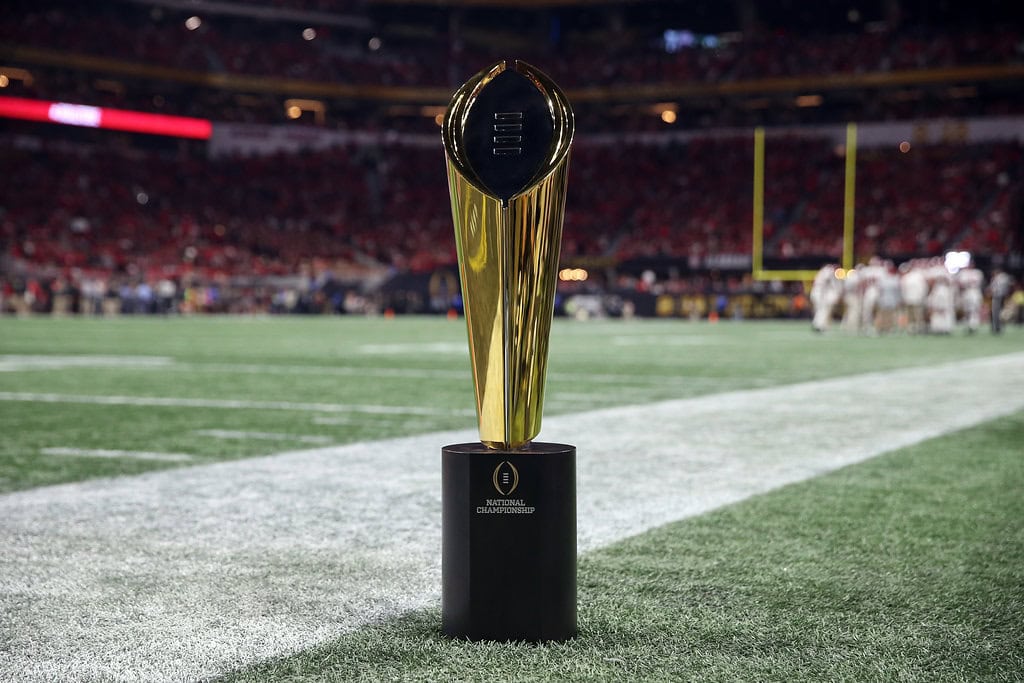
As the College Football Playoff evolves, are you an advocate for the Big 10 and the SEC getting more automatic berths?
We like expansion, and we’re at 12 teams now. I think we could go easily to 16. I think we could even go above that. There’s different models that have been proposed. If you look at the trends and the historical nature, the Big Ten and the SEC have earned those spots. Clearly, we drive the most value in terms of whether it’s TV ratings, attendance. And the fact that we play tough schedules, to me, lends itself to the AQ spots. But if we go more than 16, then I could also look at an at-large model. That would also make sense, too, because you have more of an opportunity because of who you are in the Big Ten and the strength. And selfishly, at Ohio State, we could go back to four, and we’d probably be okay most years. We definitely can be okay at 12, but for the greater good of the game, people want more high-power and high-profile matchups.
Do you think the Big Ten is done expanding its membership?
For now. It’s really hard to unwind TV contracts. It’s really hard to expand when your revenues are set based on your TV contracts. In this world of changes, you always have to stay nimble. So to me, you could never say never. Every time there’s been expansion in the last 20 years, it’s always been around television contract windows, and our contracts have until 2030 for the CBS and ABC contract, and the Fox contract until 2036. So we’re in a stable position now, but as those things wind down, what happens to the CFP expansion? What does that conversation look like? What does TV look like? Right now, we’re sort of still in the linear, traditional TV broadcast partners, but what happens if Apple or Amazon or Netflix get into college? What does that mean from a value proposition? What does that mean from a consolidation of economic rights? You got to stay nimble, but I think for now we’re in a stable position.
What do you think college football’s biggest hurdle is over the next decade?
Clarity. Clarity of the rules, the structure, the Playoff, the young people, the families, the coaches, the bands. They want to know this is the game and these are the rules, and this is how you play by the rules, and this is how the rules are enforced. If somebody violates the rules, people want clarity. The ironic thing now is, even though it’s bumpy and a little bit uncertain, the games have never been more popular. You look at the attendance, if you look at the TV viewership, and you look at the money that is being given to the athletes, the game has never been as healthy as it is now. And that’s what’s really fascinating. So if we actually fix a lot of things, then the game can actually be even more healthy than it is now. That’s what excites me about the future.
Read More:
How the Biggest NIL Deal in College Football History Went Down
Tom Brady, Matt Ryan, and the NFL QB Front Office Takeover
The Manchester United Job Is Broken, Not the Manager

10 Predictions That Will Shape Entertainment and Pop Culture in 2026

Tetris in the Sky: How Red Bull Brought a Timeless Game to Life in Dubai