Inside the NBA’s push to launch a European league, the legal tension with EuroLeague, and why the fight for basketball’s future is heating up.
FIBA, basketball’s global governing body, first introduced the EuroLeague in 1958 as the continent’s premier competition. But over the last 25 years, FIBA has lost its grip on the operation. There was a split in 2000 with the Union of European Leagues of Basketball, where top clubs chose sides in competing operations, with ULEB ultimately gaining control.
EuroLeague is now a privately run company controlled by EuroLeague Commercial Assets, which has long held a stranglehold over Europe’s second-most-popular sport. But over the last year, the NBA has signaled interest in forming a competing league of its own alongside FIBA to grow the sport in a region where 15% of the league’s players now come, including some of the world’s biggest modern superstars and nearly every league MVP this decade.
“We have been talking about this for decades at the NBA,” Leah MacNab, the league’s senior vice president, head of international strategy & operations, told Boardroom last week from Berlin, where the NBA was hosting a regular-season game between the Orlando Magic and Memphis Grizzlies. Brother Franz and Mo Wagner first played at hometown EuroLeague club Alba Berlin before starring for the Magic, and the NBA was playing its first-ever regular-season game in Germany before the two teams headed to London on Sunday. MacNab said a register-your-interest campaign on social media for the games received 450,000 responses.
NBA Europe, the league’s internal working title for the operation, was first seriously floated last year in partnership with FIBA and now has a projected start date of fall 2027. The league would have 10-12 permanent members and four to six rotating members who could qualify under some competitive format to be determined by FIBA, emulating the model of the EuroLeague, with 12 permanent members and six rotating spots, though those spots may be more restrictive than the qualification process the NBA wants to implement. But the biggest reason why the NBA is trying its hand at a European league is a simple market inefficiency.
“We think that the current structure really doesn’t take advantage of the commercial opportunities,” MacNab said. “So, we wanted to put our hats in the ring, and we’re really excited to take this to the next step.”
The next steps are finding the right markets, teams, and ownership groups for permanent members. Meetings took place last week during the NBA’s Eurotrip, with JP Morgan Chase and the Raine Group advising on the discussions. The membership will likely come from a combination of existing EuroLeague teams and top European soccer clubs looking to expand into hoops in markets where the league sees room for growth. And unlike the NBA, where sovereign wealth funds from Gulf states are limited in the stakes they can take in teams, MacNab said she expects NBA Europe to operate a little differently in that regard.
One particular meeting in London, per The Athletic, was attended by EuroLeague members Real Madrid, Barcelona, Olimpia Milano, Greek power Panathinaikos, Alba Berlin, and Lyon-area ASVEL, which is owned by NBA legend Tony Parker. The NBA also met up with representatives from soccer giants Bayern Munich, Manchester City, and AC Milan, as well as Saudi Arabia’s Public Investment Fund, Blackstone, and Arctos. Qatar Sports Investments, which owns Paris Saint-Germain, has also been linked to the NBA Europe project, while the league reportedly additionally met up with EuroLeague member and Istanbul power Fenerbahce in Berlin.
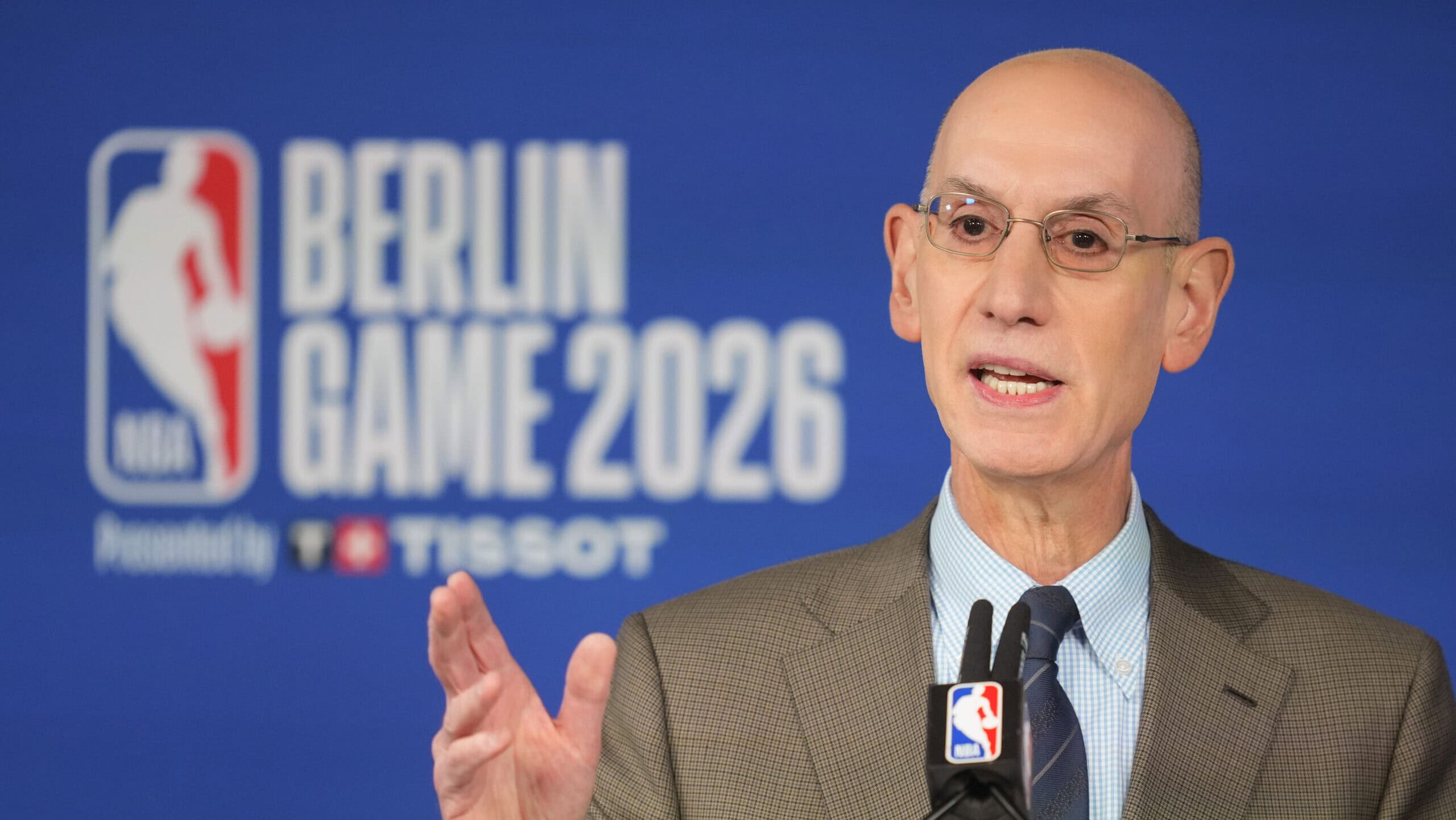
The NBA has recently played regular-season games in Berlin, London, and Paris, and will hold its first-ever regular-season game in Manchester next year. In a press conference in Berlin on Thursday, NBA Commissioner Adam Silver said he’s very familiar with Alba Berlin’s success. He confirmed discussions with Real Madrid and other Spanish clubs, and said Istanbul is a market he’s looking at. Madrid, Fenerbahce, and ASVEL are reportedly three permanent EuroLeague members who have held off on signing long-term extensions to stay in the league. While MacNab said that there’s no financial number the league is looking for right now for membership fees, a recent report claimed the league is targeting valuations of up to $1 billion.
Not surprisingly, the EuroLeague won’t let potential key members leave without a fight. Amid a report last week that claimed the EuroLeague sent a letter to the NBA stating that it would take legal action if the league had discussions with teams signed to EuroLeague contracts, Silver told reporters, “I send the legal letters to my lawyers, so I’ll let them handle that.”
A source close to the NBA told Boardroom that the league hasn’t engaged with anyone about an NBA Europe opportunity that they are not free to discuss. But there could be a pretty easy escape hatch for any interested party that has that particular conflict, as FC Barcelona is rumored to have. EuroLeague shareholders such as Barcelona, which recently signed a 10-year extension, reportedly have exit clauses of around €10 million, a relatively modest sum in what Silver has repeatedly described as a long-term play on the continent.
“I don’t think by any means it’s inevitable that there is a clash,” Silver said when asked about the EuroLeague. “If I thought that the ceiling was the existing EuroLeague and their fan interest, we wouldn’t be spending the kind of time and attention we are on this project.”
MacNab told Boardroom she thinks NBA Europe and the EuroLeague can co-exist long term on the continent and believes that there’s room for the two leagues to even compete against each other in the same markets. The NBA, in partnership with FIBA, has approached the EuroLeague several times but said it hasn’t been able to reach a partnership that makes sense for either side.
“The NBA has been announcing and announcing things for a year, but still it’s nothing that you can grasp on,” EuroLeague CEO Paulius Motiejunas told the Associated Press over the weekend. “We’ve only heard the plan or the fireworks of how amazing it will be, how much potential there is. The ’27 start is already around the corner.”
While MacNab acknowledged that the NBA has a lot to sort out over the next 18-20 months, the league is confident in its plan and path forward.
“We think that there’s enough interest both from fans and from investors,” she said. “There’s enough talent out there at a very top-tier level to make this a compelling product.”
What’s clear is that the war over the future of European basketball is only beginning, and likely won’t be ending even if and when NBA Europe gets off the ground later next year.
Read More:

YouTube Golf’s Biggest Stars Are Launching a $1 Million Tour of Their Own

Chuck Norris Invented the Action Movie Your Algorithm Keeps Recommending

Yankees Captain Aaron Judge Is Still Writing His Story

How ‘Project Hail Mary’ Gave Amazon MGM Studios Its Biggest Opening Weekend
Aaron Judge Names Jazz Chisholm, Austin Wells, Ryan McMahon as Yankees X-Factors