
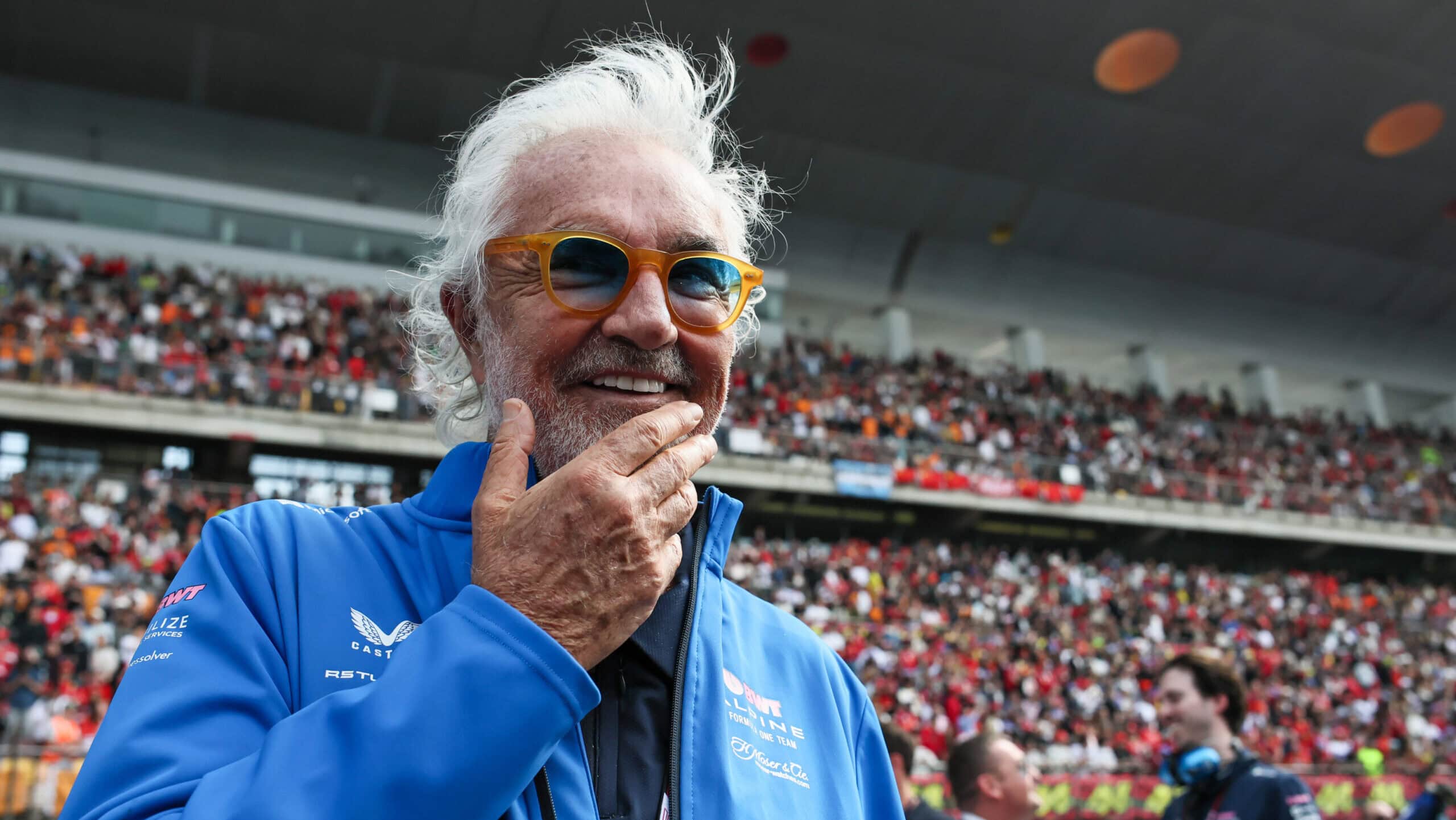
Flavio Briatore is pushing for more engaged U.S. partners as Alpine reshapes its technical program, ownership dynamics, and long-term strategy under the new F1 regulations.
Alpine has never lacked history, but lately the activity surrounding the team is almost as notable as its on-track performance.
Hollywood figures and American investors are evaluating Alpine at a moment when the team is preparing for a significant rebuild under Formula 1’s 2026 regulations. Their interest isn’t casual; it reflects the belief that Alpine’s reset could reposition the team in a more competitive and commercially valuable tier of the sport. For a mid-grid outfit still searching for consistency, attention from U.S. capital and entertainment circles points to a broader perception that Alpine has untapped potential and a clearer strategic direction than it has had in recent years.
Flavio Briatore, now serving as Alpine’s executive advisor, is direct about why U.S. partners matter and why the search for the right ones is ongoing. His mandate is broader than a typical consultancy role: He was brought back to reshape the project’s competitive direction, evaluate commercial strategy, and help position Alpine for long-term stability under the 2026 regulations.
“We don’t need a sleeping partner,” Briatore told Boardroom during the United States Grand Prix in Austin this year.
Investment Priorities Behind the Rebuild
Briatore notes that one of Alpine’s current U.S. investment groups — represented by Otro Capital — has played a limited role at a moment when the American market has become one of F1‘s most valuable growth engines. Otro Capital is part of the broader RedBird–Maximum Effort consortium that invested in Alpine in 2023, a group that includes cultural and entertainment figures such as Ryan Reynolds, Rob McElhenney, Michael B. Jordan, Travis Kelce, and Rory McIlroy. Their involvement helped boost Alpine’s visibility in the U.S. and framed the team as a brand with potential across sport and entertainment.
But Briatore is clear that visibility and star power alone are not enough. He wants active partners who can support Alpine’s sporting reset and help extend the brand beyond Europe. That expectation comes at a time when Otro Capital has reportedly explored selling its 24% stake, a move reported in late October, which underscores the shifting dynamics around the team’s ownership structure.
As Formula 1’s presence in the U.S. accelerates — with three races, sustained attendance growth, and rising cultural relevance — Alpine is seeking partners to help the team build a deeper commercial footprint. The goal is collaboration, not just capital: investors who can contribute to Alpine’s competitive rebuild and amplify the brand in a market where lifestyle appeal and narrative often shape audience engagement as much as results.
Briatore’s return is built around reshaping Alpine into a more competitive operation ahead of the next regulatory era. He has overseen similar projects before with Benetton and Renault, but the landscape now is more complex: a cost cap, a stronger competitive field, and a global fan base that follows teams as brands.
One of Alpine’s most significant forward-facing investments is its move to become a Mercedes engine customer beginning in 2026. Briatore doesn’t dwell on past shortcomings, but he is frank about the present reality.
“What we have now, what we have in 2025, is not competitive,” he said.
That clarity shaped the engine decision and the broader spending strategy. With the cost cap limiting overall development, Alpine views the Mercedes supply as a way to stabilize a key performance variable, allowing the team to redirect internal resources toward chassis refinement, operations, and cultural alignment. Briatore also emphasizes that Renault Group has historically funded the team when needed; the challenge is not corporate reluctance but ensuring that investment is deployed in targeted, high-impact areas.
Beyond the racetrack, Alpine is working to grow its performance brand identity at a time when the U.S. audience is increasingly receptive to F1 as both a sport and a lifestyle. Briatore has long believed that competitive results and lifestyle relevance go hand in hand. At Benetton, he blended cultural presence with racing to build visibility during years when performance fluctuated. He sees a similar opportunity now: Alpine as a modern F1 team that can appeal to consumers, not just fans.

Preparing for a Make-or-Break 2026
The team views 2026 as a turning point that cannot be postponed in the name of longer-term planning. Alpine does not have the bandwidth to aggressively develop its 2025 car while simultaneously designing its 2026 contender. As a result, Briatore said it has already redirected significant time and personnel toward next season’s project, knowing the short-term cost is essential to the larger payoff.
Briatore does not want 2026 framed as a transitional year. He insists Alpine must be capable of running consistently in the top half of the field and competing for podiums when opportunities arise. A competitive baseline, he argues, is non-negotiable.
“2026 is crucial,” Briatore said.
He frames success around more than mechanics and wind-tunnel time. Performance depends on a cohesive team that works without internal friction, politics, or misalignment. That means engineers, mechanics, and drivers operating under a single direction and understanding the stakes of the coming season.
Briatore’s leadership philosophy remains centered on people — not budgets — as the differentiator between mid-grid teams and consistent front-runners. He describes his role as one focused on clarity, confidence, and removing the internal blockers that limit progress. He stresses that Renault Group has granted him full autonomy over the Alpine F1 project, which is as much a signal to employees as to potential investors. Decisions sit with him, and accountability does too. The goal is a reset that allows Alpine to function with transparency and stability, qualities he sees as prerequisites to attracting top drivers, engineers, and partners.
What Success Looks Like for Alpine
Asked what legacy he wants from this chapter with the team, Briatore focuses on competitiveness and continuity. The objective is to rebuild Alpine into a team that is consistently capable of producing strong results, supported by a workforce aligned on a single direction and energized by clear leadership.
“We want to be a winning team, very competitive, you know, forever like we had before,” Briatore said.
Alpine’s 2026 bet is significant: a technical reset, a cultural overhaul, deeper investment, and a push to engage meaningfully with American partners who see opportunity in the team’s next era. If the plan works, Alpine won’t just be more competitive; it will be a more attractive long-term project for investors, drivers, and global brands.
The next chapter begins with 2026, but the interest already forming around the team suggests that Alpine’s story, on and off the track, is becoming one worth watching.
Read More:

Jack Harlow’s Hubris Overshadowed His Most Interesting Album

Dwyane Wade, Sue Bird, Tom Brady, More Tapped for JPMorganChase’s Athlete Council
How Sean Penn Broke the Oscar Rule Nobody Talks About
How Michael D. Ratner Built OBB Media Into One of Hollywood’s Quiet Powerhouses
Interview: Chase B Joins Lids as Creative Director to Expand the Brand’s Cultural Reach