Dolby doesn’t make movies or games, but it quietly shapes how we experience them. A visit inside the company’s San Francisco headquarters reveals how sound, color, and spatial tech transform modern entertainment.
If you look closely at the screen before the first note of a blockbuster movie or the opening kickoff of Sunday Night Football, you’ll see it: the double-D logo.
It is one of the most recognized marks in the world, yet Dolby is a company that produces no content of its own. It sells no consumer speakers under its own name and hosts no streaming service. Instead, it has spent the last 60 years quietly colonizing the infrastructure of our digital lives.
I recently visited Dolby’s headquarters in San Francisco to pull back the curtain on this invisible empire. What I found wasn’t just a tech company; it was a sensory laboratory. Inside, Dolby executives told me that their neuroscientists use thermal imaging cameras to prove that Dolby Vision — their high-dynamic-range technology — can make a viewer’s face physically flush red when watching a fire on screen. It is a level of realism so intense that it bypasses the “watching” brain and speaks directly to the “surviving” brain. This is the heart of Dolby’s transition: they have moved from a company that made noise-reduction tech for theaters to an experience architect that manages how billions of devices perceive reality.
Building a Better Entertainment Experience
Founded in London in 1965 by American engineer Ray Dolby, the company’s first mission was humble: eliminate the background hiss of cassette tapes. By 1977, they were the silent star of Star Wars, and by the ’90s, they were the gold standard for surround sound in cinemas and home entertainment. But the Dolby of 2026 is far more pervasive. Today, the brand is the connective tissue for the world’s biggest cultural moments. Whether it’s the Oscars, the Grammys, or the Super Bowl, Dolby is the reason the soundscapes and visuals feel three-dimensional.
At the recent Super Bowl LX Innovation Summit, the scale of this influence was on full display. Dolby isn’t just in the game; it is solving the fundamental frustrations of modern fandom. For instance, Dolby OptiView — its newest cloud platform — is tackling the spoiler gap fans often feel when there is a streaming lag. In a world where your phone’s notifications often outpace your live stream, OptiView synchronizes video across devices to within a fraction of a second. This means you aren’t just watching the game; you’re experiencing it in perfect sync with millions of other fans, finally making streaming feel as communal as traditional broadcast.
While sound made Dolby famous, Dolby Vision is redefining the company today. During my visit, the team emphasized a philosophy they call “Better Pixels.” While the rest of the tech industry obsessed over 8K resolution (more pixels), Dolby focused on making every individual pixel do more work. This manifests as Dolby Vision 2, the latest iteration that finally addresses the age-old complaint about content visually looking too dark in the streaming era. I couldn’t help but recall my own struggle watching the final season of Game of Thrones, where the heavy shadows across multiple episodes rendered the action nearly invisible, regardless of the time of day or the darkness of my room.
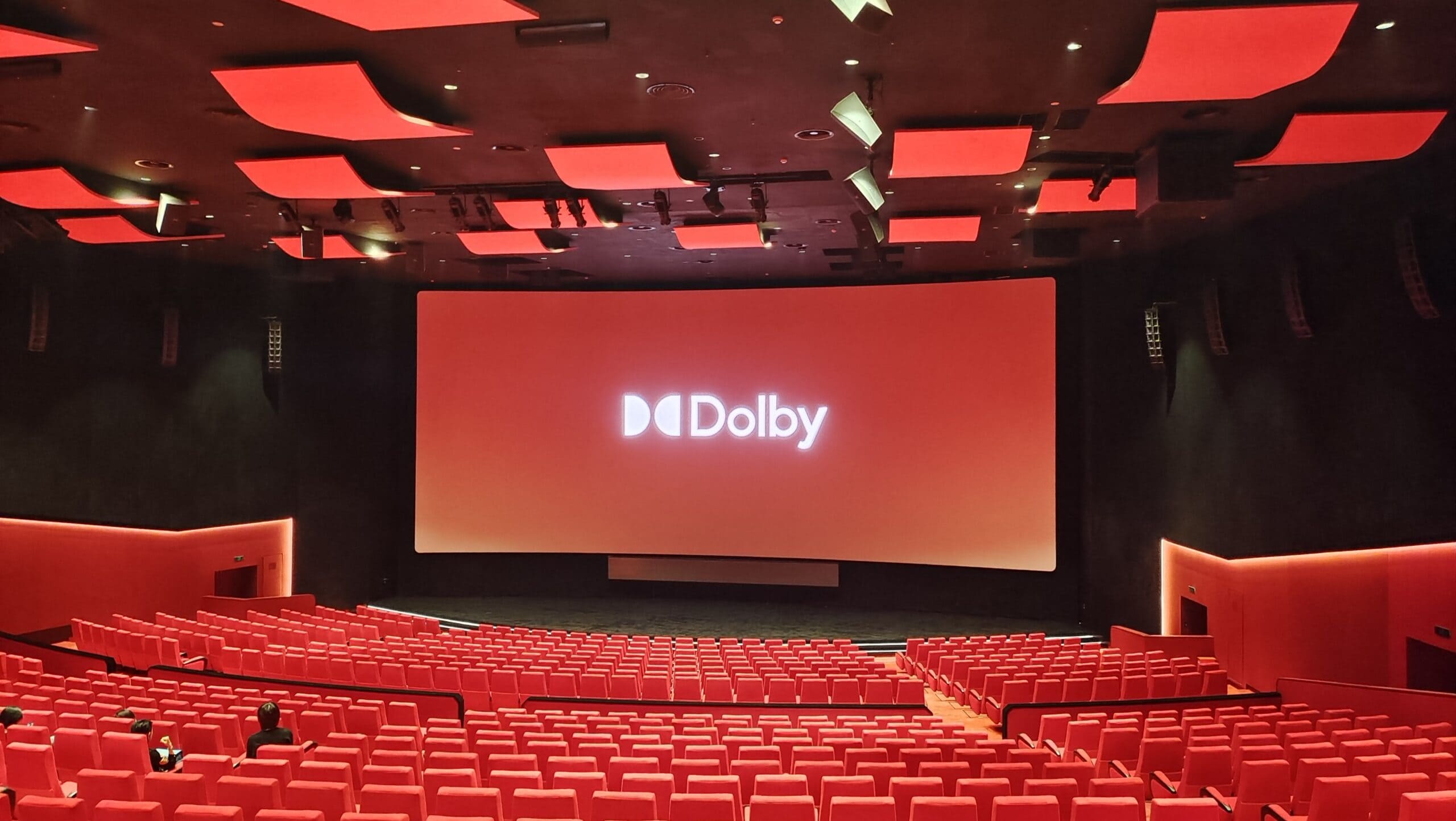
Dolby Vision isn’t just a filter; it’s a dynamic metadata system that communicates directly with your TV’s hardware to ensure “true black.” As the theater demo at HQ proved, standard screens emit a faint glow even when showing black. Leaders at the company told me that its dynamic metadata enables compatible displays to achieve deeper true color. This precision is why major leagues like the NFL and NASCAR have adopted it. For live sports, it ensures that the 49ers Red on your screen matches the team’s exact color code, maintaining an emotional connection that standard broadcasts often lose. From iPhones to the massive LED walls in stadiums, the Dolby Vision standard has moved from the theater to the palm of your hand.
The secret to Dolby’s success is that they don’t start with the consumer; they start with the artist. During my time at their HQ, I saw how music from notable artists like Gwen Stefani and Kid Cudi was amplified via Dolby Atmos, Dolby’s premiere spatial audio technology. In the past, sound was a flat wall; today, it is a 3D space. This shift has allowed artists to mix to space, placing a backup vocal or a guitar riff physically behind the listener.
This creators-first approach has turned Dolby into a mandatory partner for the industry’s elite. Even live events such as the Netflix Is a Joke comedy specials and the 2026 Milan Winter Olympics are using Dolby’s tools to create an emotional presence. For the Olympics, sound supervisors are burying microphones in the ice of hockey rinks and placing specialized mics in the starting huts of downhill skiers. The goal is simple: They want you to hear the athlete’s breath and the razor-sharp crunch of skates as if you were standing right there with them.
The Standard for a New Reality
Today, the silent giant is everywhere. It is in the iPhone in your pocket, the 150-plus car models currently shipping with Atmos, and the $200 budget TVs that now perform like the $10,000 reference monitors of a decade ago. By embedding itself into the tools creators use and the hardware consumers buy, Dolby has made itself indispensable.
As I sat in a demo car at their San Francisco garage, listening to a track that felt like it was breathing around me, the company’s mission became clear. Dolby isn’t selling a product; they are selling a feeling. They have mastered the art of being invisible while making everything we love about entertainment more visible, more audible, and more visceral.
In the war for our attention, the company that wins isn’t necessarily the one making the movies; it’s the one defining how we experience them.
Read More:

Kevin Durant and Hakeem Olajuwon Reveal Shaq, Ewing, Dwight as Toughest Defenders

Willy Chavarria’s All-Star Capsule With Adidas Fuses Hoops Heritage and Equestrian Edge

Olivia Wilde and Cooper Hoffman Lean Into Power and Obsession in ‘I Want Your Sex’
Exclusive: Big 12 to Bring LED Glass Floor to Basketball Tournaments in American Sports First
Cadillac F1 Looks to Build From Scratch as America’s Team