

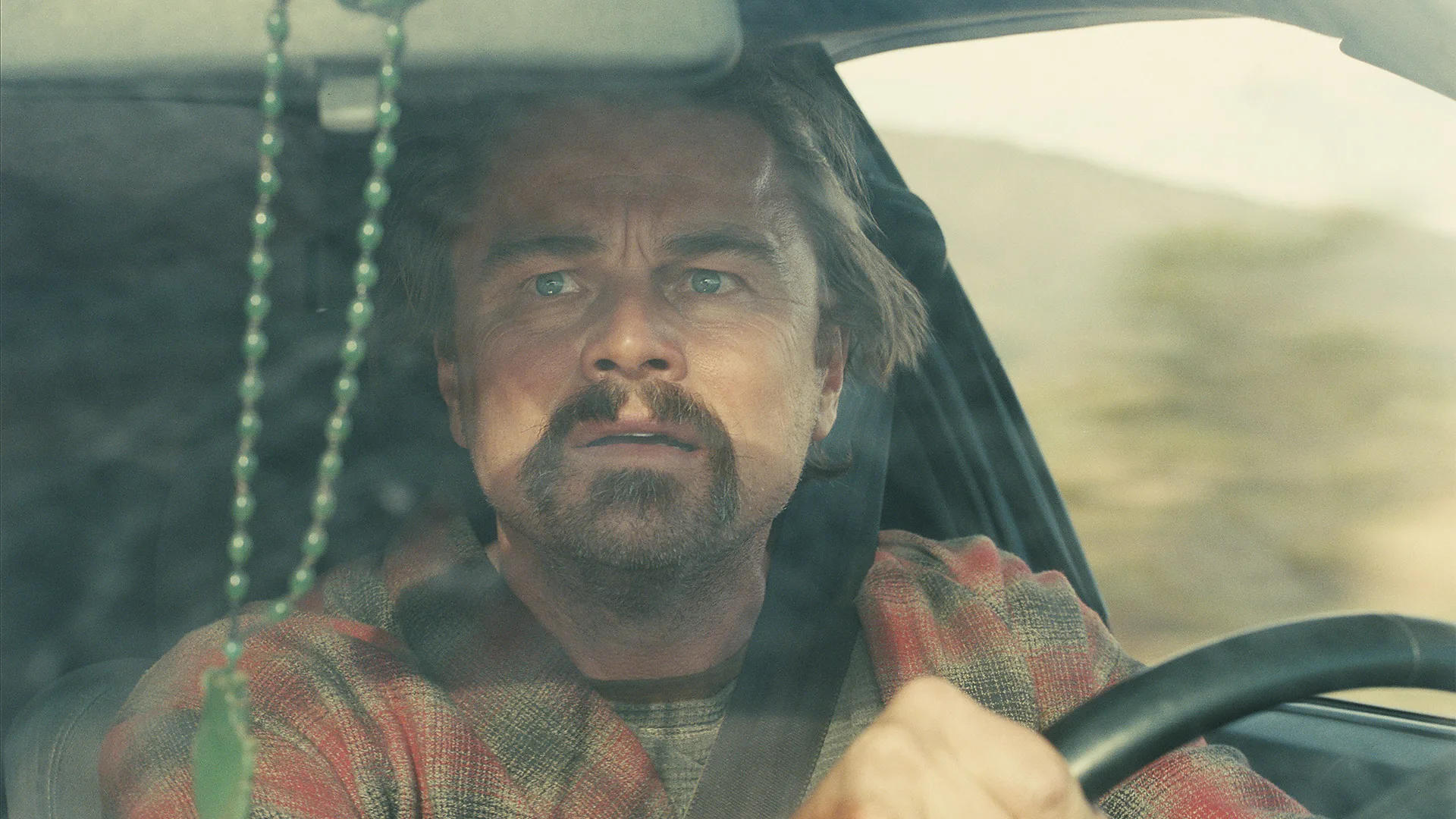
Boardroom’s Michelai Graham explores the political fire, emotional weight, and unexpected humor at the core of a genre-defying new film led by Leonardo DiCaprio.
Every now and then, a film comes along that feels like more than a movie.
It feels like a test of endurance, an emotional mirror, and a reflection of the times in which we live. One Battle After Another does all of that and more.
Clocking in at nearly three hours, this revolutionary epic could’ve easily overstayed its welcome. But instead, it pulled me in so deep that I didn’t notice time passing. I lived entire lives with these characters, and I didn’t want the story to end. It’s raw, it’s relentless, and it’s creatively unafraid to ask: What does revolution really look like in our modern age?
And even bigger: What does it cost?
Revolution as Storytelling
At its core, One Battle After Another is a story about a political activism group determined to force change by any means necessary. But what could’ve been a straightforward tale of rebellion unfolds instead as a layered meditation on love, identity, and survival in the middle of chaos.
The group at the center of it all, The French 75, isn’t fighting for glory; they’re fighting because they see no other way forward. While it’s not an official mantra in the film, the phrase “one battle after another” reflects the group’s philosophy and the cyclical nature of their struggle. It becomes both a rallying cry and a weary reminder of the personal toll that revolution demands.
What struck me most was how creative the storytelling is. This isn’t your typical political thriller. It blends sharp social commentary with moments of surreal humor, psychological tension, and generational drama. It’s a heavy film, but it never collapses under the weight of its themes. Instead, it pivots, bends, and stretches into something uniquely alive.
And in today’s world — where global politics feel like they’re teetering on the edge and conversations around resistance, power, and identity are constant — we need stories like this. Stories that take the heaviness we’re all feeling and present it from different angles, reminding us that revolution isn’t just an abstract idea. It’s deeply personal.
What makes this film resonate so powerfully is how it reframes the conversation and power struggles around politics. It isn’t about distant institutions or faceless ideologies. It’s about people; messy, complicated, deeply human people. The French 75 may stand for revolution, but the film asks: Who gets to decide what revolution means? Who pays the price? And is the pursuit of justice ever free from personal contradictions?
The narrative is peppered with questions that feel ripped from our own headlines. Immigration. Race. Purity politics. The role of violence. The seduction of extremist groups disguised as communities. Each theme pulses through the story without being heavy-handed, leaving you unsettled in the best way.
And while the film doesn’t hand out easy answers, in fact, it withholds them, that ambiguity feels intentional. Because in real life, there are no easy answers either.
Pacing and Tone
Let’s talk about that runtime: two hours and 50 minutes. On paper, that’s daunting. In practice, it felt seamless. The pacing is deliberate, yet it never feels slow. I was too immersed to check the clock.
Every chapter of the film builds on the last, shifting in tone without ever losing coherence. One moment, we’re inside a tense political standoff. Next, we’re laughing at Bob fumbling his way through a disguise. Then suddenly, we’re hit with a quiet emotional beat between father and daughter. That variety keeps the story alive and thriving. Instead of dragging, the length allows us to sit with these characters, to live alongside them, and to feel the stakes as they escalate. Visually, the film is just as layered. Sweeping action sequences give way to intimate character moments, each shot carefully constructed to balance the chaos of revolution with the intimacy of family life.
The assured pacing and tonal shifts speak volumes about Paul Thomas Anderson, a director whose career has been defined by sprawling narratives and characters caught in the tension between chaos and intimacy. From Boogie Nights to There Will Be Blood to Licorice Pizza, Anderson has always balanced scope with humanity, crafting stories that feel both epic and deeply personal. With One Battle After Another, he sharpens that balance once again, proving he can stretch a nearly three-hour runtime without losing momentum. Instead, he builds a rhythm that keeps the audience immersed; patient when it needs to simmer, and unrelenting when it needs to strike. It’s the kind of control and daring that reminds us why Anderson remains one of cinema’s most uncompromising storytellers.
Performance Check
The film’s power lies as much in its performances as it does in its politics, and the cast delivers across the board. Leonardo DiCaprio, as Bob Ferguson, surprised me most. I’ll admit I’ve never been a huge DiCaprio fan, but this performance won me over completely. Bob isn’t a polished revolutionary hero. He’s flawed, weary, and often hilariously out of his depth. That’s precisely what makes him feel so human. DiCaprio threads in just the right amount of comedic relief, and his timing gives the story a rhythm that prevents it from collapsing under its own darkness. In many ways, his humor felt like an echo of how we process political chaos in real life: through memes, dark jokes, and irreverent banter online. He makes us laugh in the middle of devastation, and that balance makes the film all the more relatable.
While DiCaprio anchors the narrative, the emotional core belongs to Willa. Watching her navigate her teenage years while stepping into her own power is as moving as it is heartbreaking. There’s something deeply resonant about a child who ends up parenting the parent, and her arc captures that bittersweet tension beautifully. The bond between father and daughter is layered with tenderness, frustration, and unspoken love — a reminder that revolutions don’t just happen on the streets; they also unfold within families.
Regina Hall, as Deandra, delivers a performance that both empowered me and broke my heart in the same breath. She brings nuance and gravitas to a role that could’ve easily been sidelined, instead shaping Deandra into one of the film’s most memorable presences. She’s a strategist, a nurturer, and a fighter, embodying the quiet resilience of women who hold movements together while carrying burdens of their own. Her moments with Willa especially linger, underscoring how women often bear the emotional and logistical weight of revolutionary work.
And then there’s Benicio del Toro as Sergio St. Carlos, also known as Sensei if you ask Bob. He plays the martial arts instructor who becomes an unlikely guide, and his performance is brilliantly understated. With a nonchalance that never undercuts his authority, del Toro exudes a kind of quiet power that makes every word and gesture land. He grounds the film whenever he’s on screen, embodying the kind of mentor who doesn’t need to announce his wisdom; it’s simply there, woven into his presence, actions, and calmness through the chaos.
Together, this ensemble elevates One Battle After Another beyond its ambitious scope. With DiCaprio’s surprising comedic touch, Willa’s poignant coming-of-age, Hall’s heart-wrenching resilience, and del Toro’s understated strength, the performances create a story that feels as epic as it does intimate. And that’s not to overlook the stacked supporting cast, who round out the world with grit and conviction, ensuring that every character feels essential to the film’s heartbeat.
Final Thoughts
In a weird way, I felt like the film offered multiple resolutions by the time it ended, but at the same time, so much was left unanswered or left up to interpretation. That balance is what makes One Battle After Another so compelling. It tells a well-rounded story that honors its characters, its themes, and its vision without sugarcoating the costs of revolution, the fractures within families, or the contradictions in human nature.
This is more than just a political thriller; it’s a meditation on resistance, family, and the absurdity of trying to survive in a broken world. It’s heavy, yes, but it’s also inventive, surprising, and oddly funny in all the right places. DiCaprio’s turn as Bob Ferguson gave me a new appreciation for him, while Willa’s arc left me more moved than I expected. Together, they anchor a story that’s equal parts political commentary and human drama, and they make it worth every minute on screen.
One Battle After Another doesn’t hand you comfort.
But it does something better. It challenges you, lingers with you, and dares you to keep fighting, one battle after another.
Read More:
Tyrese Haliburton Gets Real About the Olympics, NBA Finals, His Achilles, & Proving People Wrong

Laremy Tunsil on Jayden Daniels, Myles Garrett, & Building Beyond Football

Destinations Known: The Most Memorable Hotels to Stay In This Fall

Kyle Cooke on Saving Loverboy, Building Wealth, & Finding Financial Freedom

The Gold Standard: Jay-Z, LeBron James, Teyana Taylor, Spike Lee, Megan Thee Stallion, & More